Journalism of Courage



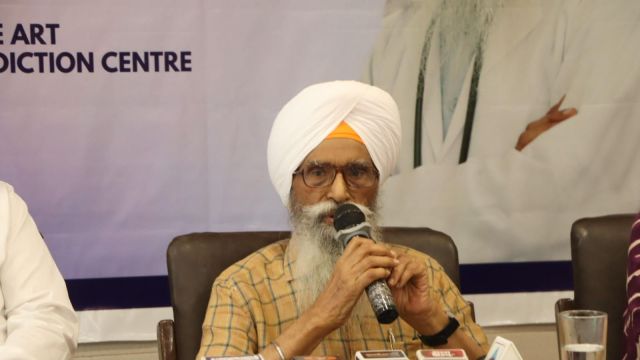 Colonel (Dr) Rajinder Singh says number of intravenous ‘chitta’ users in Punjab has soared (Express Photo)
As Punjab stares at the issue of drug abuse, particularly among its youngsters, Colonel (Dr) Rajinder Singh, 90-year-old crusader against the menace, says the number of intravenous ‘chitta’ users in Punjab has soared, largely due to the easy availability of drugs wherein you can just pick the phone and order home delivery.
On the occasion of ‘International Day Against Drug Abuse’, Col Rajinder Singh told The Indian Express that the intravenous use of ‘chitta’, an adulterated form of heroin, has picked up pace in Punjab over the past five to six years.
The former Army doctor, who retired as Senior Advisor of Psychiatry from Army Hospital, Delhi, in 1991, has been at the forefront of the fight against drugs in Punjab for the past 30 years.
Colonel Rajinder is associated with Akal Drug De-Addiction and Rehabilitation Centres which are being run under the aegis of The Kalgidhar Trust, a non-profit charitable trust. The trust has contributed 2.5 acres of land for a new centre at Chunni Kalan, in Fatehgarh Sahib district in Punjab. The 50-bed new centre will also house a research centre on the premises.
Currently, Akal Drug De-Addiction Centre is operating two centres – one in Baru Sahib, Himachal Pradesh, and another Cheema Sahib, Punjab.
“Opium, poppy husk, tramadol and chitta are the most common addictions in Punjab apart from alcohol. The young generation takes chitta. Earlier, until five years ago, they used foil paper and inhaled the fumes. Now intravenous (IV) chitta is a major issue as it gives instantaneous gratification. Most young people take IV drugs. In our hospitals also 50 per cent patients take IV chitta,” the Colonel says.
The doctor further adds that chitta is not pure heroin. He says it is adulterated with other drugs. “When we test it we find materials which are foreign. Some have not even been identified,” he says.
According to Col Rajinder, these drugs are freely available across the state in towns and villages. “Home delivery of drugs is available. You just call and it arrives. It is available in almost every village. The police are also hand in glove as are politicians,” he says.
The doctor says that not much effect is seen on the grounds of the various anti-drugs drives run by the state government. “The major issue is that where such big money is involved then it is difficult to nab the big fish,” he says.
He says there are 35-36 government-run de-addiction centres in the state, along with 170 private centres.
“Most private de-addiction centres are not functioning properly. These are in name only. These centres just hand over opioid pills as substitutes to drugs. They are just functioning as pills dispensing centres,” he says, mentioning that many politicians are running multiple de-addiction centres.
Stating that there is a severe shortage of psychiatrists in Punjab, Col Rajinder says there are just 0.75 psychiatrists for one lakh population in the state while there should be a minimum of 3 psychiatrists per lakh.
Colonel Rajinder did his MBBS from Government Medical College in Amritsar in 1956 and joined the Army in 1962. He did his MD in Psychiatry from PGIMER Chandigarh.
“Punjab has been grappling with a severe drug addiction crisis, affecting thousands of families and leading to a breakdown in societal structures. When we talk about curing addiction rather than just admonishing addicts, we are focusing on a more holistic and compassionate approach to addressing substance abuse issues. This approach involves understanding addiction as a complex medical condition that requires comprehensive treatment and support,” he says.
Col Rajinder adds that the ethos of the Akal de-addiction centres is centered on spiritual alignment to help recast the decline caused by drug addiction.
“While our treatment methods are scientific, clinical, and evidence-based, we emphasise on awakening the patient’s willpower, nurtured in the Punjabi ethos of Chardikala (ever-rising spirits). We believe in changing the world view of addiction, mental health, and treatment by insisting that divine grade and faith are the ultimate healers,” he remarks.

 4 min read