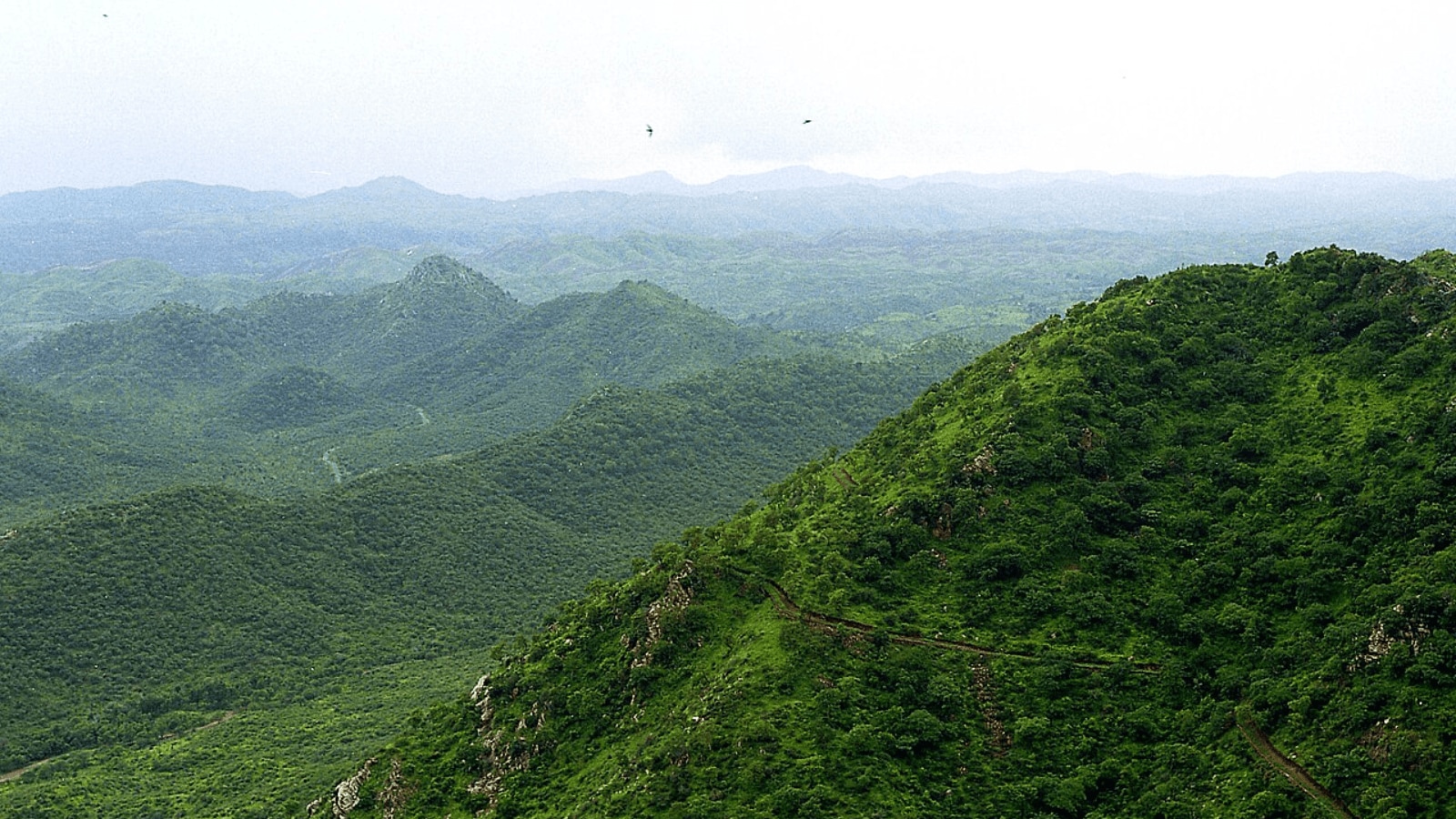
The lifting of protection for vast swathes of the Aravallis could favour real estate and mining interests, according to conservationists fighting to save one of the world’s oldest mountain ranges.
The Haryana government has proposed a new definition for the Aravalli hills using criteria of geological age and height of the feature, which, once notified, could significantly narrow the landscapes that qualify for legal conservation.

The lifting of protection for vast swathes of the Aravallis could favour real estate and mining interests, and have dangerous consequences for the region’s ecology, according to conservationists fighting to save one of the world’s oldest mountain ranges.
What is the new definition of the ‘Aravalli Hills and Ranges’ proposed by Haryana?
As per an October 4 letter from the Haryana Mines and Geology Department to the state Environment and Forests Department, only hills and ranges of the Aravalli Supergroup and Delhi Supergroup, which originated during the Palaeoproterozoic to Mesoproterozoic, and which rise higher than 100 metres (+5 metres) above the surrounding terrain, may be defined as ‘Aravalli Hills and Ranges’.
The Palaeoproterozoic Era spans from 2.5 to 1.6 billion years ago (gigaannum or Ga) and the Mesoproterozoic from 1.7-1 Ga. The proposed definition excludes all rocks and hills of the more recent Neoproterozoic Era (about 1 billion to 540 million years ago), and isolated landforms that are less than 100 metres tall, regardless of their environmental importance.
How much of the Aravallis will be excluded by the new definition?
According to M D Sinha, a former Conservator of Forests (South Haryana), the 100-metre relief criterion will potentially erase most of the Gurgaon and Faridabad Aravallis from official maps, and deny these areas protections mandated by the Supreme Court.
Since these areas mostly feature scrub hills and grasslands with only small patches of dense forest, almost all of the current ‘Aravalli hills’ outside of notified forest law zones could in effect be opened up for commercial real estate and mining, Sinha said.
Story continues below this ad
What is the Mines and Geology Department’s justification for the change in definition?
According to the letter, the definition conforms to the Geological Survey of India’s (GSI’s) classification of the Aravalli Hills and Ranges, which includes only ancient, linear, continuous ranges composed of Aravalli Supergroup (Palaeoproterozoic) or Delhi Supergroup (Mesoproterozoic) rocks.
The inclusion of rocks from other eras would dilute the geological identity of the Aravalli-Delhi fold belt, the letter states. The 100-metre height criterion has been taken from Rajasthan’s existing policy, it says.
Sinha, however, argued that this rationale is flawed, since the age and height of hills have no bearing on their ecological function – and many of India’s oldest mountain systems, including large portions of the Eastern Ghats, would fail the test of being continuous as they are ravaged by weather over time.
He added that restricting protections to only these select patches could reduce Haryana’s natural forest cover to the lowest in the country.
Story continues below this ad
Rajasthan’s policy aims are different, Sinha said – it seeks to demarcate mining areas, rather than to preserve forests.
What problems could the lifting to protections bring?
The Aravalli hills, even though they are scrubby and low, help conserve biodiversity, retain water, trap heat, and regulate climate for the wider Delhi-NCR area, Sinha said.
Losing them will worsen dust pollution, water scarcity, and extreme weather, and impact millions of people in Delhi and adjoining regions, he said. “Only a handful of powerful landowners and companies would benefit from unlocking real estate value on unprotected hills.” Sinha said.
He also said that the new definition, if accepted, could set a precedent for other states and even Delhi, where nearly all existing ridge (forest) lands would vanish from conservation maps. According to Sinha, the “jargonistic sophistry” of the new definition will accelerate ecological damage in NCR and much of Haryana.
Story continues below this ad
Earlier on August 18, the Haryana government had officially defined the “dictionary meaning of forest” for purposes of their conservation and protection in the state.
The state’s Environment, Forest and Wildlife Department stated in a notification that “A patch of land shall be deemed to be ‘forest as per dictionary meaning’ if it…has a minimum area of five hectares, if it is in isolation, and a minimum area of two hectares, if it is in contiguity with the government notified forests, and [if] it has a canopy density of 0.4 (40%) or more”.
The notification said that “all linear/ compact/ agro-forestry plantations and orchards situated outside the government notified forests shall not be treated as forests under [this] definition”. Such linear plantations are frequently found along roads, canals and railway tracks, where they can serve multiple purposes.
The new definition of forests, along with the proposed new definition of the Aravalli hills, can have very significant ecological implications, experts like Sinha believe.
Story continues below this ad
“This will worsen the NCR’s pollution problems considerably. One of the major issues in the NCR region has been because of the dryness of the area, the ambient dust load in the atmosphere is high. And if you increase it even higher, it will only lead to worse pollution. The morphological Aravalli has a very important role in overall climate mitigation in the entire NCR,” Sinha said.


 5 min read