Journalism of Courage



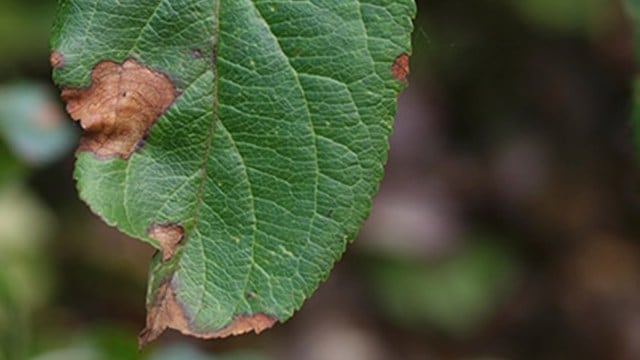 Alternaria leaf spot (Crop Science Australia)
The alternaria leaf spot, a fungus that damages leaves of apple plants resulting in premature defoliation and damage to fruit, has been spreading like wildfire in apple orchards across Himachal Pradesh, officials and experts have said.
Dr YS Parmar University of Horticulture and Forestry at Nauni in Solan district has issued an alert about the leaf spot, also known as blight.
“Areas where the maximum temperature was 25 degrees Celsius or more and received less rain are the worst affected. Moisture and humidity provide congenial atmosphere for the growth of alternaria. Indeed, this time it is on an alarming level. The worst-affected areas are Jubbal, Chaupal, Kotkhai, Ratnari, Baghi etc,” Dr Usha Sharma from the university’s pathology department told The Indian Express from Baghi, where she was on a field visit on Wednesday.
“Our university has already issued an alert. Teams have been visiting the areas. Current weather conditions are favourable for the alternaria leaf spot. The condition can deteriorate if the affected areas don’t receive adequate rain, which will bring the temperature further down,” she added.
At least eight teams of scientists from the university’s pathology and anatomy departments were constituted and they have already visited affected areas in Kotkhai, Chaupal, Jubbal and Shimla.
Sources in the state department of horticulture said they had received information about the problem along with pictures of leaves infected with the alternaria spot. “Most of the apple-belt areas, especially in Shimla, which produce more than 60 per cent of the crop in the state are affected with the alternaria leaf spot,” a source said, adding that the available infrastructure was inadequate to tackle the disease on a large level.
An officer with the state horticulture department said, “We have received hundreds of phone calls, messages and pictures showing alternaria spot-affected leaves of apple plants in the last four-five days. This fungus spreads like wildfire. The vulnerability is so high that we are receiving pictures of affected apple crops even from areas situated above the elevation between 5,500 m and 6,000m. Alternaria comes every year but not to this extent. We have been advising people about the sprays that can cure the fungus. But if the affected areas don’t receive adequate rainfall, it will be difficult to control this blight.”
Vinay Singh, Director, Department of Horticulture, said, “We along with the scientists concerned are on the job to prevent the spread of the alternaria leaf spot.”
As per the weather department, the state received 54 per cent less rain in June. This time average monsoon rain is expected. Isolated places are expected to receive rain on Wednesday but intensive rainfall has not been predicted.
An advisory issued by the university on Tuesday said, “For the management of alternate leaf spot/blight, the farmers are advised to spray, if the need be, of mancozeb (600gm/200L water), as the protectant. But where these spots/blights are severe, the farmers are advised to spray alternatively the formulations consisting of, hexaconazole 4% + zineb 68% WP (500gm/200L water) or carbendazim 25%+ flusilazole 12.5% SC (160ml/200L water) at 10-12 days interval in the infected orchards.”
Farmers are advised to address their queries to hodmpp2014@gmail.com and use the email ID to report symptoms of the diseases with photographs.
Apples are harvested from July to the first week of November, depending on the variety and the elevation of the area. The crop constitutes almost 49 per cent of the area under fruit cultivation and 85 per cent of Himachal Pradesh’s fruit economy, which amounts to Rs 4,000 crore.
Approximately 90 per cent of the apple produce in the state goes to the nationwide domestic market. In 2024, the horticulture department set a target of 5.82 lakh metric tonne apple production. The target last year was 5.30 lakh metric tonne but production was 4.84 lakh metric tonne. This was almost 28 per cent less than 6.72 lakh metric tonnes produced in 2022.

 4 min read