


Stay updated with the latest - Click here to follow us on Instagram
Tags:


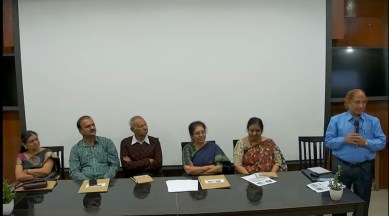
Dr T V Ramachandra, faculty at the Centre for Ecological Sciences, Indian Institute of Science (IISc), Wednesday said that the total wetland area in Karnataka stands at 2,81,299.5 hectare and the benefits which it provides to the people has an economic value of Rs 284.52 billion.
Speaking at the 13th International Biennial Lake Symposium organised by Energy and Wetlands Group, IISc, he explained, “The services of wetlands can be divided into three categories. First — provisioning services which include fishing, fodder etc which sustains the local livelihood. Second — regulating services in which groundwater recharge and bioremediation takes place and third — cultural services which include recreation.”


He said that if a lake has to be protected, its catchment area should be in a good shape. Catchment of a lake is a region which drains the water towards the lake.
Ramachandra further said, “Before the construction of the Linganamakki dam in 1965 on the Sharavathi river, the region used to receive 3,000 mm to 4,500 mm of rainfall per year and after the construction of the dam, the region received 700 mm to 1,900 mm of rainfall. We need to urge the government to protect the integrity of the catchment area.”
He added, “The catchment should have vegetation so that it sustains the water for the livelihood of the people. When we studied this region, we did a mapping of the animals as well. We found that scarcity of water also impacts the availability of animals. We also found that wherever there is scarcity of water, only two-legged species of animals are found and where water is abundantly available, sloth bears and tigers were also found.”
Ramachandra also said that the recurring issue of floods in Bengaluru is due to the loss of interconnectivity between the lakes. He said, “The government talks about the interconnectivity of rivers. How could they maintain the interconnectivity of rivers when they could not maintain the interconnectivity of the lakes. The buffer zones of the lakes have been encroached. We have lost 75 per cent of the lakes in the last few decades.”
He added, “If a lake gets polluted, then the livelihoods of those who are dependent on it, such as the fishermen, get affected. Lakes play an important role in groundwater recharge. In the Nagashettyhalli area, when the lake, Nagashettyhalli kere, existed, the groundwater was available at 60-100 feet and today the groundwater has gone down to 1,900 feet because the lake disappeared a few years ago. In the name of remodelling the drains, they are being narrowed and concretised which also results in flooding and reduces groundwater recharge,” he said.


Stay updated with the latest - Click here to follow us on Instagram


