4 min read
Stay updated with the latest - Click here to follow us on Instagram

Journalism of Courage



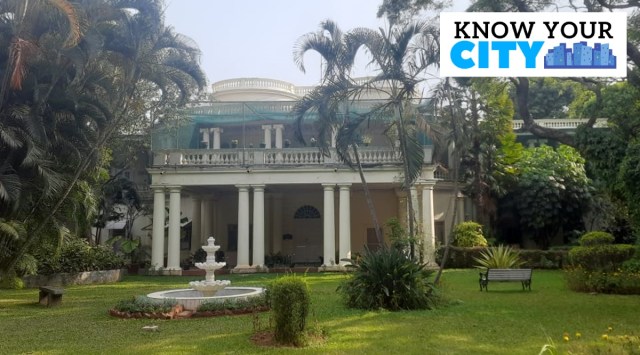 "Hopeville" or Bank House in Bengaluru (Express Photo)
Over the years, rulers of Karnataka have left their marks on Bengaluru. Kempe Gowda and Tipu Sultan both made their marks with fortifications. The Gandaberunda sigil of the Wodeyars is still seen in many places similarly and the British Residents also left their marks. The most famous remnant of the Residency is the Raj Bhavan, but lesser-known parts of the city too bear this legacy.
The Residency itself in most parts of the country was a product of the Subsidiary Alliance, a treaty that curtailed the autonomy of a princely state in exchange for the military protection of the British. The Resident was the representative of the British and, depending on the era he was in, might be more of a diplomat or an administrator. Some Residents got sucked into the political intrigues of the time — James Kirkpatrick, Resident to the Nizam in the early 1800s, very nearly lost his job after his marriage to a local noblewoman—while Sir Mark Cubbon tended to define the administration of Mysore with his legacy visible all over the centre of the city today.
While the Raj Bhavan is not accessible to the public today, it was Cubbon’s private residence for a time after he built it some time around 1840. After the British Resident’s office was abolished in 1843 and combined with that of the commissioner of Mysore, a post with expanded powers, Cubbon took it up. His successor, Lewin Bowring, purchased the building in 1862. The office of the Resident was reinstated in 1881. The building was thereafter known as the Residency until independence, and also gave its name to Residency Road.
The two-floor building is today an imposing edifice in the neoclassical Greek style, but when Cubbon originally built it, it was a single-floor building, with the second floor being added in 1967. Its occupants over the years have made many additions—from a ballroom to honour the visit of the Prince of Wales (later King Edward VII), to the electrification of the building in 1906. Not far away, the original General Post Office was also part of the buildings that came under the Residency. It has since been torn down to accommodate the current GPO.
Records seem to show the ways in which the Residency intertwined itself with the administration of Mysore over the years. For instance, arrangements for Prince Chamarajendra Wodeyar to travel to Japan were routed through the Residency. There are hints of inequality here, though, as the Residency declined to address him as “Prince” on travel documents, referring to it as a “courtesy title”. The Residents and their entourage, for their part, seem to have wished for the comforts of England to be brought to Bangalore, but did not get all of them. A request for the princely sum of Rs 3,200 in 1933 for laying out water closets and a garden in 1933 was rejected by the Raj on grounds of the expense involved.
Another legacy of the Residency remains within the property of State Bank of India on St Marks Road. Also built in a similar style to the Raj Bhavan, if on a far smaller scale, was Hopeville — or the Bank House, as it is also known. It serves as the residence of SBI’s chief general manager in charge of Karnataka. Like the Raj Bhavan, it is not open to the public.
Former chief general manager Arundhati Bhattacharya writes in her book, Indomitable, that Cubbon himself may have lived here for a time, while the title deed mentioned CB Saunders, who later became the Resident of Hyderabad. At that time, the house had been damaged by seepage, particularly at the top of the Greek-style pillars and near balustrades open to the elements. The Indian National Trust for Art and Cultural Heritage was engaged to restore the building with traditional methods involving “mud, lime, jaggery, burnt coconut and burnt brick”.
Stay updated with the latest - Click here to follow us on Instagram