Journalism of Courage



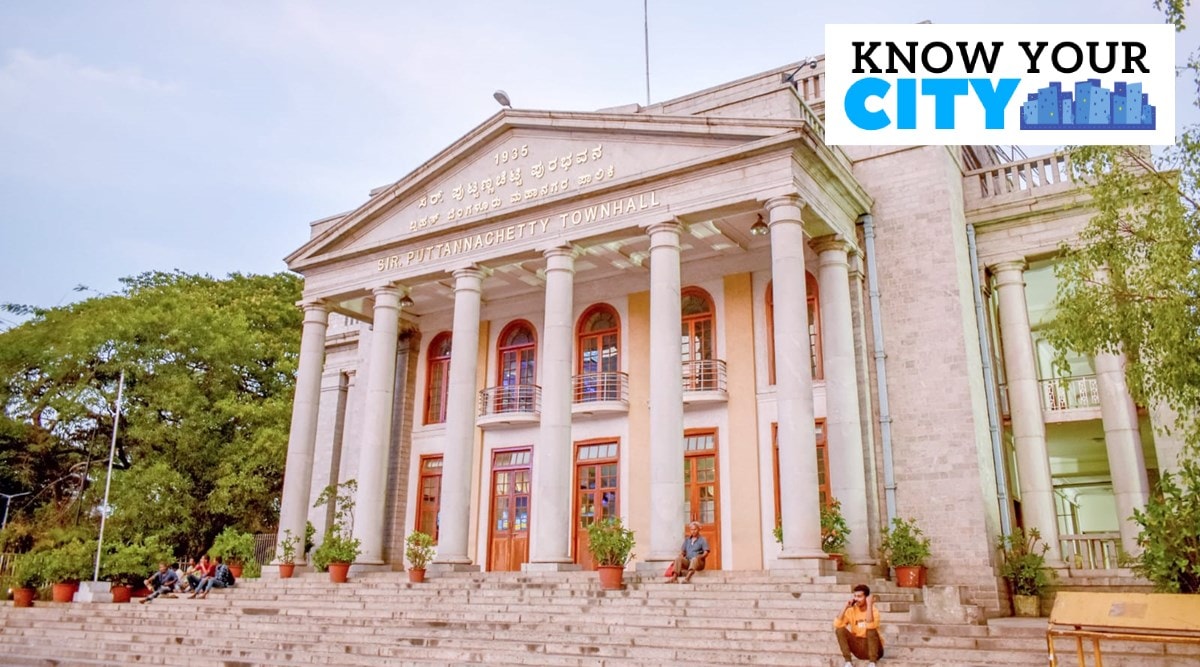 By 1933, the Town Hall project was taken up anew, with construction starting just off Jayachamarajendra Road. It was completed in 1935, being inaugurated by no less a figure than the crown prince of the Mysore state, Kanteerava Narasimharaja Wodeyar. (Express Photo by Jithendra M)
 At first glance, the Town Hall looks like a piece of Athens given form in the heart of modern Bengaluru. Embodying the neoclassical style beloved by the colonial British (notably with the huge Tuscan columns at the front of the building and pedimented roof), this iconic building is perhaps more interesting given the figures that were behind its construction.
To begin with, Bengaluru was one of the later cities to obtain a dedicated town hall of its own. While some other cities had town halls built decades earlier, Bengaluru, on the other hand, was for a long time no match as a city for British strongholds such as Kolkata and Delhi. Towards the end of World War I, architect EW Fritchley was brought on board to build the long overdue town hall. If Fritchley’s plans had gone through, the site would have been slightly closer to the old “pete” sections of Bengaluru. But it was not to be –by the turn of the decade, the plans had been shelved. The financial crunch in the inter-war period is likely to have played a role.
By 1933, the Town Hall project was taken up anew, with construction starting just off Jayachamarajendra Road. It was completed in 1935, being inaugurated by no less a figure than the crown prince of the Mysore state, Kanteerava Narasimharaja Wodeyar. The Town Hall bears the official name of Sir K P Puttanna Chetty Town Hall, after one of the prime movers in modern Bengaluru. Chetty had himself contributed a princely sum of Rs 75,000 towards the construction of the building. Notably, Chetty had served in the civil service of Mysore state since 1875 and had risen to membership in the Dewan’s council in 1906. From 1913 to 1920, he served as the president of the Bangalore Municipal Council, under the proviso that he would avoid red tape by answering directly to the dewan.
Another prominent figure in the history of the Town Hall is Sir Mirza Ismail, who served as the civil engineer for the project. He is unique for having served as the dewan for three different princely states –from 1926 to 1941 for Mysore, from 1942 to 1946 under Man Singh II at Jaipur, and finally at Hyderabad for around a year in 1946-47. An avowed nationalist, he left the final post as the negotiations between Hyderabad and the Union government regarding integration broke down.
The Town Hall itself has had its ups and downs over the years, with renovations reducing seating capacity by about 200 from 1,038. It has twice undergone major renovations, once in 1990 after the same was ordered by Devaraja Urs in 1976, and more recently in 2014. A short-lived plan to pledge the building as collateral by the BBMP also sparked controversy in 2014 before it fizzled out. But today, the Town Hall remains a symbol of what Bengaluru was and is – and a memorial to those who laid the foundations of a modern city.

 3 min read