4 min read
Stay updated with the latest - Click here to follow us on Instagram

Journalism of Courage



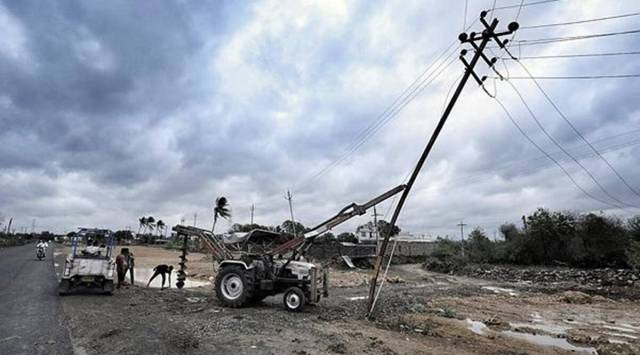 The findings of the work have been recently published in the International Journal of Disaster Risk Reduction by Elsevier.
A team of researchers at the Indian Institute of Technology Gandhinagar (IITGN) has developed a comprehensive framework to reduce post cyclonic damages to power transmission systems in coastal areas.
The team, comprising MTech student Surender V Raj, Prof Udit Bhatia and Prof Manish Kumar, studied Odisha’s power transmission network damaged during Cyclone Fani in 2019 with a focus on the vulnerability of individual towers to strong winds generated during cyclones. They assessed the functionality of the network and the influence of strategic interventions on them.
The framework developed by the team helps in prioritising the towers that should be strengthened to minimise the overall losses in functionality in a cost-effective manner. They use damage-cum-wind speed data to develop a fragility model for towers, which helps assess the functionality of the network and the influence of strategic interventions on the same.
Explaining the significance of this framework further, Prof Manish Kumar, Associate Professor of Civil Engineering at IITGN, said, “The framework can be useful for cost-effective strengthening of the transmission tower networks of other coastal states of India as well, such as West Bengal, Andhra Pradesh, Tamil Nadu, Gujarat and Maharashtra. The towers can be prioritised differently if a different performance metric is selected. ”
The findings of the work have been recently published in the International Journal of Disaster Risk Reduction by Elsevier.
Based on the data collected from the Odisha Power Transmission Corporation Limited (OPTCL) about damaged transmission towers due to Cyclone Fani and the estimated maximum cyclonic wind speeds at the locations of these towers using a radial wind profile model, the team assessed the damage probabilities for more than 41, 000 power transmission towers.
Subsequently, a series of simulated realistic cyclone scenarios were generated to study the functionality of the transmission system and estimate the population that can get affected due to a range of cyclone scenarios.
The research team observed that the loss in functionality of transmission towers depends considerably on the location of the landfall of the cyclone. The damage was greater if the landfall was close to a region with many substations in the vicinity.
A simulated cyclone trajectory indicated that it could damage towers even up to 300 km apart from each other, which further underscores the need to perform such studies on a holistic scale. The observation emphasises the need to consider the orientation of the network with respect to the coastline and the realistic properties of the cyclones.
The damage to power transmission lines at a larger scale leads to a significant and sudden loss of connectivity, consequently increasing the magnitude and duration of disruption in the aftermath of the cyclone, which can, sometimes, hinder the rescue operations as well.
The team found that the most efficient strategy could be to pick a fraction of towers from the highest wind speed zones (according to the Indian standards) that are associated with substations serving a large population. On the other hand, strengthening towers nearest to the coast may somewhat help reduce the number of towers damaged during a cyclone, but its resultant impact on the affected population may not be as significant.
The study results revealed that a greater number of reinforced towers or a greater level of strengthening in them based on the tailor-made and efficient reinforcement prioritisation strategies in a particular region leads to better functionality of power transmission systems.
“The changing climate scenarios and upward trend in frequency and magnitudes of cyclones as a consequence of increasing sea surface temperature put our coastal infrastructure at a greater risk. We showed that strategic interventions could result in 2.3 times faster restoration of services in the networked systems, helping businesses and lives come back to normalcy in a swift manner. Our framework brings us one step closer to possible solutions that stakeholders and infrastructure managers can invest in,” said Prof Udit Bhatia, Assistant Professor of Civil Engineering at IITGN.
Stay updated with the latest - Click here to follow us on Instagram


The Supreme Court stated that there should be a regulatory body for content that’s available online for streaming. That brought back the murmurs that started during the Tandav-Prime Video India controversy back in 2021 that the OTT platforms would soon be censored/certified by the Central Board of Film Certification. Now, the government has clarified that it won’t be the case.