4 min read

Journalism of Courage



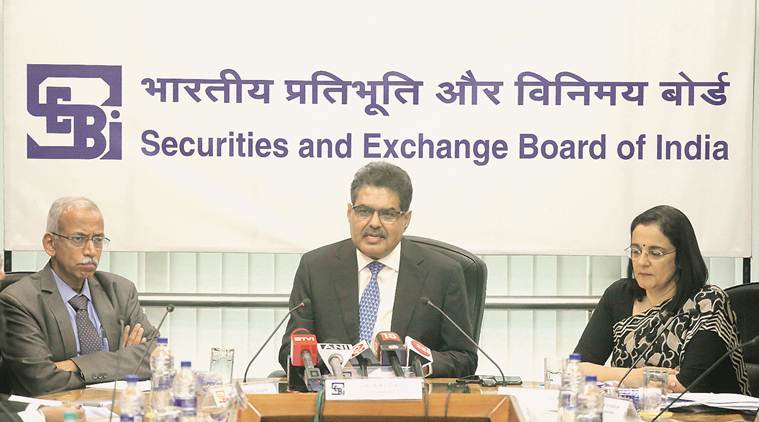 Sebi Chairman Ajay Tyagi (centre) during a press conference at Sebi Bhavan, Mumbai on Thursday. (Exprress photo by Nirmal Harindran)
The Securities and Exchange Board of India (SEBI) on Thursday tightened the norms for disclosing the details of pledged shares by promoters, amid concerns about exposure of some mutual fund houses to loan against share schemes. Under this scheme, debt mutual funds invest in papers of little-known/lower-rated companies backed by promoter shares.
According to the new Sebi rules, any direct, indirect lien on shares will now qualify as encumbered shares. “The promoters will have to furnish reasons if combined encumbrance crosses 20 per cent of the company’s equity capital,” said Sebi.
It said if amount of pledged shares of a company is over 20 per cent, then the company will have to keep its audit panels informed of any undisclosed encumbrance. The regulator also announced risk management framework of liquid funds and norms governing investments in debt and money market instruments.
Sebi said that valuation of debt and money market instruments shall be based on mark to market. It also said that liquid schemes should hold at least 20 per cent in liquid assets and reduced the cap on sectoral limit of 25 per cent be reduced to 20 per cent.
Sebi’s decision to reduce sectoral cap for debt oriented mutual funds and reduce additional exposure to HFCs from 15 per cent to 10 per cent will go on to reduce investors risk on account of MF exposure to NBFCs and HFCs that are currently under pressure. It will however, also reduce the fund availability for NBFCs and HFCs from mutual funds. The regulators decision on disclosure norms for pledged shares will improve transparency and lower risk.
From now, liquid and overnight schemes will not be permitted to invest in short term deposits, debt and money market instruments having structured obligations or credit enhancements. While graded exit load will be levied on investors of liquid schemes who exit the scheme up to a period of seven days, senior officials in Sebi said grading of exit loads will be decided by the regulators and mutual fund industry soon. “Mutual funds have been a very good story in the last three-four years, with their assets under management (AUM) almost doubling in four five years. To restore the confidence, especially in debt schemes these measures have been taken. They are timely and hopefully confidence of investors’ including the retail investors will continue or be reviving in the mutual funds,” said Ajay Tyagi, chairman of Sebi.
The regulator also came down heavily on the so called standstill agreements that mutual funds have entered with certain corporates. “So we don’t recognise any such standstill agreement, MFs are not banks and there is nothing called standstill and they are investing rather than lending. This is in consultation with the industry to bring in more discipline and to be careful in investing money of the investors by the mutual funds. If further cases come we will take action,” said Tyagi.
Sebi on Thursday also approved a new framework for issuance of differential voting right (DVR) shares from July 1, 2019.
He said the regulator has taken a cautious approach with differential voting rights in shares. This is the first time this is being tried in India, he said. Apart from this, Sebi has put a cap of 5 per cent of net sales on royalty paid by companies to their parents or promoters and mandated companies to get shareholder approval for royalty payments above the cap.
“Payments made to related parties towards brand usage/ royalty may be considered material if transaction exceeds 5 per cent of annual consolidated turnover of listed entity,” said Sebi. Tyagi said Sebi has started the adjudication process against a few credit rating agencies. He also said the regulator has completed its probe into the Whatsapp leaks and the report will be put in the public domain shortly.