3 min read





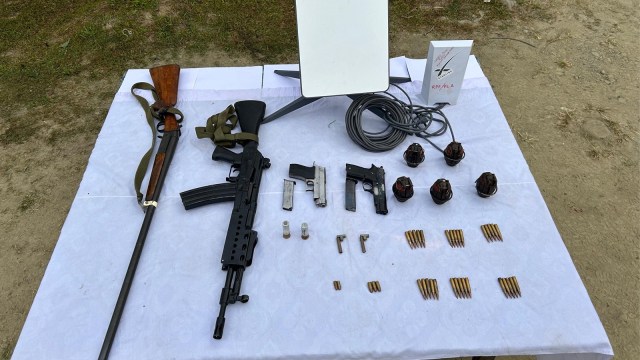 The Spear Corps of the Indian Army had shared photos of the items seized on X, and social media users were quick to note that one of the devices had a "Starlink logo" on it. (Photo: X/@Spearcorps)
SpaceX’s billionaire founder Elon Musk has rejected claims that his satellite communication service Starlink was being used by rebels in violence-hit Manipur, after pictures shared by a unit of Indian security forces showed they had seized a device that contained Starlink’s logo.
Starlink’s services are yet to be greenlit in India, and the company cannot legally allow communications in the country via its platform.
On December 16, the Spear Corps of the Indian Army said it had carried out joint operations in the hill and valley regions in the districts of Churachandpur, Chandel, Imphal East and Kagpokpi along with the state’s police. During the operations “29 weapons comprising of snipers, automatic weapons, rifles, pistols, country made mortars, single barrel rifles, grenades, ammunition and war like stores” were recovered. The unit also shared a picture of a white device with Starlink’s label on it as one of the recovered items.
After people raised concerns that rebels in the violence-hit state were using Starlink to bypass internet restrictions in the state, Musk said, “This is false. Starlink satellite beams are turned off over India”.
This is false. Starlink satellite beams are turned off over India.
— Elon Musk (@elonmusk) December 17, 2024
India has not yet cleared an application by Starlink to offer satellite-based communication services in the country. It is understood that its application is pending security approvals from the Ministry of Home Affairs.
Last month, Telecom Ministry Jyotiraditya Scindia had said that any decision on the launch of SpaceX’s satellite internet service Starlink was contingent on recommendations from the Telecom Regulatory Authority of India (TRAI), which is holding a consultation process.
Therefore, the company cannot legally offer its services in India as of now.
An availability map on Starlink’s website, which shows the regions in which the service is available, says that Starlink is “pending regulatory approval” in India. It shows a similar message for Pakistan, and says that the service is “starting in 2025” in Bangladesh and Bhutan. Starlink is not available yet in Nepal and Myanmar.
With India snubbing Reliance Jio’s proposal to auction airwaves for satellite communication and favouring administrative allocation instead, the move is being seen as a big win for some of the company’s biggest rivals, particularly billionaire Elon Musk’s Starlink.
The Telecommunications Act, 2023, has added spectrum for satellite communication in the list of administrative allocation. The Department of Telecommunication (DoT) had later asked the Telecom Regulatory Authority of India (TRAI) to come up with a methodology to assign the spectrum.
With TRAI exploring pricing models for the service, Jio wrote to the regulator making a case for auction of satellite spectrum. Their essential argument is that administrative allocation may not be able to bring about a level playing field between satellite and terrestrial services. Musk, however, responded to the submissions, saying: ““That would be unprecedented, as this spectrum was long designated by the ITU as a shared spectrum for satellites”.