6 min read


© The Indian Express Pvt Ltd



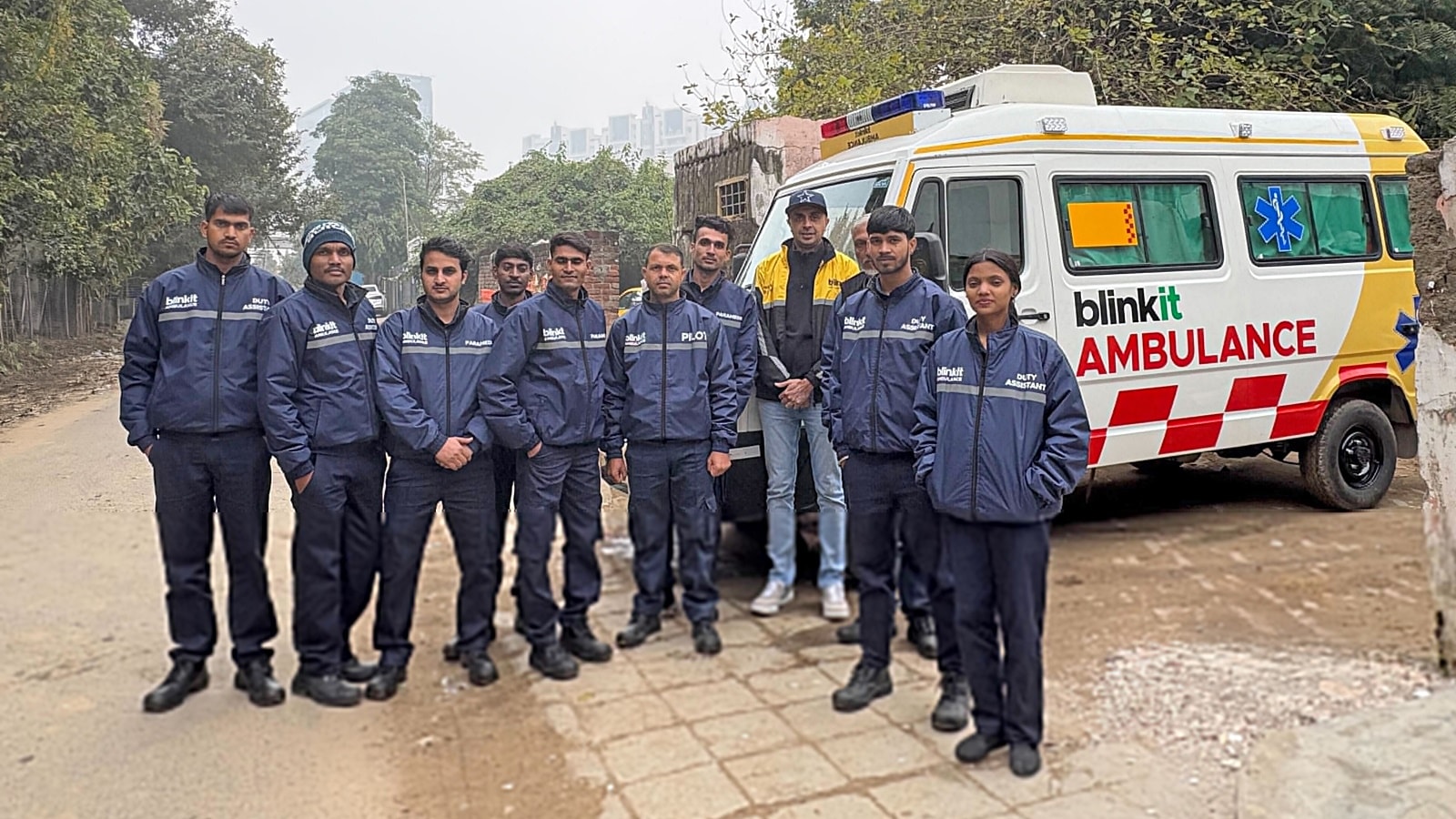 The Blinkit ambulance service will begin with five ambulances in Gurugram. (Photo: X)
A day after Zomato-owned quick commerce platform Blinkit said it was launching a 10-minute ambulance service, Union Commerce Minister Piyush Goyal sounded caution that the firm would have to adhere to India’s “legal requirements” while offering the service.
“As regards Blinkit with ambulance service or medicines being delivered, my only submission would be that they have to make sure that they meet the law of the land, and whatever other legal requirements should be properly taken care of. No laws of the land should be broken,” Goyal told reporters Friday.
Experts said that Blinkit’s legal responsibilities include ensuring that its ambulance is designed and constructed as per norms laid out by the Ministry of Road Transport and Highways under the Central Motor Vehicle Rules and the Automotive Industry Standard (AIS) 125, which define the dimensions and structural integrity of the vehicles, among other things. For ambulances supported by the National Health Mission, the obligations of an ambulance operator depend on the memorandum of understanding between the operator and the state governments.
The move of a major private firm introducing ambulance services raises concerns around the state’s accountability for offering basic healthcare services, even if it allows Blinkit to improve its public perception. Experts pointed out that there are regulatory gaps in enforcing current guidelines, apart from the problem of ambulance shortage in the country, which the government’s own data shows.
It is unclear what Blinkit’s terms and conditions for its ambulance service are if there are certain legal immunity-related clauses it has baked into the terms of service, as the feature on the app currently shows a ‘coming soon’ message at the time of publication. A query sent to Blinkit remained unanswered until publication.
 As per a picture Dhindsa shared along with his post on X, Blinkit’s ambulance service would carry a flat Rs 2,000 fee.
Blinkit CEO Albinder Dhindsa said the service will begin with five ambulances in Gurugram. “As we expand the service to more areas, you will start seeing an option to book a Basic Life Support (BLS) ambulance through the Blinkit app,” he said in a post on X.
Underlining that the facility was not launched with profit as a goal, Dhindsa said the aim was to expand to all major cities in the next two years. Dhindsa said that the company’s ambulances are equipped with essential life-saving equipment, including oxygen cylinders, AED (Automated External Defibrillator), stretcher, monitor, suction machine, and essential emergency medicines and injections.
Each ambulance has a paramedic, an assistant and a trained driver. “Profit is not a goal here. We will operate this service at an affordable cost for customers and invest in really solving this critical problem for the long term,” he said. As per a picture Dhindsa shared along with his post on X, Blinkit’s ambulance service would carry a flat Rs 2,000 fee.
The Covid-19 pandemic highlighted the stark shortages of ambulances across the world, including in India, with people in need of immediate medical care struggling to find an ambulance service to a hospital. Generally, the high cost of securing ambulances in crucial times also make them inaccessible for several people.
India’s ambulance services range from basic life support (BLS) to advanced life support (ALS) units, which are designed for specific medical needs. BLS ambulances are more useful during straightforward emergencies as the units focus on basic techniques like CPR, rescue breaths, and using an Automated External Defibrillator (AED) to stabilise and support life functions. ALS ambulances, on the other hand, provide advanced medical interventions for critically ill or injured patients, and come equipped with advanced airway management, IV access, medication administration, and advanced cardiac life support.
As per data available with the National Health Mission, India had only 17,495 operational basic life support (BLS) ambulances until December 2023. The number of advanced life support ambulances was even lower, with 3,441 such operational vehicles. The data also showed the wide regional disparity in ambulance availability, particularly in the north eastern states, where ALS ambulances are hard to come by.
Patient transport vehicles (PTVs), take a larger share of the currently available ambulances in India. These ambulances are typically used for non-emergency medical situations, as they do not have most of the advanced systems present in an ALS ambulance. However, the share of ALS ambulances needs to increase in the country, to reduce trauma-related mortality within the critical “golden hour” timeframe.
The Ministry of Health and Family Welfare has launched the National Ambulance Services (NAS) under the NHM. As per the ministry, An ALS ambulance is supported for an average population of 5 Lakh and a BLS ambulance is supported for over one lakh population. States are at liberty to propose the number of ambulances as per the norm to fill the gap.
As per a report from June by the consultancy firm Primus Partners, the India Ambulance Services market in 2022 stood at $1502.8 million which is expected to grow at a rate of 5.12 per cent CAGR between 2024-2028.
The report also said that over the period of 2020-2023, an average of 11,648 ambulance registrations annually were recorded. The year 2020 marked a notable starting point with 7,814 registrations, followed by a significant upsurge in 2021, reaching a peak of 14,236 registrations.
“However, subsequent years witnessed a discernible decline in registrations, with 12,737 recorded in 2022 and a further dip to 11,950 in 2023. This downward trajectory in registrations serves as a sobering indicator of how swiftly our attention shifts away from healthcare imperatives, often in the aftermath of acute crises such as pandemics,” the report added.