© The Indian Express (P) Ltd
 3 min read


 Here's a list of four collections that give a glimpse of Glück’s poetic genius.
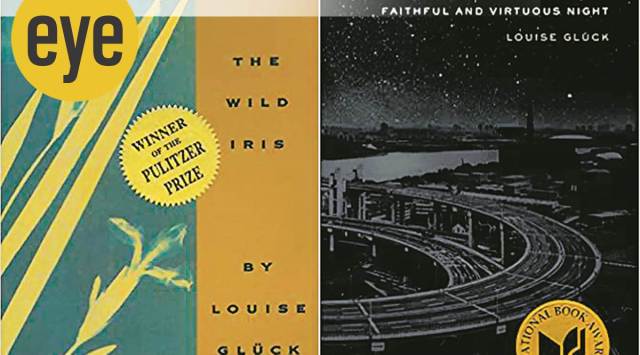
 After its controversial selection of Peter Handke for the 2019 Nobel Prize for Literature, the Swedish Academy returned on course this year with a Laureate who met with all-round approval: Louise Glück’s mastery at laying bare the inner life of the individual has long been acknowledged. Here’s a list of four collections that give a glimpse of Glück’s poetic genius:
The House on Marshland (1975)
Glück’s second book of poetry, which came seven years after her debut volume, Firstborn, is considered to be the one that announced the arrival of a powerful new voice in American poetry. One of the poems in the collection, Gretel In Darkness, in particular, drew both censure and acclaim for its exploration of the theme of familial and cultural trauma, told from the perspective of Gretel, one of the protagonists from the Grimm Brothers’s fairytale.
Wild Iris (1992)
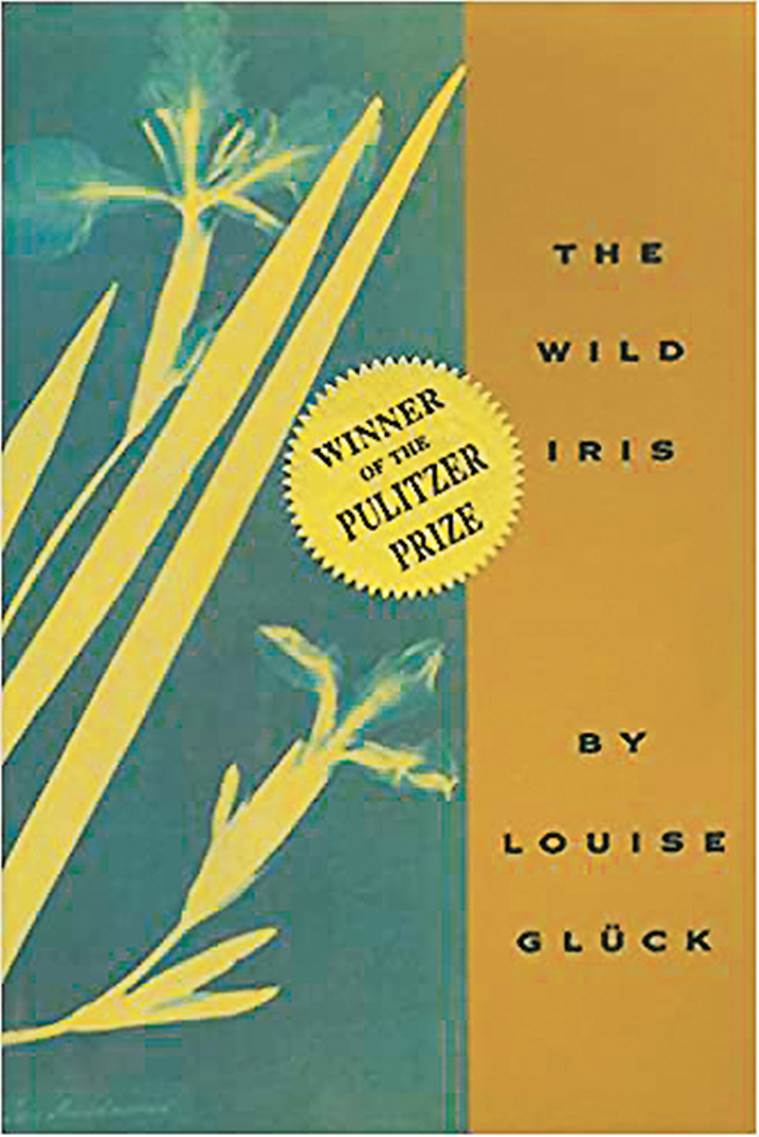 The cover of the book.
Time and mortality yoke this collection of 54 poems that won Glück the Pulitzer Prize in 1993. Written in three segments, Wild Iris speaks in the voices of the flowers, the gardener and an omniscient god figure. In each segment, Glück creates a cyclical world, much like the seasons, seeking answers to spiritual and intellectual questions.
Averno (2006)
While announcing the Prize, the Swedish Academy took particular note of Glück’s Averno, a collection in which she reworks ancient Greek and Roman mythologies to explore themes of old age, grief, and, of course, her forte — familial relationships and the dissolution of emotional bonds. In Averno, Glück takes up the story of Persephone, daughter of Zeus, king of gods, and Demeter, goddess of earth, who was abducted by Hades, the ruler of the underworld. Even though the poet tells the story from various perspectives, she insists it “should be read / as an argument between the mother and the lover”. The 18 poems in the collection are thematically linked and form a rich tapestry of voices of figures that recur in the Greek myth.
Faithful and Virtuous Night (2014)
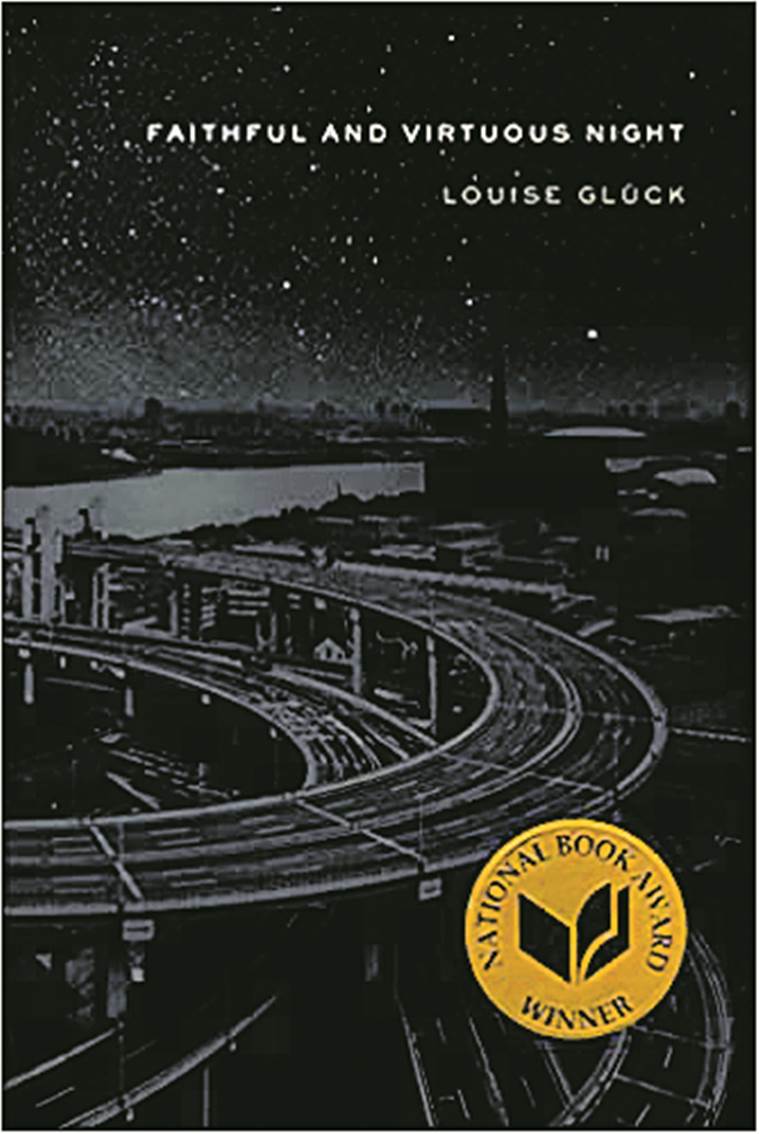 The cover of the book.
In her essay ‘Disruption, Hesitation, Silence’ (1994, Proofs and Theories), Glück writes: “I do not think that more information always makes a richer poem. I am attracted to ellipsis, to the unsaid, to suggestion, to eloquent, deliberate silence. The unsaid, for me, exerts great power: often I wish an entire poem could be made in this vocabulary.” Among her remarkable experiments with form, Faithful and Virtuous Night is also notable for the power of suggestion that hangs heavy over the collection. As she writes in Afterword, a poem from the collection, “Reading what I have just written, I now believe/ I stopped precipitously, so that my story seems to have been/ slightly distorted, ending, as it did, not abruptly/ but in a kind of artificial mist of the sort/ sprayed onto stages to allow for difficult set changes”. The book won the National Book Award for Poetry in the US the same year.