6 min read

© IE Online Media Services Pvt Ltd



 Roald Dahl was my favorite author, and Matilda was my favourite book. (Express Photo)
 Like most prepubescent bookworms, Roald Dahl was my favorite author, and Matilda was my favourite book. For me, Matilda was never just the story of a little girl discovering telekinesis, my connection with that seven-year-old was much deeper than that. In my world, I was Matilda. While I was not reading Charles Dickens and Ernest Hemingway at three, or moving objects with my eyes, I was the child always buried in storybooks, always at the top of my class, always carrying the quiet certainty that I was different.
I related to Matilda in almost every way, barring one: my parents were not dismissive like hers. On the contrary, they noticed everything – every grade, every medal, every compliment. But as I grew older, the celebration of each achievement became expectation. That is when I realised that Matilda’s story was only half told.
Roald Dahl, one of the greatest storytellers of all time, ended Matilda’s tale at her peak – living with Miss Honey, toxic parents gone, bullies defeated. While that makes sense in a children’s book, we never really see what happens after the curtain falls on Matilda’s childhood.
As children, triumph is the only ending we understand. What is harder to process is what happens when a gifted child grows up. Dahl closed Matilda’s story at age seven, but mine was just beginning.
Matilda and I both spent nights reading under the covers with a torch. The hunger for story, for escape, discovery, was something I recognised immediately when I first met her.
I was not gifted like Matilda, but I did prefer the library to the playground. She read under the covers in rebellion, while I did it out of devotion. My parents gladly bought me all the books I wanted, but the insatiable pull of a new and more exciting world was what truly bound me to her.
I remember devouring a 300-page novel a day, always carrying a book in my school backpack, begging for books as birthday and Raksha Bandhan gifts. While Matilda was reading Jane Austen, Charles Dickens, and Ernest Hemingway, I was devouring Roald Dahl, Enid Blyton, and later Meg Cabot. Books gave me life lessons I couldn’t find in real life–and that’s when the burnout began.
Matilda read to escape, while I read to excel. But both of us were driven by the same impulse: to be bigger than the worlds we had been handed.
As I grew older, though, I discovered that when you outgrow the world around you too quickly, the real one has a way of shrinking. I turned the last page of Matilda’s story when she was seven, surrounded by everything she ever wanted. But I kept aging into a different reality.
Burnout struck when I began reading not for joy but to cram within our hyper-competitive education system. I abandoned Sophie Kinsella’s romantic comedies for R D Sharma’s math problems. Soon enough, I could NOT read a single page without being pulled back into the real world.
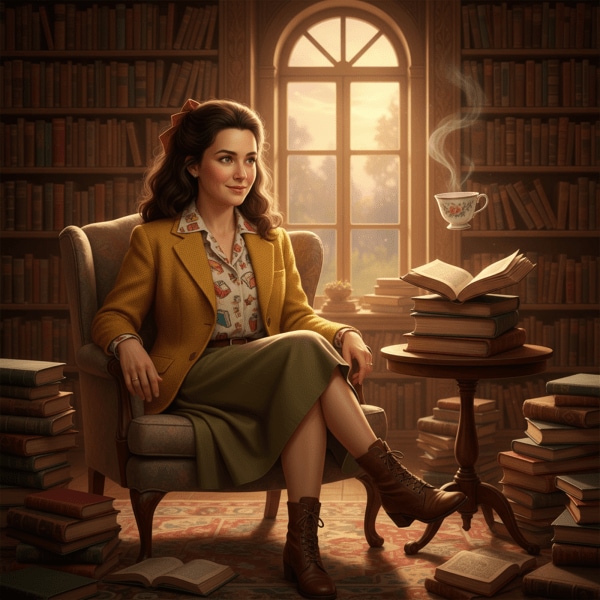 Dahl’s neat ending disguised the messiness of real life. Childhood victories don’t erase scars. (Generated using AI)
Matilda’s story ends on the highest possible note for a child. She escapes the Wormwoods and finds a home with Miss Honey. I cheered when her parents abandoned her, and when she triumphed over Miss Trunchbull. As a child, it felt magical. As an adult, it feels more complicated.
Because Matilda’s victories came at a cost– immeasurable trauma. She was rejected by her own family, and left to live with a teacher she barely knew. She survived an identity crisis as a child, unable to connect with the people who raised her. Revenge against Miss Trunchbull couldn’t erase years of fear and humiliation.
Dahl’s neat ending disguised the messiness of real life. Childhood victories don’t erase scars. Abandonment, humiliation, the loss of belonging—all of that follows you into adulthood.
I know because I carried my own scars. My father’s death echoed Matilda’s abandonment. I saw Miss Honey’s quiet struggles reflected in my widowed mother. And I, too, let survival outweigh the ambition to create my own world. Like Matilda, I learned that our past follows us into our so-called “safe spaces,” reshaping what we mean by a happy ending.
Reading Matilda as an adult also made me wonder: why don’t we ever see her find love? How could she? A child abandoned by family and terrorised by a sadistic headmistress would almost certainly carry wounds that complicate intimacy. Dahl’s rose-tinted lens softened trauma into a tidy resolution, but in reality, the “gifted child” learns to prepare for exams, applause, and performance – never for the terrifying risk of closeness.
Perhaps at 26, Matilda still hadn’t learned how to love, because no one ever showed her it was safe to be loved.
At 30, Matilda is probably in therapy. The abandonment, the displacement, the scars of her school years – how could they not catch up? But maybe that’s not a tragedy. Maybe therapy is where she finally learns to build a world that belongs to her.
Like Matilda, I have survived my own traumas, my own early scars. And like her, I hope to write my own unfinished chapters. Adulthood has taught me that life isn’t about perfection or extraordinary brilliance. It’s about staying with your story long enough to tell it yourself.
The real victory for Matilda, as an adult, is not defeating Trunchbull, escaping the Wormwoods, or acing exams. Her victory would be learning to live with her demons, slowly, fully, and then turning the page to write her next chapter.
(As I See It is a space for bookish reflection, part personal essay and part love letter to the written word.)