5 min read

Journalism of Courage



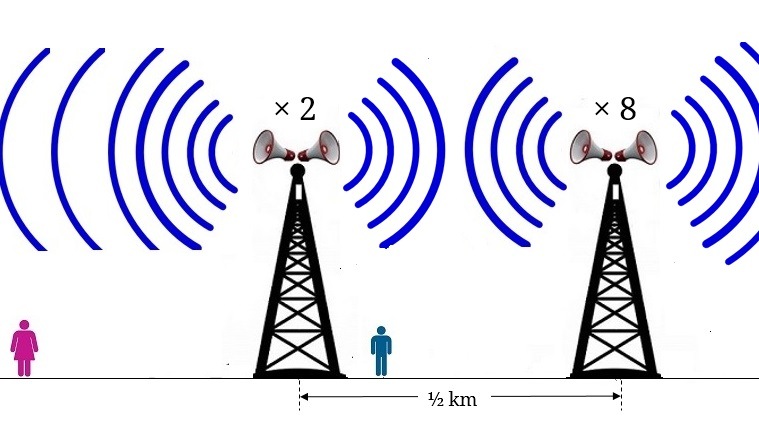 At which two points is the sound from both sources of equal intensity? (Source: Express illustration)
Politics, whatever its shortcomings, is not without its uses, e.g. it can be a source of puzzles. But try building any such puzzle around a political context and you end up attracting non-regular readers who think this is a political “article” of some sort and who post comments accordingly, particularly on Facebook. Hence a disclaimer: whatever subject this blog turns to, including Mann ki Baat, the larger picture remains mathematics — which, as everyone knows, is infinitely more entertaining than sweet nothings like politics.
[related-post]
So this village sets up these two towers half a kilometre apart, one with two loudspeakers and the other with eight, all 10 of identical specifications. The idea is to amplify Mann ki Baat for listeners, which the setup does do, but not quite in the manner the village authorities had hoped. As long as the intensity of sound from each source is different, the result is an uncomfortable buzz around the ears.
One listener finds a way out. He walks along the straight line connecting the towers until he finds, between the towers, a point where the sound from each source is equally intense. This, he finds, rests easier on the central nervous system.
Along the same straight line, another listener begins the long walk. She reaches a second point of equal intensity on the far side of the tower with two speakers.
Puzzle#17A: That’s two points for you to locate. Incidentally, are those the only two such points?
What you wrote
Your solutions to last week’s puzzles:
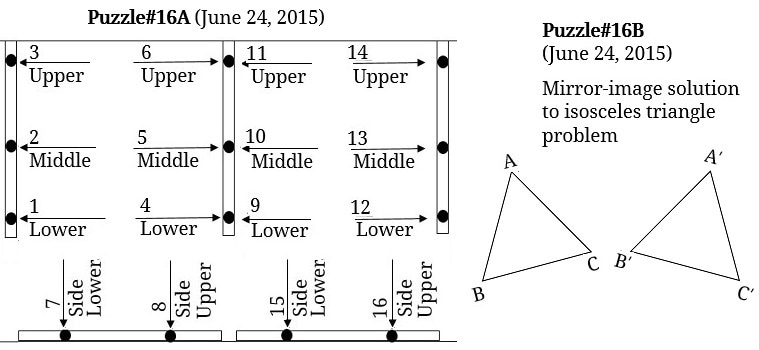
Mr Kabir, in Puzzle#16A, divide the seat number by 8 and look at the remainder. If it’s 1 or 4, then it’s a lower berth. If it’s 2 or 5, it’s middle; if it’s 3 or 6, then it is upper berth; if it is 7, it’s side lower berth; if no remainder, it is side upper berth.
Sampath Kumar V (IIM Kozhikode alumnus)
Hi, Kabir. To solve Puzzle#16B, I’m going to apply the principles of congruence of triangles on triangle ABC and triangle ACB. The two triangles are not the same when seen within the strict paradigm of congruent triangles. Now, AB = AC (given), BC = CB and AC = AB (repetition); hence the 2 triangles are congruent by SSS. So the corresponding angles are also congruent. This would mean angle ABC = angle ACB, i.e., angle B = angle C. This proves that the two angles opposite equal sides in isosceles triangles are equal.
Biren Parmar (PhD student, Texas A&M University)
***
Dear Kabir, making use of the rule, “In a triangle, the angle opposite the largest side is largest and angle opposite the smallest side is the smallest”, consider angle B > angle C (or angle C > angle B). This inequality is invalid as sides opposite to both angles are the same. So neither of them is greater than the other, which means they are equal.
S Sreenvas (Executive member, Career Development & Placement Office, IIM Raipur)
Thanks, Sreenvas, for this interesting variation. As for Biren’s solution, one way of looking at it is to view the original ABC and its mirror image, A’B’C,’ as two different triangles. Correspond side AB with A’C’, side AC with A’B’, prove the triangles are congruent, and you can equate the base angles.
Solved both puzzles: Sanjay Gupta (New Delhi), Jaysun Antony Alumkal (IIM Raipur), Vivek Jalan (Customate Systems), Sampath Kumar V, Biren Parmar, S Sreenvas
Solved railway puzzle: Anindita Basu (IBM India), Bindia George (Kochi)
Y it’s a vowel
Although they teach at school that the English alphabet has five vowels, I prefer to go with the relatively small club who say there are six of them. According to British gaming expert David Parlett, Y is a vowel 97% of the time. In my 1982 copy of ‘The Penguin Book of Word Games’, Parlett lists 46 words with Y as the only vowel, not counting plurals with an S added. Examples are BY, MY, CRY, SHY, WRYLY.
Puzzle#17B: Without accessing that list, what is the longest word you can find that uses no vowel other than Y? Plurals with an S are allowed.
Please mail your replies to:
kabir.firaque@expressindia.com