This is an archive article published on July 28, 2015
Journey started with cattle shed, some cycling help from a colleague
Kalam had converted a cattle shed at this coast into a laboratory to work on sounding rockets.
Written by Shaju Philip
Thiruvananthapuram | Updated: July 29, 2015 05:35 PM IST
2 min read
Whatsapp
twitter
Facebook
Reddit
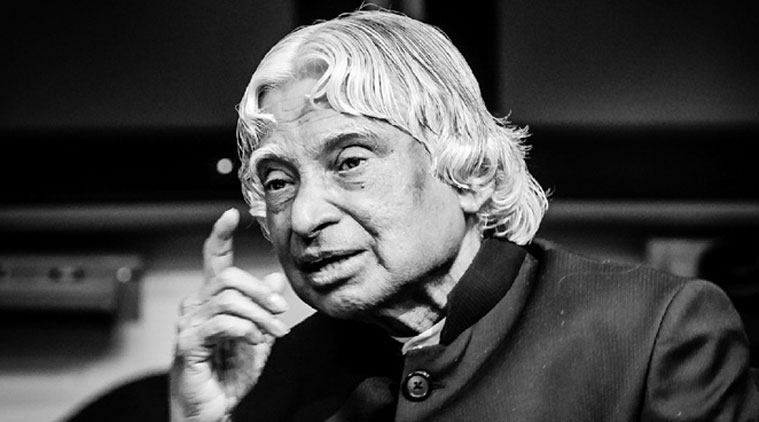
A P J Abdul Kalam
The journey of A P J Abdul Kalam as a space scientist began in early 1960s at Thumba, a coastal village near here, which housed India’s first rocket launcher, Thumba Equatorial Rocket Launcher.
Kalam was one of the few young scientists sent by Dr Vikram Sarabhai for training of ‘sounding rockets’ at the National Aeronautics Space Agency in the US. When he reached Thumba in 1964, Kalam had little to fall back on.
He had converted a cattle shed at this coast into a laboratory to work on sounding rockets.
[related-post]
In those days, even rocket parts and payloads were transported by bicycle. Kalam, who was not a cyclist, used to hitch a ride with his former colleague R Aravamudan, who was also handpicked by Vikram Sarabhai.
Later, Kalam played a key role in transforming the equatorial rocket launcher station into a hub of space technology, when it was renamed Vikram Sarabhai Space Centre after Sarabhai’s death in 1971.
At VSSC, one of the major tasks fulfilled by Kalam was to design, develop and build a satellite launch vehicle called SLV3 to put India’s first satellite, Rohini, into the earth orbit. When the Rohini satellite was successfully launched in 1980, Kalam, as project director, took India into an exclusive member of the Space Club.
He worked at VSSC until 1982, when he moved to the DRDO.
Shaju Philip is a Senior Assistant Editor at The Indian Express, where he leads the publication's coverage from Kerala. With over 25 years of experience in mainstream journalism, he is one of the most authoritative voices on the socio-political, religious, and developmental landscape of South India.
Expertise, Experience, and Authority
Decades of Regional Specialization: Shaju has spent more than two decades documenting the "Kerala Model" of development, its complex communal dynamics, and its high-stakes political environment.
Key Coverage Beats: His extensive reporting portfolio includes:
Political & Governance Analysis: In-depth tracking of the LDF and UDF coalitions, the growth of the BJP in the state, and the intricate workings of the Kerala administration.
Crime & Investigative Journalism: Noted for his coverage of high-profile cases such as the gold smuggling probe, political killings, and the state’s counter-terrorism efforts regarding radicalization modules.
Crisis Management: He has led ground-level reporting during major regional crises, including the devastating 2018 floods, the Nipah virus outbreaks, and the Covid-19 pandemic response. ... Read More