Journalism of Courage



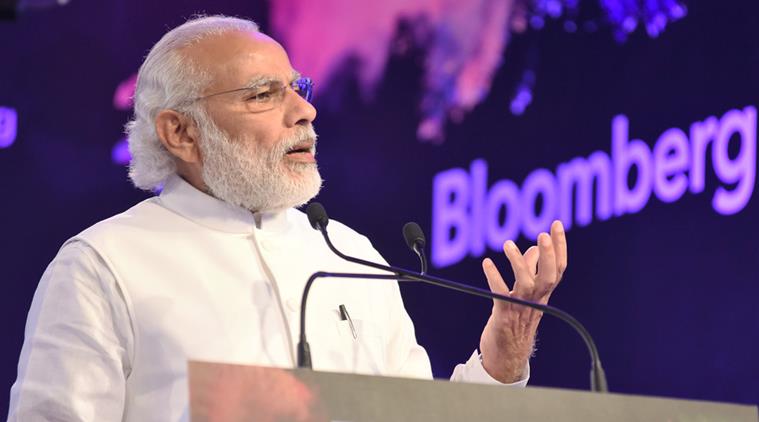 Prime Minister Narendra Modi
As Prime Minister Narendra Modi listened attentively, a top official of the Saudi-India business council asked him seven tough questions Sunday in a room full of top Saudi and Indian businessmen and senior Indian officials.
Hailing Modi for being the “man who has made red tape disappear”, Kamel S Al Munajjad, co-chair of Saudi Arabia-India business council, told Modi, “You are preaching to the converted, but even the converted have occasional concerns. Whereas the doors of our ministers in Saudi Arabia are always wide open, and are accessible to foreign investors, bureaucratic requirements make it more difficult in India. We need your help for an equal opportunity to do so in India.”
Then he shot off seven questions, saying a “lot of questions” come to mind and “I hope you can answer them”.
“Why a parliamentary gridlock on a major reform like GST in India? What’s happening to your land reform law, your bankruptcy law? Why does your government promise a tax-friendly government to investors… and at the same time, your tax department takes steps in the opposite direction?”
[related-post]
“Why are you inviting foreign investors in infrastructure projects when we are not seeing Indian government and companies invest aggressively in this sector? How solid, how strong is your banking sector? India is home to the second largest Muslim community in the world, are you considering opening your markets to the principles of Islamic banking? Will you allow Saudi banks to operate in India, bearing in mind that SBI is already here,” Al Munajjad said.
National Security Advisor Ajit K Doval, Foreign Secretary S Jaishankar, Secretary (Economic Relations) Amar Sinha were present in the room along with Indian business heads including Tata Group chairman Cyrus Mistry and L&T Group executive chairman A M Naik.
Responding to these concerns, the Prime Minister said retrospective taxation has been relegated to history, but he is “not able to do anything” on two pending cases as “they are sub-judice”.
“There are two cases of the previous government, but they are sub-judice matter, so I am not able to do anything… Now, retrospective tax in India has become a thing of the past. It will not happen going ahead,” Modi said.
“You are worried about GST. Do not worry about GST. GST will happen. I cannot give a timeframe, but it will happen. It was our commitment, and it is about to happen,” he said.
The Prime Minister said the government is in favour of “long-term”, stable and “predictable” policies and any retrospective amendment to tax laws is a thing of the past.
“My government is working towards banking sector reform and making sure all our states are on board,” he said. “Let us move beyond merely the export-import relationship. Joint investment, technology transfers are areas we should explore.”
The Prime Minister pitched for greater investment, saying his government has opened up various sectors to foreign investment. India, he said, stands out as a “beacon of hope” amidst the global economic slowdown.
“World Bank has upgraded India by 12 ranks in Ease of Doing Business. I expect in the next review, our ranking will improve further because we have made a lot of administrative reforms. From petroleum to renewable energy, infrastructure, defence and agriculture, there is a tremendous opportunity for expanding our cooperation,” he said.
“India and Saudi Arabia are old friends, but we are ready to take bold, new steps into a golden future.”
After the meeting, Al Munajjad shot a selfie with Modi.
The meeting was also attended by Saudi Minister of Commerce and Industry Tawfiq bin Fawzan Al Rabiah who also advocated increased investments in both countries.


 4 min read