4 min read
Stay updated with the latest - Click here to follow us on Instagram

Journalism of Courage



NEITHER INDIA’S diabetes burden nor the Prime Minister’s emphasis has been able to bring to life — and the market — a low-cost glucometer and glucose testing strips. The technology, developed by BITS Pilani, remains on the drawing board 18 months since the time Indian Council of Medical Research (ICMR) claims to have handed it over to a company for manufacturing and marketing. ICMR and the company, Soothe Healthcare, trade charges about what caused the delay.
ICMR says Soothe is too new in the field and getting all the relevant licences has taken up most of the last two years even though in February 2015, when the handover happened, the council was under the impression that it would reach the market in six months. And Soothe says ICMR handed over unvalidated technology, that too a full year after signing the MoU and taking the payment. ICMR maintains there is no exclusivity of the technology and should another company with the expertise come forward, it would share the technology with that company too.
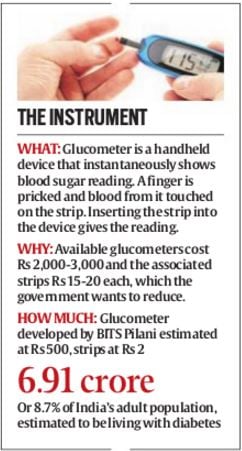
A glucometer costs Rs 2,000-3,000 and the strips essential for measuring blood sugar levels can cost in the range of Rs 15-20 each. It was the idea of former health minister Ghulam Nabi Azad that India should work on its own blood sugar measuring devices. In 2010, ICMR invited medical and technical institutes to come up with ideas. Subsequently about 20 projects were funded and three selected for scaling up, the first being that of BITS Pilani.
“The commercial partner was chosen based on expressions of interest received. We handed the technology over to Soothe in August 2015,” said Dr Chandra Shekhar, Scientist at ICMR. “Our assessment was the machine could be marketed for Rs 500 and the strips for about Rs 2. When we signed the MoU our understanding was that it would be in the market in six months. However that did not happen.
The company was too new, there are a lot of licences and clearances that are required. We are regularly in touch with the company but have stopped asking for a timeline. What is the point?”
Sahil Dahiya, CEO of Soothe, had a different version of events. “ICMR did not sign the MoU until February 2015 and after taking the money — the sum is confidential — did not give us the dossier for the technology for the full year. They had not even applied for a patent, and did not pay BITS Pilani till about a month ago. My experience of working with ICMR has been very bad, they take days to move a file from one room to the next. It was not even validated, so we will have to test the prototypes on 2,000 people to know whether it even works.” If it works, he said, it should be in the market in eight to nine months. “If it doesn’t, we will know in three months.”
Shekhar said a second technology for a low-cost glucometer is currently in the validation stage and a third, which does not even require blood to be drawn, should be with ICMR in six weeks. “The (BITS Pilani) technology is not exclusive. We are ready to share it with any company that has the wherewithal to develop it,” he said, but added that as a government official he could not respond to what Dahiya said.
Stay updated with the latest - Click here to follow us on Instagram