Journalism of Courage



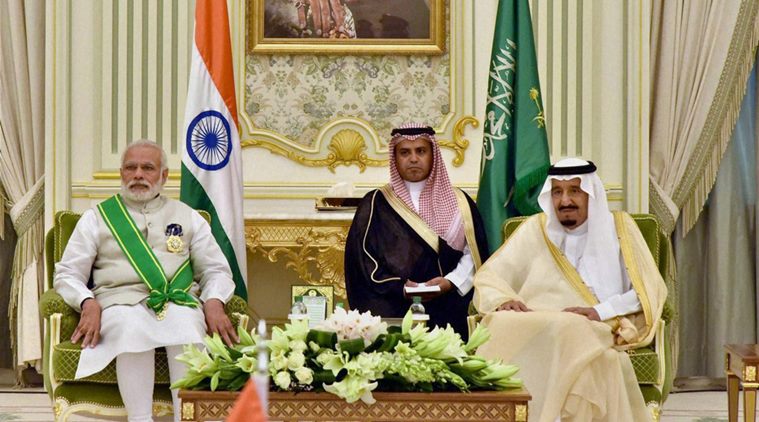 Prime Minister Narendra Modi at the signing of agreements between India and the Kingdom of Saudi Arabia in Riyadh on Sunday. PTI Photo
India and Saudi Arabia on Sunday came out strongly against terrorism, as they called on countries to reject the use of terrorism against others, dismantle terrorism infrastructure and cut off any kind of support and financing to terrorists operating against others.
While Indian officials said the statement was an oblique reference to Pakistan, Saudi officials felt that it was indirectly aimed at Iran, as it feels that Tehran is behind sectarian tension in the Saudi kingdom in recent months. Both sides chose to read the joint statement from their own perspective.
The statement was the result of the “shared perception on terrorism”, Indian officials said, after an extensive meeting between Prime Minister Narendra Modi and Saudi King Salman bin Abdulaziz for about three hours at the royal palace. Later, Modi met the Crown Prince and Interior Minister Mohammed bin Naif and the Deputy Crown Prince and Defence Minister Mohammed bin Salman.
The two sides also signed five agreements, which encompassed terror financing, bilateral investment promotion, welfare of Indian workers, preservation of heritage and standardisation of products. However, the highlight of the joint statement was the paragraphs on terrorism. Saudi Arabia became the second country in the Gulf region — after the UAE — which came out strongly against terrorism in the last one year.
The joint statement, which had five extensive paragraphs on terrorism instead of the rudimentary mention of terrorism in the past, said, “They called on all states to reject the use of terrorism against other countries; dismantle terrorism infrastructures where they happen to exist and to cut off any kind of support and financing to the terrorists operating and perpetrating terrorism from their territories against other states; and bring perpetrators of acts of terrorism to justice.”
The two leaders directed their agencies to coordinate efforts to counter radicalisation and “misuse of religion by groups and countries for inciting hatred, perpetrating and justifying terrorism for pursuing political aims”.
While the Indian side perceived this as hinting towards Pakistan, a Saudi official told The Indian Express, “We are glad that India has understood our position on terrorism emanating out of Iran.” Ministry of External Affairs Secretary (economic relations) Amar Sinha said, “The key part in the joint statement is the shared perception of terrorism. They have moved substantially because of the threat on them.”
Officials said the Saudi kingdom was supportive of the Comprehensive Convention on International Terrorism (CCIT), a long pending Indian demand at the global level, for the time although the “i’s need to be dotted, t’s need to be crossed”. In this context, India and Saudi Arabia on Sunday signed a crucial pact on financial intelligence-sharing on money laundering and terrorism financing.

 3 min read