5 min read

Journalism of Courage



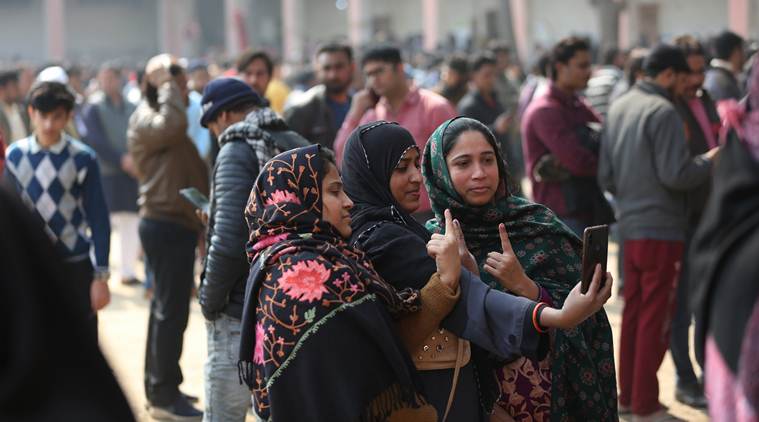 Women click a selfie after casting their vote, Saturday. Tashi Tobgyal
The microphones had fallen quiet, the stage lay empty. There were no speeches, songs, sloganeering or poetry. The story of the 56th day of the marathon Shaheen Bagh protest against the Citizenship Amendment Act (CAA) lay in its silence. And away from its now-iconic tent.
It was the lanes and bylanes of the neighbourhood, on the banks of the Yamuna, that pulsated with life on Saturday, as women and men, young and old, stepped out in large numbers to vote. The queues spilled out of the two polling centres in the area, housed in the Abul Kalam Azad Boys Public School and the Shaheen Public School.
Estimated voting percentage from the Okhla constituency, under which Shaheen Bagh falls, is 58.83% — a slight dip from 60.73% in the 2015 polls.
“Log pooch rahe hain dharne ka koi asar pada ya nahi. The point is just like the protests, voting is our right,” pointed out Shama Parveen, a local resident and a regular at the sit-in.
With the anti-CAA protests about to complete two months in the area, the concept of ‘adhikaar’ (rights) dominates every other discussion at Shaheen Bagh, witness to endless sessions on citizenship and nationhood.
“You ask why more people are voting this time? I have a counter-question. Have you seen so many Muslims on the street before? When did you last see women occupying a road?” said Jameela, when asked about the visibly large turnout.
Under the tent, occupied mostly by farmers from Punjab during the day, the organisers went around requesting people not to interact with the media and refrain from political discussions.
But politics flowed, inexorably, in the corner shops, outside showrooms with downed shutters, on the lanes leading to the polling centres, all under the hawk-eye vigil of a large contingent of security personnel.
Shaheen Bagh falls under the Okhla assembly constituency, one of the six minority-dominated seats in the national capital, where the Congress hoped to make inroads riding on the unrest against CAA and proposed NRC and AAP’s “strategic silence”.
Outside Shaheen Public School stood Anas Siddiqui, Naeem Roshan and Fahad. While Siddiqui wore an AAP cap, Roshan and Fahad sported Congress topis. “Vote ektarfa hua hai. Amanatullah Khan (AAP) is set to register a huge victory. There is no split in Muslim votes. Aap dekh lena 11 tareekh ko,” said Siddiqui (32), a civil contractor.
Roshan and Fahad’s responses, however, were more telling. “No one can deny that Amanatullah Khan has delivered,” Fahad (28), a software developer, said.
Roshan put up a mild resistance, only to concede that the AAP had a clear edge. “But power has gone to their (AAP’s) head. This is why one needs some opposition presence,” he said, pointing to how Chief Minister Arvind Kejriwal avoided visiting Shaheen Bagh or the Jamia protests. “This is exactly what the BJP wanted,” retorted Siddiqui, echoing the argument made by the AAP chief himself in speeches and interviews over the last few weeks, justifying his absence.
At the polling centre inside Jamia Millia Islamia, where voting took time owing to limited number of EVMs, the views were no different, with families quietly walking in and out of the booths, having voted for “progress and development”.
By afternoon, men in motorbikes could be seen going around the neighbourhood announcing that Amanatullah Khan is set to return “with a margin bigger than 2015”, when he had defeated BJP’s Braham Singh, his closest rival, by over 65,000 votes.
This time, the Congress fielded Parvez Hashmi while BJP repeated Singh. The voices on the ground, however, had made up their minds long before voting day.
“Humare liye toh Kejriwal hi hai. My child goes to the government school and I have seen work happening there. We are tenants but the impact of free water and power cannot be discounted. These things matter for the poor. And why will I not vote for someone who is better placed to defeat the BJP?” said Nazeem (27), a homemaker, returning to the tent after getting inked.
As evening descended, the focus lights at the protest tent flickered back to life, the crowd grew in size. The locals bid goodbye to several batches of the Sikh farmers, who prepared to leave for Moga, their hometown.
But the stage remained unoccupied, the microphones silent. The voting centres were still occupied.