5 min read

Journalism of Courage



 Gujjar protesters on the railway tracks in Sawai Madhopur. (Express photo)
The Rajasthan Assembly on Wednesday passed a Bill granting five per cent reservation to five communities, including Gujjars, and had the Governor sign it within hours. Though the Gujjars are yet to call off their protest, the Congress hopes it has managed to tide over the crisis with its move.
The current reservation protest is among the many called by the community over the past 13 years. According to the BJP’s internal statistical analysis, prepared ahead of last year’s Assembly elections and accessed by The Indian Express, Gujjars are a majority in eight seats and are the second largest community in 18 others, accounting for 4.27 per cent of the voting population. The Gujjars have a considerable presence in the eastern districts of the state — Dausa, Bharatpur, Karauli and Sawai Madhopur. But the BSP also has a presence in these districts and the Congress will be worried about the former jeopardising its applecart if the BSP fields a good candidate and if the Congress fails to woo the Gujjars.
Gujjars are also present in parts of Hadauti region, in districts such as Kota, Bundi and Jhalawar, apart from pockets of the state such as Bhilwara, Alwar, Jaipur and Tonk.
As they seek reservation, Gujjar leaders point to seats such as Bayana in Bharatpur and Niwai in Tonk, where they outnumber other communities, but both seats are reserved for SCs. Of the Lok Sabha seats, the community could influence results in Tonk-Sawai Madhopur as well as Kota and Jaipur Rural. Two other seats where they have influence, Bharatpur and Karauli-Dholpur, are reserved constituencies.
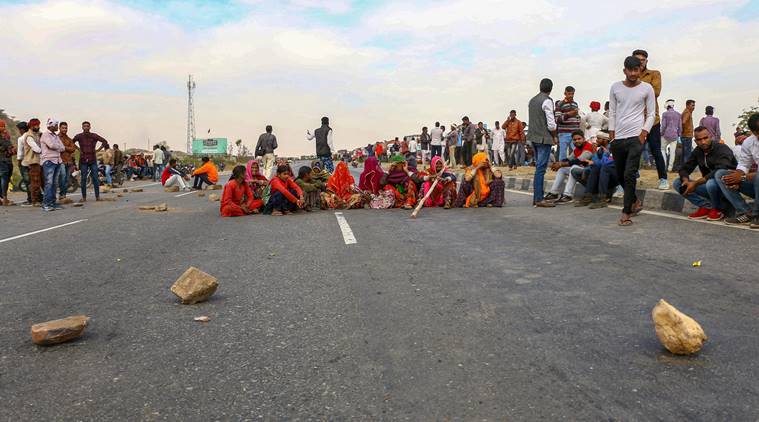 Ajmer: Gujjar community members block national highway 58 in support of their demand for reservation in Ajmer. (PTI Photo/File)
In the 2013 Assembly elections, BJP had eight Gujjar MLAs against the Congress’s four. However, in the latest elections, held late last year, the BJP drew a blank — not a single Gujjar MLA among its 73 MLAs, while the Congress has seven among its 100: Sachin Pilot, Ashok Chandna, Shakuntala Rawat, Indraj Singh Gurjar, Jitendra Singh, Bidhuri Rajendra Singh and Gajraj Khatana. Of the seven, 2 are in CM Gehlot’s Council of Ministers. The only other Gujjar MLA is BSP’s Joginder Singh Awana.
The BJP realises it has a lot of work to do before it can win over the community. On Monday, during the first session of the 15th Assembly, BJP leaders raised the issue of farm loan waiver but did not bring up the matter of the protesting Gujjars, which was later taken up by BSP’s Awana.
The BJP, though, attacked the Congress with Deputy Leader of Opposition Rajendra Rathore saying the party missed an opportunity to elect a Gujjar as CM in Rajasthan. The Congress and the BSP hit back, accusing the BJP of hypocrisy and by bringing up the deaths of 72 Gujjar protesters at the height of the protests between 2007 and 2008, during the BJP’s term.
The Gujjars further distanced themselves from the BJP when, early last year, Kirodi Lal Meena, who had quit the BJP to form his own party, came back with two MLAs and his supporters — Gujjars are known to be opposed to Meenas, an ST community. Later, after the government passed two Bills which were stuck down by the High Court, Gujjars threatened to block then CM Raje’s Gaurav Yatra in Bharatpur, saying she had not ensured their reservation.
But it was not always so. Early in the last decade, there was talk of including Gujjars in the Scheduled Tribe list. Around the 2003 elections, Raje had promised Gujjars of a “positive outcome” if elected to power. However, beginning 2006, the community leaders were up in arms, saying Raje had done nothing about granting them ST status. This was opposed by members of the Meena community, who feared that granting ST status to Gujjars would eat into their share of the reservation pie.
Ashok Gehlot’s is the fourth consecutive state government which has sought to extend the benefits of reservation to the community. But all the legislations so far have either been stayed or struck down by courts.
Citing these experiences, Gujjars are yet to call off their protest, though Pilot, while claiming that the circumstances are different this time, cites Parliament’s recent breach of the 50 per cent reservation ceiling with the 10 per cent quota to the Economically Weaker Sections (EWS) among those in the general category.