7 min read
Stay updated with the latest - Click here to follow us on Instagram
© IE Online Media Services Pvt Ltd



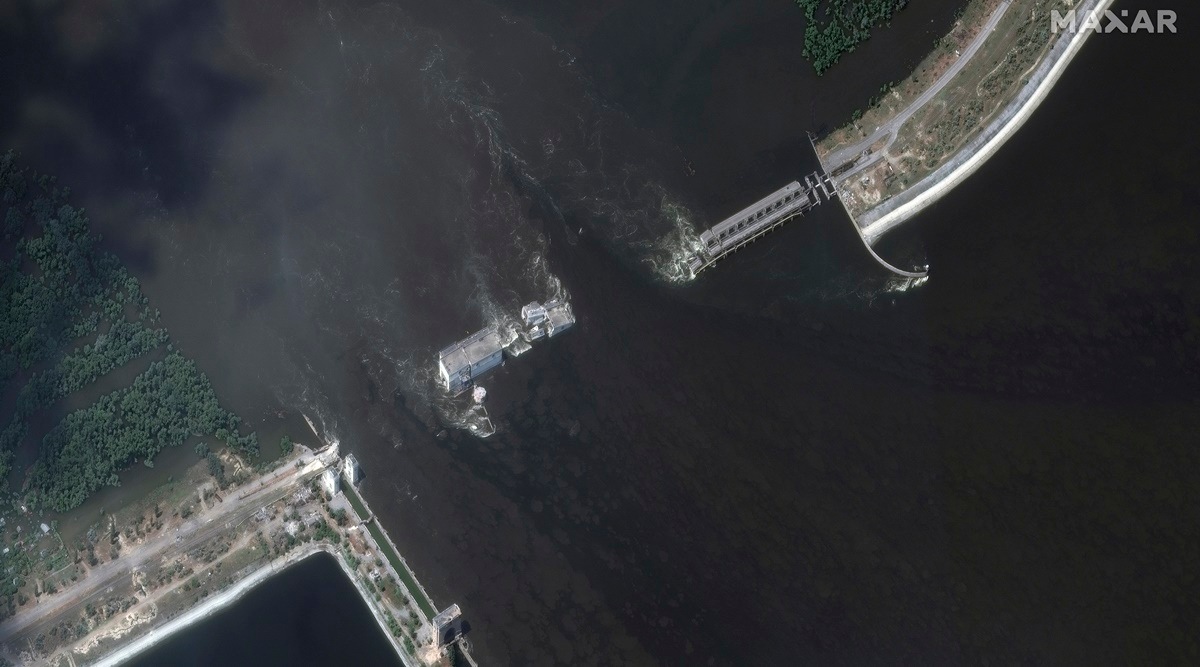 This image provided by Maxar Technologies shows Kakhovka dam and station in Ukraine after collapse, on June 7. (Satellite image ©2023 Maxar Technologies via AP)
 In the early hours on Tuesday, the Kakhovka dam in southern Ukraine was ripped open after an explosion wreaking havoc and fuelling fears of vast and irreparable damage to life and ecology.
While the Ukraine army’s southern military command said the dam had been blown up by Russian forces, the local Russian-installed mayor has called it a “terrorist act”.
The dam — one of the biggest in Europe — was holding nearly 18 cubic-kilometres of water when it fissured, unleashing a torrent of water into cities, towns, and lowlands downstream on the Dnipro River — affecting regions held by both Russia and Ukraine.
Ukrainian officials say more than 40,000 people — 17,000 in Ukraine-held territory west of the Dnipro River and 25,000 in the Russian-occupied east — are at risk.
 A view shows a flooded area after the Nova Kakhovka dam breached, amid Russia’s attack on Ukraine. (Reuters)
The dam had supplied essential drinking water and irrigation to a huge area of southern Ukraine, and had also provided water for cooling at Ukraine’s biggest nuclear plant.
Russia and Ukraine have come up with conflicting claims regarding the destruction of the Kakhovka dam, each blaming the other for the disaster. Ukraine, which controls the river’s western bank and the city of Kherson, has accused Russian forces of blowing up and the dam and hydroelectric power station. Ukrainian President Volodymyr Zelenskyy accused the invading nation of committing the “terrorist act”.
“Russia has been controlling the dam and the entire Kakhovka HPP [Hydroelectric Power Plant] for more than a year. It is physically impossible to blow it up somehow from the outside, by shelling. It was mined by the Russian occupiers. And they blew it up. Russia has detonated a bomb of mass environmental destruction. This is the largest man-made environmental disaster in Europe in decades,” Zelenskyy said.
On the other hand, Russian officials have blamed Ukrainian bombardment for the dam’s fall. Russia controls the eastern bank for about the last 300 kilometers.
Russian President Vladimir Putin said that Ukraine is “openly using terrorist methods, and organising sabotage on Russian territory.” “A clear example of this is the barbaric action to destroy the Kakhovskaya hydro-electric power plant in the Kherson region which led to a large–scale environmental and humanitarian catastrophe,” Putin was quoted as saying.
The BBC reported that Mykola Kalinin, the chief engineer of a hydropower and water management engineering company in Ukraine, Ukrhydroproject, claimed that an explosion was the cause of the collapse. The dam, he told Ukrainian data journalism site Texty, was “built to withstand a super-powerful impact from the outside”. Kalinin concluded that it was mined from the inside to cause a destruction of such magnitude.
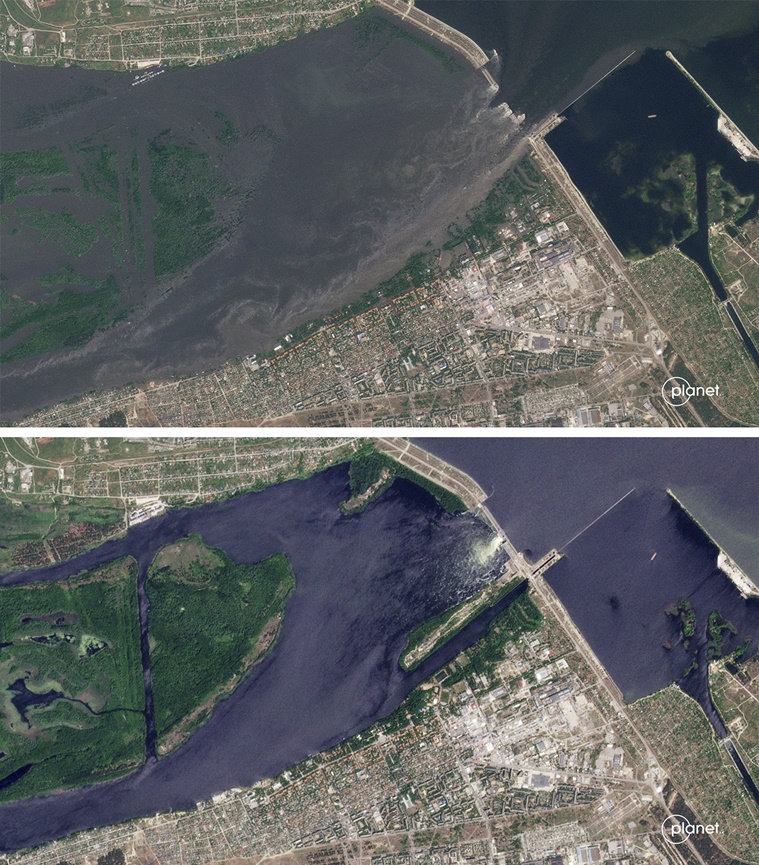 This combination image made with photos provided by Planet Labs PBC shows flooding in Kakhovka, Ukraine, following the Kakhovka dam breach on Tuesday, June 6, 2023. The bottom photo was captured on Monday, June 5, prior to the flooding, and the top photo was captured on Tuesday, June 6, during the flood. (Planet Labs PBC via AP)
Three deaths have been reported from the Ukrainian region, while Russian officials have reported five deaths in the occupied territory due to the collapse of the dam.
Oleksandr Prokudin, head of the Kherson regional administration, said about 1,700 people had been evacuated in Ukraine-controlled areas as of Wednesday. The area has a population of about 42,000.
On the eastern side, Moscow-appointed regional Governor Vladimir Saldo that while about 4,000 people had been evacuated, almost 40,000 people remained in flooded areas.
Meanwhile, the rupturing of the dam will also spell water shortages for dependent areas, including Russia-annexed Crimea.
“Hundreds of thousands of people were left without normal access to drinking water,” Zelenskyy said.
Further, the United Nations has warned that the destruction of the Kakhovka dam could spark a dire environmental disaster.
The deluge has inundated tens of thousands of hectares of agricultural land and is likely to turn at least 5 lakh hectares of farmland deprived of irrigation into deserts. Ukraine’s agriculture ministry said about 94 percent of irrigation systems in the Kherson region have been left without a water source.
The damage has driven up the global wheat prices, with Ukraine being one of the largest exporters of wheat in the world.
The impaired reservoir also provided water for the cooling system of the Zaporizhzhia nuclear power plant in Ukraine – the largest in Europe.
While UN watchdog International Atomic Energy Agency (IAEA) has observed that there appears to be “no immediate nuclear safety risk” for the plant, Ukraine’s Deputy Foreign Minister Andrij Melnyk has called the breach “the worst environmental disaster in Europe since Chernobyl.”
AP drone footage of the collapsed Ukrainian dam and surrounding villages under Russian occupation shows hundreds of submerged homes, greenhouses, and even a church falling into the flooded river.
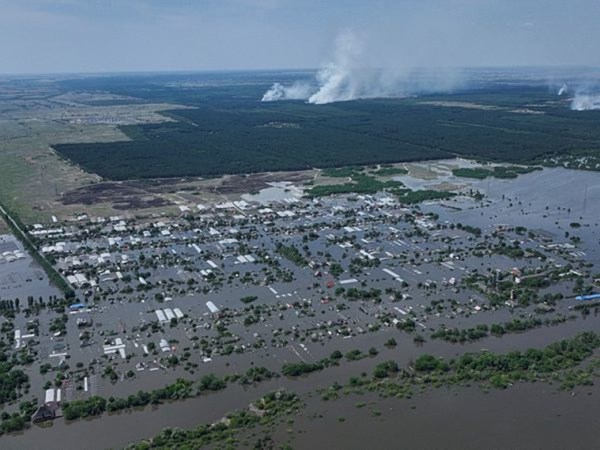 Houses are seen underwater in the flooded village of Dnipryany, in Russian-occupied Ukraine. (AP photo)
“The destruction of the Kakhovka Hydroelectric Power Plant dam in Kherson — the most significant incident of damage to civilian infrastructure since the start of the Russian Federation’s invasion of Ukraine — will have grave and far-reaching consequences for thousands of people in southern Ukraine,” United Nations Emergency Relief Coordinator Martin Griffiths said.
The UN said it has provided up to 25,000 bottles of water, sanitation supplies, and over 10,000 water purification tablets. “The UN has also distributed ready-to-eat food for about 400 people within hours of their evacuation. And today the UN is providing one month’s worth of food to 200 people in the Mykolaiv region,” a spokesperson said on Wednesday.
President Emmanuel Macron said on Wednesday France would send aid to Ukraine “within the next few hours” after he had a phone conversation with his Ukrainian counterpart.
“France condemns this atrocious act, which is endangering populations. Within the next few hours, we will send aid to meet immediate needs,” Macron had written on Twitter.
Meanwhile, the White House has said that it is still assessing what led to the dam collapse. “It is — the damage, obviously, and the devastation that we’re seeing is heartbreaking… And, you know, this dam was under Russia’s control, and they bear responsibility for the destruction caused by this war. And we will do everything that we can to support the people of Ukraine at this difficult time,” press secretary Karine Jean-Pierre said.
“Russia will have to pay for the war crimes committed in Ukraine. The destruction of the dam, an outrageous attack on civilian infrastructure, puts at risk thousands of people in the Kherson region. Europe is mobilising support through our civil protection mechanism,” European Commission President Ursula von der Leyen said.
Notably, Ukrainian President Zelenskyy has criticised the international community, particularly the UN and the Red Cross, for their lack of assistance in the face of the flood crisis. “Now we need a clear and quick reaction from the world to what is happening,” Zelenskyy urged.
Stay updated with the latest - Click here to follow us on Instagram