


Stay updated with the latest - Click here to follow us on Instagram
Tags:


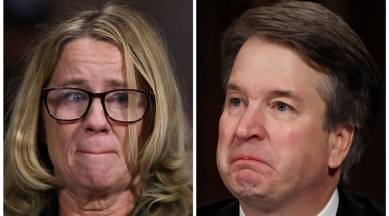
Judge Brett Kavanaugh and his accuser faced off Thursday in an extraordinary, emotional day of testimony that ricocheted from a woman’s tremulous account of sexual assault to a man’s angry, outraged denial, all of which played out for hours before a riveted nation and a riven Senate.
The two very different versions of the truth, unfolding in the heated atmosphere of gender divides, #MeToo and the Trump presidency, could not be reconciled. The testimony skittered from cringe-worthy sexual details to accusations and denials of drunken debauchery to one juvenile exchange over flatulence.



Senators must ultimately take sides — and their decisions in the coming days will determine the ideological balance of the Supreme Court for decades. Immediately after the hearing adjourned, President Donald Trump praised Kavanaugh’s testimony on Twitter, saying that the judge had “showed America exactly why I nominated him.”
“His testimony was powerful, honest, and riveting,” the president wrote. “Democrats’ search and destroy strategy is disgraceful and this process has been a total sham and effort to delay, obstruct, and resist. The Senate must vote!”
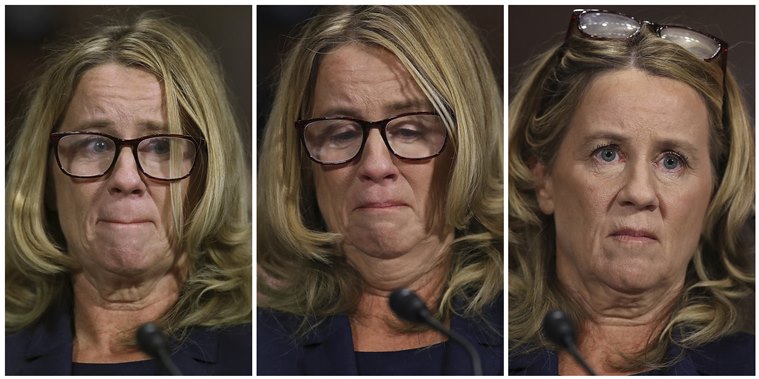
On Thursday morning, with her voice cracking but her composure intact, the accuser, Christine Blasey Ford, told a rapt Senate panel about the terror she felt on a summer day more than 30 years ago, when, she said, a drunken young Kavanaugh pinned her to a bed, tried to rip off her clothes and clapped his hand over her mouth to muffle her cries for help.
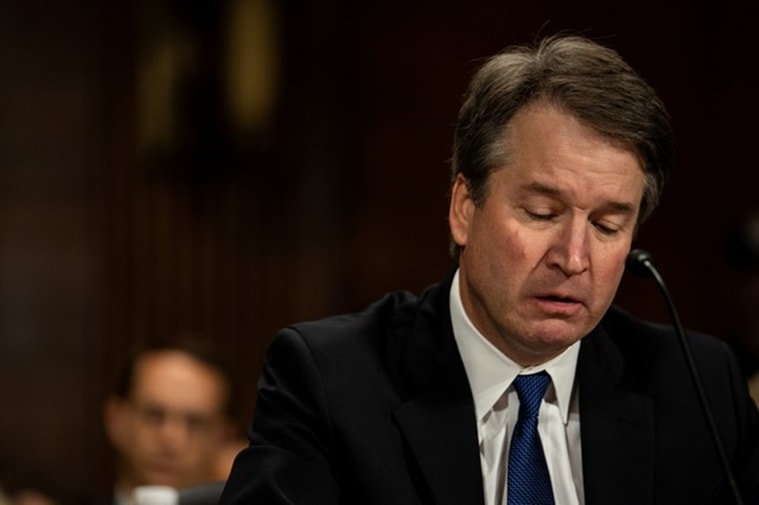
“I believed he was going to rape me,” she said, adding, “It was hard for me to breathe, and I thought that Brett was going to accidentally kill me.”
A few hours later, Kavanaugh, Trump’s nominee to the Supreme Court, delivered a blistering, scorched-earth defence. Speaking through tears at points, he denied he assaulted Blasey — “I am innocent of this charge!” — and denounced a partisan “frenzy” bent on destroying his nomination, his family and his good name.
“This confirmation process has become a national disgrace,” he said in opening remarks written only 24 hours before. “The Constitution gives the Senate an important role in the confirmation process, but you have replaced ‘advice and consent’ with ‘search and destroy.’”
For Kavanaugh, and the nation, the stakes could not be higher: If confirmed, the judge would replace the court’s swing vote — the retired Justice Anthony Kennedy — with a reliable conservative, shaping American jurisprudence and pushing it toward the right for decades to come. Kavanaugh had vigorously denied Blasey’s accusations before the hearing, but he wasted little time in going on the offensive.
Even before excruciating questioning about his drinking, sexual activity and personal behaviour began, it was clear Kavanaugh had little interest in hiding his anger, and he sparred frequently with Democratic senators who he openly accused of an underhanded last-minute attack.
His performance dispensed with the high-minded judicial persona he adopted during his initial confirmation hearings and embraced the partisanship Democrats have accused him of. He repeatedly rebuffed Democrats’ demands for him to request an FBI investigation of the assault allegations against him.
His open attacks on Democrats led members of that party to question his temperament and impartiality as a justice. But he may well have won over the 50 Republicans he needs for his confirmation. It was a striking display by a nominee to the Supreme Court, and it stood in stark contrast to Blasey, who delivered cautious testimony laced with a scientific description of how neurotransmitters code “memories into the hippocampus” to lock trauma-related experiences in the brain.
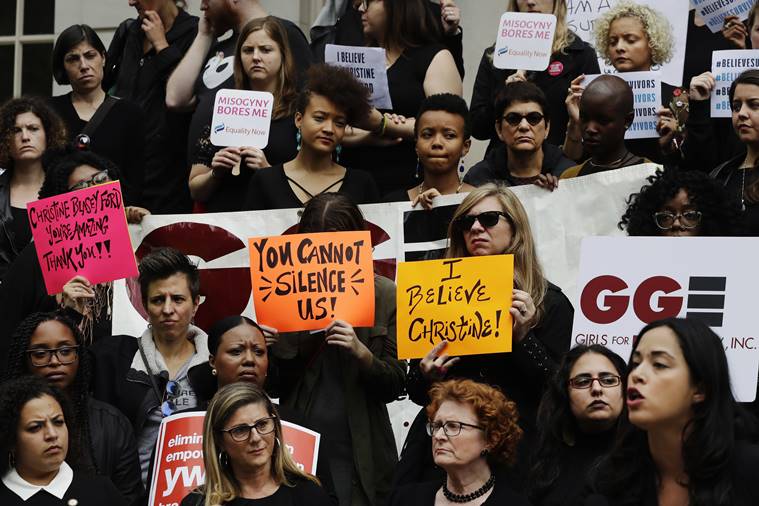
The hearing riveted the nation. Televisions across America — including on the floor of the New York Stock Exchange — were tuned in. Women were calling C-SPAN to share their own experiences of sexual assault. But Kavanaugh’s fate most likely rests with only a handful of undecided senators — Susan Collins of Maine, Lisa Murkowski of Alaska and Jeff Flake of Arizona, all Republicans, chief among them — who had kept their views on the hearing close late into the day.
At least Flake, who sits on the Judiciary Committee, will have to render a decision in short order: Republicans have scheduled a committee vote on Kavanaugh for Friday, and Republican leaders have said they expect the full Senate to vote next week.
As Blasey testified, Republican senators sat in mute witness, forgoing questioning and giving over their time to an outside lawyer, Rachel Mitchell, whose clipped questioning gave the hearing a prosecutorial tone. She seemed to have little success rattling Blasey or undermining her story. But the alternative scenario — Republican male senators handling the questions — may have been worse.
During a break in the hearing, Sen. Orrin Hatch, R-Utah, told reporters: “I don’t think she’s incredible. I think she an attractive, good witness.” Asked for clarity, he said, “In other words, she’s pleasing.” Democrats applauded Blasey’s courage and questioned her gently; when one asked about her strongest memory of the assault, she said it was of Kavanaugh and his friend laughing as they piled on top of her: “The uproarious laughter between the two and having fun at my expense.”
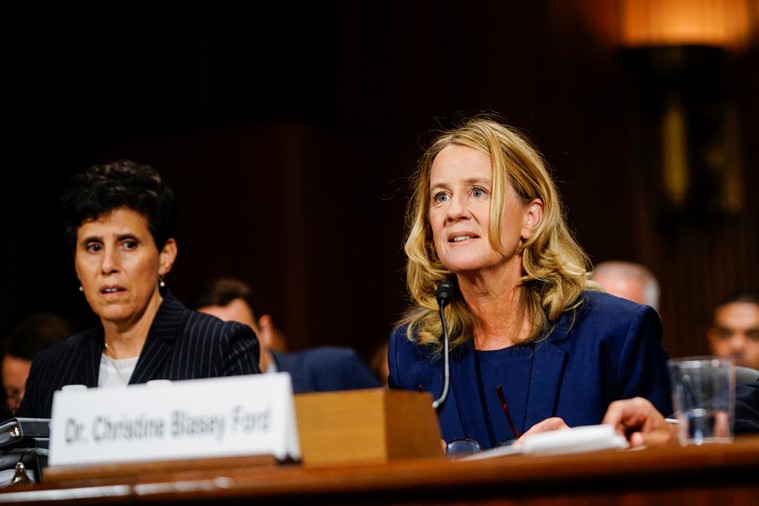
For Blasey, a research psychologist at Stanford University, it was a stunning public appearance by a woman who never intended to become a public figure. Blasey also swatted away any notion that she was mistaking someone else for the young Kavanaugh. She was asked by at least three Democratic senators if she was certain Kavanaugh had assaulted her; three times she said yes.
“I am asking you to address this new defence of mistaken identity directly,” Sen. Dick Durbin, D-Ill., said to her as she testified before the Senate Judiciary Committee. “Dr Ford, with what degree of certainty do you believe Judge Kavanaugh assaulted you?”
Blasey, who sometimes uses her married name, Ford, responded unequivocally. “One hundred per cent,” she said.
Playing out only weeks before midterm elections that have already energized female voters and Democrats, the testimony occurred at the combustible intersection of politics and women’s rights. It evoked strong memories of one of Washington’s most memorable judicial confirmations: the 1991 hearings of Justice Clarence Thomas, who was accused of sexual harassment by law professor Anita Hill.
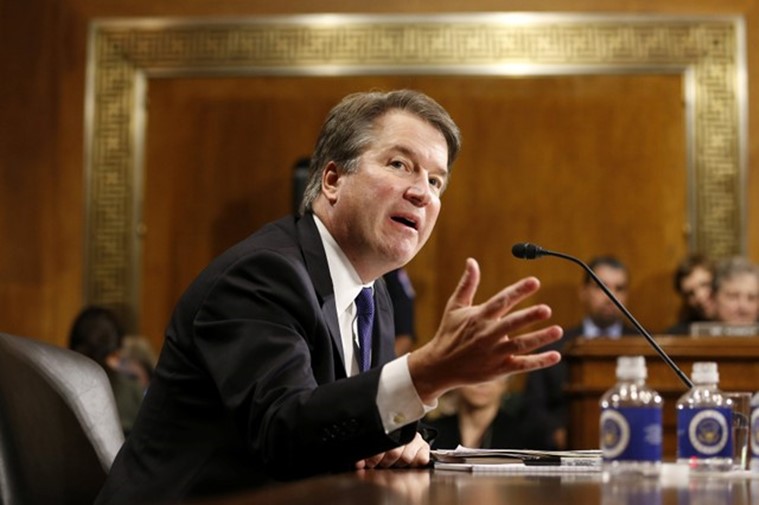
At times it appeared Kavanaugh was channelling Thomas himself, who in 1991 denounced a “high-tech lynching for uppity blacks” at the hands of Democrats. “My family and my name have been totally and permanently destroyed by vicious and false additional allegations,” Kavanaugh told the committee Thursday. But he vowed never to withdraw.
“You may defeat me in the final vote, but you will never get me to quit,” he said. “Never.”
Kavanaugh condemned Democrats, who he said had searched for reasons to sink him weeks before, only to turn to dark accusations. He pointed back at deep-seated liberal grudges, going back to the presidency of Bill Clinton and the victory of Trump as evidence of the animus. And he warned of dire consequences for the federal judiciary in decades ahead if nominees face a path like his. He also directly addressed the portrait painted by Blasey of a drunken young man who tried to rape her and muffle her screams as she pleaded for help.
“I liked beer. I still like beer,” he said. “But I did not drink beer to the point of blacking out, and I never sexually assaulted anyone.”
Behaving like the lawyer he is, Kavanaugh cited evidence — the testimony of other witnesses who said they have no memory of the assault, and his own “very precise” calendars from the summer of 1982 — in an effort to prove that he was never at a party with Blasey and that the assault never happened. He also bluntly dismissed accusations raised by two other women, Deborah Ramirez and Julie Swetnick, who said that they either experienced or witnessed sexual misconduct by a drunken young Kavanaugh in high school or college.
“The Swetnick thing is a joke,” Kavanaugh said under questioning. “That is a farce.”

The facts of Blasey’s story are already well known, but hearing her detail them, with clarity and sometimes confessing that she did not remember specifics, was compelling. Her main challenge was to prove that she is credible, and she appeared to have little trouble doing so. During a break in the hearing, Sen. Chuck Grassley, R-Iowa, chairman of the Judiciary Committee, was asked if he found her credible.
He demurred at first, but then said: “Let me suggest this. I know that we’ve got to take what she says very seriously.”
Blasey told senators that the experience “dramatically altered my life for a long time,” and during her college years, she struggled academically because of it. And it has affected her in sometimes unusual ways, she said. When she and her husband were remodelling their home, she told senators, she insisted on having a second front door — an obvious reference to how she escaped the home where she said the assault occurred, by running down the stairs and out the front door.
The young Kavanaugh described by Blasey and Democrats is a far cry from the image the judge projected at his previous confirmation hearings, where he portrayed himself as a churchgoing father of two daughters and a beloved basketball coach for their teams.
Sen. Dianne Feinstein of California, the top Democrat on the Judiciary Committee, noted that Kavanaugh has previously made statements that he never “drank so much he couldn’t remember what happened.” That statement, the senator said, is at odds with one given by Kavanaugh’s freshman roommate at Yale, who has said that the young Kavanaugh was “frequently, incoherently drunk,” and that when he was, he became “aggressive and belligerent.”
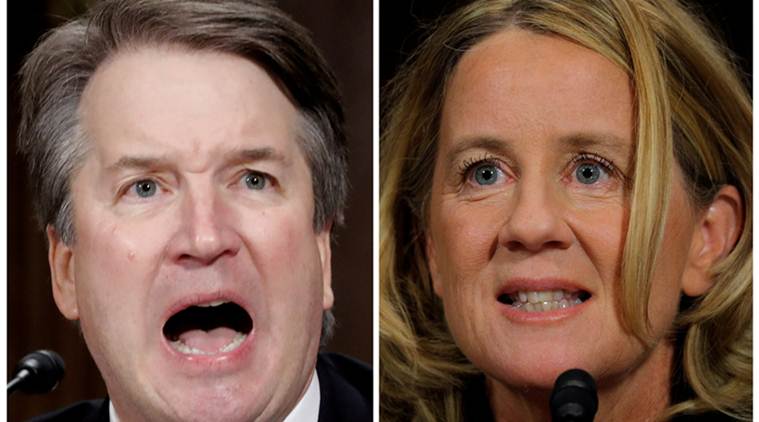
Speaking calmly, Blasey used her opening statement to recount how she met Kavanaugh when their social circles at their elite private schools intersected during her freshman or sophomore year, when she was 14 or 15. She said she had been friendly with a classmate of Kavanaugh’s, who introduced them. “This is how I met Brett Kavanaugh, the boy who sexually assaulted me,” she said.
One evening in the summer of 1982, after a day of diving at the Columbia Country Club in suburban Washington, she attended what she said was “almost surely a spur of the moment” gathering at a nearby home, Blasey told senators. She said it was clear that Kavanaugh and one of his friends, Mark Judge, had been drinking, and that she had only had one beer. When she went up the narrow staircase to use the restroom, she said, she was pushed from behind into a bedroom.
“Brett and Mark came into the bedroom and locked the door behind them,” Blasey said. “There was music playing in the bedroom. It was turned up louder by either Brett or Mark once we were in the room. I was pushed on the bed and Brett got on top of me and he began running his hands over my body and grinding into me. I yelled, hoping that someone downstairs might hear me, and I tried to get away from him, but his weight was heavy.”

She said Kavanaugh had a hard time removing her clothes because she was wearing a one-piece bathing suit underneath. Eventually, after Judge jumped on top of them and they tumbled off the bed, she was able to escape, she said.
“I ran inside the bathroom and locked the door,” Blasey said. “I waited until I heard Brett and Mark leave the bedroom laughing and loudly walked down the narrow stairway, pinballing off the walls on the way down. I waited and when I did not hear them come back up the stairs, I left the bathroom, went down the same stairwell through the living room and left the house. I remember being on the street and feeling this enormous sense of relief that I escaped that house and that Brett and Mark were not coming outside after me.”


Stay updated with the latest - Click here to follow us on Instagram


