Journalism of Courage



 Share
Share


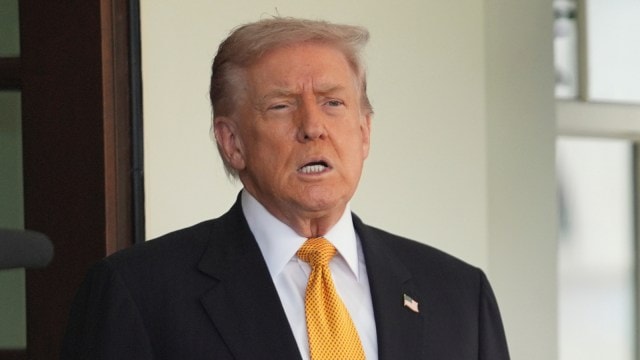 US President Donald Trump speaking at the White House. (Photo: AP)
 Since June, President Donald Trump has sent troops to Los Angeles; Washington, DC; Chicago; Memphis, Tennessee; and Portland, Oregon — often over the objections of state or local leaders.
He said they were needed to protect federal buildings and personnel amid protests and to help fight rampant levels of crime. Officials in those cities, which are mostly heavily Democratic, have said troops were unnecessary and have filed lawsuits to block the deployments, with several of them accusing the Trump administration of exceeding its legal authority.
The guard is a state-based military force, and both state governors and the president have the power to activate its troops under certain circumstances. But when presidents have done so for duty in the United States, it has almost always been at the request of state or local officials.
While many of the legal issues at the center of the cases are similar — for instance, who has the power to call up the guard, and what conditions must be met to do so — they vary based on the circumstances surrounding each deployment. Some court rulings initially sided with state or local governments, only to get overruled on appeal.
The cases remain largely unresolved, and the US Supreme Court may end up ruling on at least one of them, which could affect the outcome of others. Here are the basics of the legal fights and where they stand.
The Trump administration has asked the Supreme Court to intervene after a federal judge temporarily blocked the president’s efforts to deploy the guard in the Chicago area over the objections of Gov. JB Pritzker of Illinois.
Trump moved to send troops from both the Illinois and Texas National Guard to Chicago on Oct. 4, after the Department of Homeland Security requested the force’s presence to protect immigration facilities in the area. Protests at one facility in Broadview, Illinois, had sporadically turned violent, sparking clashes between demonstrators and federal agents.
Chicago and Illinois sued to stop the deployment, and a federal judge, April M. Perry, temporarily blocked guard operations in the area, saying that she had seen no evidence that there was a danger of a rebellion and that the deployment of troops would only inflame tensions. The US Court of Appeals for the 7th Circuit upheld her ruling.
For now, lawyers representing both sides have agreed to indefinitely extend Perry’s temporary restraining order, pending her final decision or a Supreme Court ruling.
The deployment of Guard troops to Portland remains tied up in the courts after divided rulings.
On Friday, a federal judge, Karin Immergut found that Trump had exceeded his authority in sending the National Guard to Portland, permanently blocking the deployments in the city as a response to protests over the immigration crackdown. Before Friday’s ruling, Immergut had issued a temporary restraining order barring the troops’ deployment.
Trump first sent federalized National Guard troops to the city Sept. 28, calling it “war-ravaged” and ordering the forces to protect an immigration facility there amid the protests. State and local leaders in Oregon quickly filed suit.
According to US armed forces law, a president can federalize the National Guard against a governor’s wishes in cases of invasion or rebellion, or when the federal government is otherwise unable to enforce its laws. In her final ruling on the case, Immergut said that the protests at the immigration facility didn’t meet those criteria.
She added that Trump’s actions had violated the US Constitution’s 10th Amendment, which relegates to the states any powers it does not explicitly give to the federal government.
Government lawyers have signaled that if Immergut ruled against them, they would appeal to the US Court of Appeals for the 9th Circuit.
Judges at the 9th Circuit have so far been divided on the Trump administration’s arguments. In October, a three-judge panel from the court initially sided with the Trump administration against Immergut’s temporary restraining order, clearing the way for the deployment to proceed. But the court reversed course a week later, voting to rehear the case before a larger, 11-judge panel.
The 9th Circuit has allowed the military deployment in Los Angeles — the first case of Trump federalizing the National Guard over a Democratic governor’s objections — to continue after a lower court judge initially blocked it.
The Trump administration sent 700 US Marines and 4,000 National Guard troops to Southern California in June after a rash of combative immigration raids set off protests. Now, only a skeleton force of 300 guard troops remains under federal orders that have extended their activation well into next year.
Nearly 200 California troops are in Oregon, as part of the stalled deployment there. A small group has also been sent to Chicago to train other federalized guard troops.
The lawsuit against the deployment has continued despite the reduced troop presence. The 9th Circuit is currently weighing appeals of two separate orders from Judge Charles R. Breyer of the US District Court in San Francisco, one of which found Trump had exceeded his authority in calling up the guard, and another that determined troops had illegally engaged in law enforcement.
Both of those orders have been paused, pending appeal.
A judge has allowed the National Guard deployment in Memphis to proceed over legal challenges from state and local lawmakers, who argue that the governor exceeded his authority in deploying the troops there at Trump’s behest.
Memphis is one of several Democratic-led cities that Trump has targeted in a nationwide crackdown on crime. But unlike other cities, Memphis is in a state led by a Republican governor, Bill Lee, who welcomed the guard deployment.
As such, Lee remains in command of the troops, though their mobilization came at Trump’s urging and will be backed by federal funds.
The state and local lawmakers who sued Lee over the deployment — among them a county mayor — argued that the conditions in Memphis did not amount to “rebellion or invasion,” the criteria to authorize such a deployment established in the state constitution.
So far, a judge has denied the plaintiffs’ initial request for a temporary restraining order against further deployment.
A second lawsuit against the National Guard deployment to Washington, D.C., is pending before a federal district court judge after the city settled a previous lawsuit against the Trump administration.
Arguments around the deployment of the National Guard troops to Washington have largely centered on the Home Rule Act. That law, from 1973, gives the federal government control of the District of Columbia National Guard, while the district is granted local governance rights, such as giving residents the power to elect their own mayor.
Trump first deployed the National Guard to the city in August, as part of a broader crackdown on crime in which he also seized control of the city’s police, citing the Home Rule Act.
Brian Schwalb, the District of Columbia’s attorney general, sued the administration over that takeover. The case was settled after the US attorney general, Pam Bondi, agreed to allow the city’s police chief to maintain control of the police department’s day-to-day operations while taking orders from the mayor.
On Sept. 4, Schwalb filed suit again, this time over the deployment of the National Guard troops, whose numbers peaked at about 2,400 and were supplemented by troops from nine states.
Schwalb argued that the arrival of guard troops without the mayor’s consent had violated Washington’s autonomy under the Home Rule Act. The US District Court for the District of Columbia is weighing his request to block the deployment.
This article originally appeared in The New York Times.
Share