27 min read

© IE Online Media Services Pvt Ltd



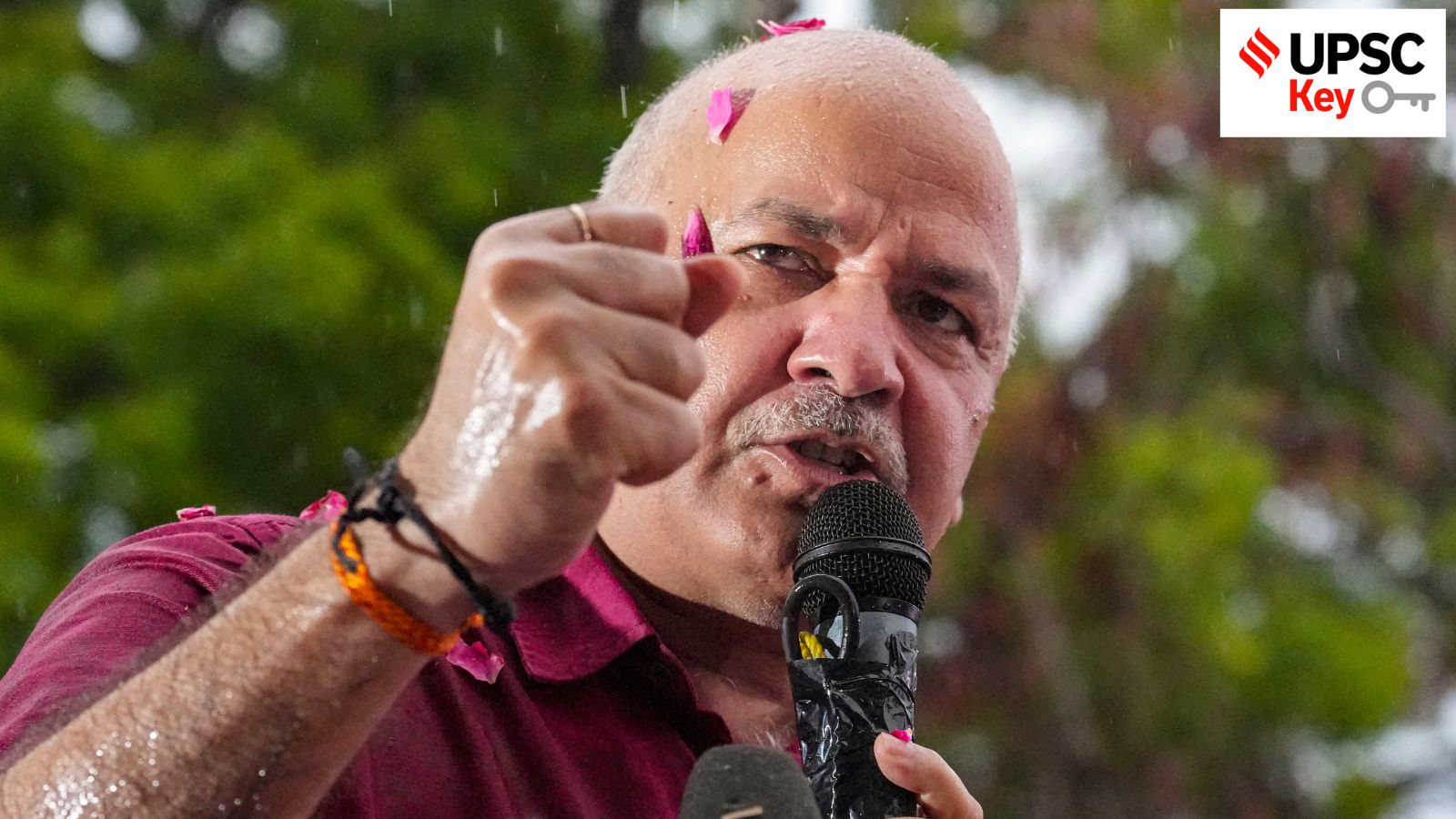 AAP leader Manish Sisodia addresses supporters after his release from Tihar jail following his bail granted by the Supreme Court in corruption and money laundering cases linked to the alleged Delhi excise policy scam, in New Delhi, Friday, Aug. 9, 2024. Know more in our UPSC Key. (PTI Photo/Kamal Kishore).
🚨 Attention: UPSC Key is now all 7 Days a Week!🚨
Important topics and their relevance in UPSC CSE exam for August 10, 2024. If you missed the August 9th, 2024 UPSC CSE exam key from the Indian Express, read it here.
🚨 The Indian Express UPSC Essentials brings to you the July edition of its monthly magazine. Click Here to read. Share your views and suggestions in the comment box or at manas.srivastava@indianexpress.com🚨
UPSC Syllabus:
Preliminary Examination: Current events of national and international importance
Mains Examination: GS-II: Polity, Constitution
What’s the ongoing story- The Supreme Court granted bail Friday to former Delhi Deputy Chief Minister Manish Sisodia in the CBI and ED cases against him for his alleged role in the Delhi excise policy matter, saying “there is not even the remotest possibility of the trial being concluded in the near future”.
Prerequisites:
— What is the Prevention of Money Laundering Act (PMLA), of 2002?
— What is Article 21?
— What are the bail provisions under PMLA?
Key takeaways:
— “In our view, keeping the appellant behind the bars for an unlimited period of time in the hope of speedy completion of trial would deprive his fundamental right to liberty under Article 21 of the Constitution. As observed time and again, prolonged incarceration before being pronounced guilty of an offence should not be permitted to become punishment without trial,” the bench said.
— Section 45 of the Prevention of Money Laundering Act, 2005 prescribes a rather high bar for granting bail. The negative language in the provision itself shows that bail is not the rule but the exception under PMLA and both trial and constitutional courts are required to apply a ‘triple test’ to grant bail.
— These three conditions are: (i) that there are “reasonable grounds for believing that (the accused) is not guilty of such offence”; (ii) that “he is not likely to commit any offence while on bail”; and (iii) that the accused is not a flight risk.
For Your Information:
— Menaka Guruswamy writes: “This judgment is notable for three reasons. First, it reaffirms and reminds all courts in the country of the age-old principle that bail is the norm and jail, the exception.
— “Second, the right to speedy trial must be respected and that keeping an accused behind bars for an unlimited period of time while awaiting trial violates his or her right to life under Article 21 of the Constitution.”
— “Finally, the right to bail in cases of delay coupled with incarceration for a long period should be read into the bail provisions of the Code of Criminal Procedure, 1972 (CrPC) and the Prevention of Money Laundering Act, 2002 (PMLA).”
— “The Sisodia judgment will go a long way in protecting the rights to life and liberty guaranteed by our Constitution. It reasserts that cardinal principle that is the backbone of the criminal justice system — bail is the norm and jail the exception.”
Points to Ponder:
— What is the Enforcement Directorate’s (ED) role in money laundering cases?
— What are the recent amendments to the PMLA?
— What are the criticisms of the PMLA?
— How is Anticipatory Bail different from the Regular Bail or interim bail?
Post Read Question:
Prelims
(1) Consider the following statements:
1. The PMLA was enacted by the Indian Parliament under Article 253.
2. Section 45 of the PMLA deals with the provision of bail.
How many of the above statements is/are correct?
(a) 1 only
(b) 2 only
(c) Both 1 and 2
(d) Neither 1 nor 2
Mains
Discuss how emerging technologies and globalisation contribute to money laundering. Elaborate measures to tackle the problem of money laundering both at national and international levels. (UPSC CSE 2021)
Other Important Articles Covering the same topic:
SC bail to Sisodia: Why Bench said trial delay, bail right must be read into PMLA Sec 45
How anti-money laundering law came to have a vast scope, granting police powers to ED
UPSC Syllabus:
Preliminary Examination: Current events of national and international significance
Mains Examination: GS-II: Constitution, Government policies and interventions for development in various sectors and issues arising out of their design and implementation.
What’s the ongoing story- Days after the Supreme Court called for exclusion of the creamy layer from the ambit of Scheduled Caste/Scheduled Tribe reservation, the Union Cabinet Friday turned it down, saying “there is no provision for a creamy layer in SC/ST reservation” in “the Constitution given by B R Ambedkar”.
Prerequisites:
— What is the subcategorisation of the SC/ST?
— What are Articles 46 and 341?
— What is the Presidential List of Scheduled Caste?
— What are the constitutional provisions for the protection of SC and ST?
Key takeaways:
— On August 1, a seven-judge Constitution Bench of the Supreme Court, in a landmark 6-1 majority verdict, ruled that Scheduled Castes do not constitute a socially homogeneous class and can be sub-classified by States for the purpose of providing reservation to the less privileged among them. Four judges favoured excluding the creamy layer from the SC/ST quota.
— The Ideas Page : Sub-quota red herrings
— Yogendra Yadav, Prannv Dhawan and Shivam Mogha write: “The sub-quota debate has begun on a false note. Instead of addressing some real problems and genuine apprehensions with the Supreme Court judgment, the debate has been distracted by red herrings. It needs more light than heat.”
— “The biggest problem is that many supporters of social justice have assumed, wrongly, that the Supreme Court verdict is about diluting the existing system of reservation.”
— “CJI Chandrachud’s elaboration of the principle of “substantive equality” takes forward the legacy of the NM Thomas judgment and would act as a bulwark against any future attempt to dismantle affirmative action in the name of merit.”
— “There are some specific but equally misplaced criticisms. First, there is a legal-constitutional objection that the court has usurped the domain of Parliament… The court has neither carried out the sub-division nor even mandated it.”
— “The second criticism, about the SC passing such a major order without authentic empirical evidence, is factually incorrect. The Census of India provides authentic and granular data not just of the head count, but also of the occupation, family assets and educational attainments of each of the Scheduled Castes and Tribes (but not for the rest of the population) at every administrative level.”
— “The conclusion is evident: There is nothing homogeneous about the educational disadvantage of Dalits communities…To be sure, this inequality is not because of any oppression or discrimination by the relatively less disadvantaged Dalit communities, but it needs a redressal anyway.”
— “Finally, there is the political objection, that sub-classification would create political rift within Dalits. Frankly, the ground reality is that the social life and political expression of diverse SC jatis is already fragmented and fractured. In fact, the only way to create unity within and between categories is by creating broad, consociational arrangements.”
— “Once we set aside these misconceived criticisms, we can confront some real apprehensions and difficulties that need to be dealt with. First, there is a real possibility that the licence to sub-classify may be used as a tool of political expediency, if not as a weapon to punish the communities not aligned with the ruling party.”
— “Second, we cannot rule out the possibility of sub-classification being used as a ploy to reduce the number of eligible candidates for higher jobs and using the “Not Found Suitable” route to first keep the positions vacant and then transfer them to the “unreserved” category.”
— “Third, there are multiple problems with the sudden application of the “creamy layer” doctrine to the SC and ST. One, the issue of “creamy layer” was not framed by the court and the litigants did not get a fair chance to contest this point.”
— “Finally, there is the issue of the impact of this verdict on the Scheduled Tribes, while the case was argued substantively on the social reality of the Scheduled Castes. In one sense this was unavoidable: There cannot be two different interpretations of Article 341 and 342, one for SCs and another for STs.”
— “Instead of protesting against the idea of the sub-quota, the politics and policies of social justice should focus on correcting some flaws in the present judgment and move on to the real long-term issues: Enhancing SC/ST reservation as per the current population of SCs and STs, removal of the 50 per cent ceiling and deepening and broadening of the social justice apparatus beyond public sector jobs.”
— The Ideas Page: Social Injustice
— Abdul Khaliq writes: “The Supreme Court verdict permitting sub-classification… is deeply flawed. It may be used to dilute affirmative action and pave the way to do away with reservation.”
— “The argument that the creamy-layer concept is applicable to OBCs and hence should logically be extended to Dalit communities is akin to equating chalk with cheese. The OBCs, as a group, are in a different stratosphere, way above the SCs/STs on the economic ladder, and more particularly, in social standing. Today, the Dalit, stuck at the bottom of our iniquitous social hierarchy, would gladly exchange places with a member of any other group. Eliminating the creamy layer from the purview of reservation will only make matters worse for Dalits.”
— “It is bizarre that in a country riddled with the most flagrant and inhuman inequalities, only the alleged inequality within the most vulnerable group — the Dalit community — is being targeted for correction.”
— “It will shatter whatever solidarity exists among the SCs. The Supreme Court has, in effect, decreed that the long-suffering victims of the caste system should themselves be compartmentalised into different subsets, creating another hierarchy and caste system. This will drive a wedge between the different sub-groups.”
— “Caste is still deeply embedded in our culture. The Court verdict ignores the complexities and rationale behind reservation for SCs/STs. The raison d’etre for granting reservation is not merely economic backwardness… but untouchability and its unremitting grip on our society.”
— “So ingrained is caste that the Dalit, irrespective of economic advancement or a government job, is still socially handicapped on account of his origins, the so-called “creamy layer” included.”
— “The judgment violates Article 341 of the Constitution, which authorises the President to issue the notification specifying the caste categories deemed to be Scheduled Castes. Article 341(2) allows Parliament to amend by law such notification to include or exclude any caste or group within any caste…”
— “By permitting the states to tamper with and modify the notification and by allowing sub-classification and “varied” treatment within the same class of Scheduled Castes notified under Article 341, the judgment is unquestionably unconstitutional.”
Points to Ponder:
— What are the challenges faced by the SC and ST community?
— What are the reasons for the backwardness of the SC/ST community even after more than 70 years of independence?
— What are the arguments in favour and against the subcategorisation of SC/ST?
— What are the initiatives taken by the government for the socio-economic improvement of the SC/ST community?
Post Read Question:
Prelims
(2) If a particular area is brought under the Fifth Schedule of the Constitution of India, which one of the following statements best reflects the consequence of it? (UPSC CSE 2022)
(a) This would prevent the transfer of land of tribal people to non-tribal people.
(b) This would create a local self-governing body in that area.
(c) This would convert that area into a Union Territory.
(d) The State having such areas would be declared a Special Category State.
Mains
What are the two major legal initiatives by the State since Independence addressing discrimination against Scheduled Tribes (STs). (UPSC CSE 2017)
UPSC Syllabus:
Preliminary Examination: Current events of national and international importance
Mains Examination: GS-II, III: Government policies and interventions, IPR, Economy
What’s the ongoing story- “Google is a monopolist, and it has acted as one to maintain its monopoly,” Judge Amit Mehta of the US District Court of Columbia said in a landmark verdict on Monday. He held that tech-giant Google violated antitrust laws to maintain a monopoly over “general search services” and “general search text ads.”
Prerequisites:
— What is the role of the Competition Commission of India (CCI)?
— What is the Draft Competition Bill, 2024?
— What are anti-competitive practices?
Key takeaways:
— The Justice Department and several states had sued Google for illegally cementing its dominance, in part, by annually paying the likes of Apple and Samsung billions of dollars to have Google automatically handle search queries on smartphones and web browsers.
— In India too, Google has faced allegations of anti-competitive practices. On Monday, the Alliance of Digital India Foundation (ADIF) filed a complaint claiming that Google has indulged in anti-competitive practices in the online advertising market.
— Moreover, in October 2022, the Competition Commission of India (CCI) — which decides disputes relating to practices that may harm competition in Indian markets — imposed a monetary penalty of Rs 1337.76 Crores on Google.
— It held that mandatory pre-installation of the Google Mobile Suite (Google Search, YouTube, GMail, etc.) on Android devices with no option to uninstall the apps is an abuse of Google’s dominant position in the market.
— Judge Mehta ruled that a consequence of Google’s position as the default General Search Engine (GSE) is that it now operates at a scale that disincentivises competitors from emerging in the same space.
— The Ministry of Corporate Affairs released the Draft Competition Bill, 2024, in March which is geared towards preventing tech companies of this scale — termed Systemically Significant Digital Enterprises (SSDEs) — from participating in anti-competitive practices.
— The Bill imposes restrictions on SSDEs, including barring them from favoring their own products and services, and barring them from using or sharing users’ personal data without their consent.
— Big tech companies have objected to the Bill, saying that it imposes significant compliance burdens on them which would shift focus from innovation and research to pre-emptively ensuring that companies do not engage in anti-competitive practices.
For Your Information:
— The draft law, called the Digital Competition Bill, 2024, also has provisions to set presumptive norms to curb anti-competitive practices before they actually take place, and promises to impose heavy penalties — which could amount to billions of dollars — for violations.
— The proposal is similar to the EU’s Digital Markets Act (DMA), which went into complete effect earlier this year, and requires large tech firms like Alphabet, Amazon and Apple to open their services, and not favour their own at the expense of rivals.
Points to Ponder:
— What are the concerns related to the Digital Competitive Bill?
— Why government need to curb anticompetitive practices?
— What are legislatures enacted by international entities to curb anti-competitive practices?
Post Read Question:
Why has India proposed the Digital Competition Bill, of 2024? Discuss the potential benefits and challenges of this bill for tech companies in India.
Other Important Articles Covering the same topic:
What the draft Digital Competition Bill proposes, why Big Tech opposes it
UPSC Syllabus:
Preliminary Examination: Current events of national and international importance
Mains Examination: GS-II: International Relations
What’s the ongoing story- In 2009, Muhammad Yunus said at The Indian Express Idea Exchange that he had recently refused an invitation to head a caretaker government [during 2006-09 when there was no elected government in Bangladesh]… A decade and a half later, the 84-year-old “father of microfinance” took oath as Chief Adviser to the interim government of Bangladesh — presumably on his own terms. The young protesters who had brought down Sheikh Hasina’s 15-year regime wanted him to take charge of the country.
Prerequisites:
— Who is Muhammad yunus?
— What is the ongoing crisis in Bangladesh?
Key takeaways:
— The Grameen Bank Story: In 1976, Grameen Bank was launched as a research project in a village in Chittagong. It became a full-fledged bank in 1983, aiming to provide collateral-free, low-interest credit to the poor, women, and socially and economically marginalised sections. Loans were disbursed to groups of borrowers, with the whole group acting as co-guarantors.
— As of June 2024, Grameen Bank operates in 81,678 (around 94%) of villages in Bangladesh, serving almost 45 million people through 10.61 million borrower members, 97% of whom are women.
— The Grameen initiative has spread beyond microfinance, and today has a number of for-profit and nonprofit ventures, targeted at the rural poor in sectors ranging from fisheries to software, education to telecom, FMCG to energy. Yunus is seen as a pioneer for “social businesses”.
— The Grameen Bank model has been replicated across the developing world as a way to operate sustainable development initiatives with women at their centre.
— But this model has its critics. Several economists say microfinance traps the poor in a cycle of debt from which they struggle to get out. In the end, all the negatives of traditional lending afflict microfinance too, from aggressive debt collection tactics to high interest rates.
— A difficult road lies ahead for Yunus. Following Hasina’s ouster, Bangladesh has seen a spate of attacks on minorities, and escalating sectarian tensions. In his first comments after arriving in Dhaka from abroad, Yunus described Bangladesh as a “family” and said the first task was to reunite it.
For Your Information:
— That the Indian ambassador to Dhaka, Pranay Verma, attended the swearing-in ceremony of Muhammad Yunus, the head of the interim government, should send a positive signal to the people of Bangladesh and calm the over-the-top strands in the discourse in Delhi about the tumultuous developments next door.
— The Indian leadership has rightly pointed to the importance of safeguarding the rights of minorities amidst widespread violence, especially against the Hindu community, in Bangladesh. — But Delhi should resist the temptation of focusing exclusively on the plight of the Hindu minority in a way that could complicate the extraordinary challenges at hand in Bangladesh and cloud the prospects for relations between India and the new regime.
— Delhi must focus on understanding the sources of the revolution led by the student movement in Bangladesh. It needs to reach out to the leaders of the student movement, get a sense of what they hope to achieve. At the same time, the government must order an internal review on why and how the government agencies turned a blind eye to the gathering political storm in Bangladesh.
Points to Ponder:
— What steps need to be taken by India to ensure peace and stability in the neighbourhood?
— What are the significance and criticism of the Grameen Bank?
— What is the importance of micro-financing?
Post Read Question:
Prelims
(3). Exercise SAMPRITI is a military exercise between India and which of the following nations?
(a) Bangladesh
(b) Sri Lanka
(c) Nepal
(d) Thailand
Mains
Analyze internal security threats and transborder crimes along Myanmar, Bangladesh and Pakistan borders including Line of Control (LoC). Also discuss the role played by various security forces in this regard. (UPSC CSE 2018)
Other Important Articles Covering the same topic:
Express View: Delhi must reach out to Dhaka
UPSC Syllabus:
Preliminary Examination: Current events of national and international importance
Mains Examination: GS-II: Constitution, Polity
What’s the ongoing story- The Centre Friday expanded the ambit of rules issued under the Citizenship (Amendment) Act to facilitate grant of Indian citizenship to persecuted minorities coming from Bangladesh, Pakistan and Afghanistan.
Prerequisites:
— What is CAA?
— What is the Inner Line Permit?
— What are the constitutional provisions related to citizenship in India?
Key takeaways:
— The Ministry of Home Affairs said any document issued by the Central or a state government or a quasi-judicial body in India proving that either of the parents, grandparents or great-grandparents is or had been a citizen of one of the three countries will be acceptable.
— The Ministry clarification came after many applicants seeking Indian nationality under the Citizenship (Amendment) Act, 2019, were said to be facing difficulties due to a particular clause of the Citizenship (Amendment) Rules, 2024.
— The CAA was enacted in December 2019 for granting Indian nationality to persecuted Hindu, Sikh, Jain, Buddhist, Parsi and Christian migrants from Afghanistan, Bangladesh and Pakistan who came to India on or before December 31, 2014.
— Following the enactment, the CAA got the President’s assent but the rules under which Indian citizenship would be granted were issued only on March 11 this year, after over a delay of four years.
For Your Information:
— The Citizenship (Amendment) Bill, which sought to fast-track the process of granting Indian citizenship to Hindus, Sikhs, Buddhists, Jains, Parsis and Christians – but not Muslims – who migrated to India owing to religious persecution in Pakistan, Afghanistan and Bangladesh, was passed by Lok Sabha on December 9, 2019, and Rajya Sabha two days later.
Points to Ponder:
— How is citizenship lost in India?
— What are the significance and concerns related with the CAA?
— Why Indian constitution has accepted for a single citizenship?
— How is citizenship acquired in India?
(Thought Process: The Citizenship Act of 1955 has provided five ways of acquiring citizenship in India- birth, descent, registration, naturalisation, and incorporation of territory.)
Post Read Question:
(4) With reference to India, consider the following statements: (UPSC CSE 2021)
1. There is only one citizenship and one domicile.
2. A citizen by birth only can become the Head of State.
3. A foreigner once granted citizenship cannot be deprived of it under any circumstances.
Which of the statements given above is/are correct?
(a) 1 only
(b) 2 only
(c) 1 and 3
(d) 2 and 3
Other Important Articles Covering the same topic:
CAA: Issues in the legal challenge to the law
UPSC Syllabus:
Preliminary Examination: Current events of national and international importance
Mains Examination: GS-II: Government policies and interventions
What’s the ongoing story- In a major push for rural and urban housing, the Centre on Friday gave its nod for three crore additional houses under the Pradhan Mantri Awaas Yojana (PMAY).
Prerequisites:
— What is the Pradhan Mantri Awaas Yojana (PMAY)?
— What are the components of PMAY?
Key takeaways:
— Of the 3 crore houses, two crore will be constructed under the Pradhan Mantri Awaas Yojana-Gramin (PMAY-G) and one crore under the PMAY-Urban.
— The Centre had launched the PMAY-G from April 2016 with an aim to construct 2.95 crore houses by March 2024.
— The PMAY-Urban 2.0 scheme aims to construct 1 crore new homes through four verticals — beneficiary-led construction, in which financial assistance would be provided to EWS families to build homes on their own land; affordable housing in partnership, which will give aid to EWS families buy houses constructed by states or private agencies; affordable rental housing, in which rental housing units for industrial workers and working women hostels will be made; and interest subsidy scheme, in which EWS, LIG and MIG families taking loans of up to Rs 25 lakh will get 4% interest subsidy.
For Your Information:
— The government had launched the Pradhan Mantri Awas Yojana (Urban) on June 25, 2015, to provide pucca houses to all eligible beneficiaries by 2022. The PMAY-U is one of the two schemes envisioned under the PMAY-U. It is focused on the urban areas, while the other one—PMAY-G—is for rural areas.
— The scheme has four verticals: “In-situ” Slum Redevelopment (ISSR); Credit Linked Subsidy Scheme (CLSS); Affordable Housing in Partnership (AHP) and Beneficiary-led individual house construction/enhancements (BLC)
Points to Ponder:
— Why PMAY was introduced?
— What are the challenges associated with PMAY?
— What are the other schemes launched by the government to provide affordable housing to all?
Post Read Question:
Discuss the various social problems which originated out of the speedy process of urbanization in India. (UPSC CSE 2013)
Other Important Articles Covering the same topic:
Explained: What is PMAY-U? Who can avail it?
UPSC Syllabus:
Preliminary Examination: Current events of national and international importance
Mains Examination: GS-II: Government policies and interventions
What’s the ongoing story- The Cabinet on Friday approved the Clean Plant Programme (CPP), with an outlay of Rs 1,766 crore, under the Mission for Integrated Development of Horticulture (MIDH).
Prerequisites:
— What is the Mission for Integrated Development of Horticulture (MIDH)?
— What is the Clean Plant Programme (CPP)?
Key takeaways:
— An official statement read: “With a substantial investment of Rs 1,765.67 crore, this pioneering initiative is set to revolutionise the horticulture sector in India, as well as expected to set new standards for excellence and sustainability…”
— The CPP will provide access to virus-free and high-quality planting materials, leading to improved crop yields and income opportunities for farmers.
— The CPP will have three components — Clean Plant Centres (CPCs), certification and legal framework, and enhanced Infrastructure. “The programme will be implemented by the National Horticulture Board in association with the Indian Council of Agricultural Research.”
For Your Information:
— Highlight from the Union Budget 2024 on Agriculture
— Allocation: Agriculture and allied sectors were allocated 1.52 Lakh Crore in the Union Budget 2023-24.
— Release of new varieties: The new 109 high-yielding and climate-resilient varieties of 32 field and horticulture crops will be provided to the farmers.
— Natural Framing: In the next two years, 1 crore farmers across the country will be initiated into natural farming. The government will establish 10,000 need-based Bioinput research center.
— Digital Public Infrastructure (DPI) for Agriculture: The government in partnership with states will facilitate implementation of DPI in three years. The government will enable Jan Samarth-based Kisan Credit cards in five states.
— The CDP-SURAKSHA is an initiative of the central government to promote horticulture crops. SURAKSHA stands for “System for Unified Resource Allocation, Knowledge, and Secure Horticulture Assistance.” The platform will allow an instant disbursal of subsidies to farmers in their bank account by utilising the e-RUPI voucher (more on this later) from the National Payments Corporation of India (NPCI).
Points to Ponder:
— What is the status of horticulture farming in India?
— What are the challenges faced by the horticulture sector?
— What are the government initiatives to improve horticulture?
Post Read Question:
Assess the role of National Horticulture Mission (NHM) in boosting the production, productivity and income of horticulture farms. How far has it succeeded in increasing the income of farmers? (UPSC CSE 2018)
Other Important Articles Covering the same topic:
What is CDP-SURAKSHA, govt’s new digital platform to disburse subsidies to horticulture farmers?
UPSC Syllabus:
Preliminary Examination: Current events of national and international importance
Mains Examination: GS-II: International Relations
What’s the ongoing story- In the first high-level visit to Maldives since President Mohamed Muizzu came to power, External Affairs Minister S Jaishankar on Friday met Maldives Foreign minister Moosa Zameer in Male to discuss all areas of bilateral cooperation to deepen the partnership.
Prerequisites:
— What is the ‘Neighborhood First’ policy?
— What is Vision SAGAR?
Key takeaways:
— “Maldives is one of the cornerstones of our ‘Neighborhood First’ policy, it is also one of our Vision SAGAR, as well as of our commitment to the Global South…” Jaishankar said on Friday.
— Jaishankar said Maldives occupies an important place in India’s vision of ‘Neighbourhood First’ and that he was looking forward to “fruitful engagements” with the leadership of the Maldives.
— The ties between India and the Maldives came under severe strain since Muizzu, known for his pro-China leanings, took charge of the top office in November 2023.
— He had demanded the withdrawal of Indian military personnel from his country. Subsequently, the Indian military personnel were replaced by civilians by May 10, the mutually agreed date.
For Your Information:
— India has been a significant contributor to Maldives’ tourism industry for many years, especially during the pandemic. Currently, it ranks sixth in our top 10 markets this year. The top market for the Maldives currently is China.
— India and Maldives have signed an agreement to introduce the Unified Payments Interface in the archipelago nation, which will have a “very positive” impact on its tourism sector, External Affairs Minister S Jaishankar has said.
Points to Ponder:
— What is the ‘India Out’ campaign in the Maldives?
— What is the significance of Maldives for India?
— Why is Maldives important for Global South Cooperation?
— What are the challenges in the India-Maldives relationship?
Post Read Question:
Prelims
(5) India and Maldives are separated by which of the following channels?
(a) Seven Degree Channel
(b) Eight Degree Channel
(c) Nine Degree Channel
(d) Ten Degree Channel
Mains
In light of the Maldives’ growing closeness with China, evaluate the necessary steps India must take to reinforce its historical bonds with Maldives and effectively implement its ‘Neighbourhood First Policy’ to mitigate potential security challenges.
Other Important Articles Covering the same topic:
Maldives hopes to make India one of its top 3 tourism markets again
India to introduce UPI payment service in Maldives
| Answer Key |
| 1. (c) 2. (a) 3. (a) 4. (a) 5. (b) |
Subscribe to our UPSC newsletter and stay updated with the news cues from the past week.
Stay updated with the latest UPSC articles by joining our Telegram channel – Indian Express UPSC Hub, and follow us on Instagram and X.
https://www.youtube.com/watch?v=NLF5t533dYo?si=jKB3XGA8LG4TabZY&w=560&h=315

Read UPSC Magazine