30 min read

© IE Online Media Services Pvt Ltd



 Same photos provided for multiple beneficiaries in Bihar and Uttar Pradesh. Know more in our UPSC Key. (Photo: CAG Report | Enhanced for clarity with AI)
Important topics and their relevance in UPSC CSE exam for December 20, 2025. If you missed the December 19, 2025, UPSC CSE exam key from the Indian Express, read it here.
Syllabus:
Preliminary Examination: Current events of national and international importance
Mains Examination: General Studies-II: Government policies and interventions for development in various sectors and issues arising out of their design and implementation
What’s the ongoing story: The use of “11111111111” as the bank account number; the same photograph used for multiple beneficiaries; payouts pending for more than 34 lakh candidates; and shuttered training centres.
Key Points to Ponder:
— What is the Pradhan Mantri Kaushal Vikas Yojana (PMKVY) scheme?
— What is the role and function of the CAG?
— What are the various schemes launched by the government for skill development?
— What is the Skill India Mission?
— What are the challenges faced in the implementation of the PMKVY?
— What are the other skill development schemes of the government?
Key Takeaways:
— These are some of the glaring irregularities identified by the Comptroller and Auditor General of India (CAG) in the implementation of the Centre’s flagship skills training initiative, Pradhan Mantri Kaushal Vikas Yojana (PMKVY), in three phases from 2015-2022.
— The CAG findings were detailed in an audit report tabled in the Lok Sabha on Thursday. They are significant because PMKVY has been one of the major interventions by the Government to provide skills training to combat joblessness among youth — according to available data, the unemployment rate was 15 per cent in the age group of 15-29 years in May 2025.
— The skills scheme was launched in July 2015 to enable a large number of youth to take up industry-relevant skill training and certification.
— The anomalies in bank account numbers recorded on the Skill India Portal (SIP) were found during the CAG’s audit of candidates’ electronic identities and contact details.
— The CAG noted that its “analysis of account number field in PMKVY 2.0 and 3.0 data did not provide adequate assurance about the identity of participants of this scheme”.
— The report also detailed the ministry’s explanation in May 2023 “that initially account details was a mandatory field on SIP, but it was made non-mandatory later due to problems at ground level implementation”.
— The CAG also found instances of skill certification by employers who do not merit classification as ‘Best-in-Class’, the report said. It also noted discrepancies in photographic evidence of training conducted as the same photos were provided for multiple beneficiaries in UP, Bihar, Maharashtra and Rajasthan.
— According to the Ministry, “Face-authentication and geo-tagged attendance have been mandated; a live attendance dashboard has been operationalised; and Central Communication Layer (CCL)–based candidate feedback mechanisms are being used for ongoing course correction.”
Do You Know:
— The Skill India Mission today supports all flagship schemes of the government, such as PM Kaushal Vikas Yojana (PMKVY), PM Vishwakarma, PM JANMAN Yojana, Lakhpati Didi, Solar Mission, Green Hydrogen Mission and AI for India.
— Since its inception in 2015, the Mission has equipped millions of young Indians with the skills needed to thrive in a rapidly evolving job market.
— PMKVY is focused on short-term skill development training. It focuses on the rural youth and has trained over 1.49 crore candidates.
— The Skill India Digital Hub (SIDH) — a platform for all skilling requirements— has been envisaged as an information repository for all government initiatives related to skilling and entrepreneurship.
Other Important Articles Covering the same topic:
📍Corruption cloud: Skill Ministry blacklists 178 training partners
📍Skilling India — for the world
Previous year UPSC Prelims Question Covering similar theme:
(1) With reference to Pradhan Mantri Kaushal Vikas Yojana, consider the following statements: (UPSC CSE 2018)
1. It is the flagship scheme of the Ministry of Labour and Employment.
2. It, among other things, will also impart training in soft skills, entrepreneurship, and financial and digital literacy.
3. It aims to align the competencies of the unregulated workforce of the country to the National Skill Qualification Framework.
Which of the statements given above is/are correct?
(a) 1 and 3 only
(b) 2 only
(c) 2 and 3 only
(d) 1, 2 and 3
Previous year UPSC Mains Question Covering similar theme:
“Demographic Dividend in India will remain only theoretical unless our manpower becomes more educated, aware, skilled and creative.” What measures have been taken by the government to enhance the capacity of our population to be more productive and employable? (UPSC CSE 2016)
Syllabus:
Preliminary Examination: Current events of national and international importance
Mains Examination: General Studies-II: Government policies and interventions for development in various sectors and issues arising out of their design and implementation
What’s the ongoing story: Jean Drèze writes: Twenty years ago, India acted as a vishwaguru (world teacher) of sorts by launching the National Rural Employment Guarantee Act. The idea was not entirely new. India had a long history of using open-ended public works as a means of crisis relief, and Maharashtra had already shown the way with its employment guarantee scheme from the early 1970s onwards. But NREGA took the idea much further and became an inspiration for the world.
Key Points to Ponder:
— What are the features of the VB-M RAM G Bill 2025?
— What was the objective of launching MGNREGA?
— What are the concerns related to the new Bill?
— How is it different from the MGNREGA?
— How has the financial cost of the scheme been changed in the new Bill, and how is it going to impact the Centre-state relationship?
Key Takeaways:
— Six years later, in 2011-12, important evidence emerged that the programme was doing quite well. At that time, MGNREGA (as it was renamed by then) officially generated more than 200 crore person-days of employment per year for 50 million rural households.
— Nearly half of the workers were women, and more than 40 per cent belonged to a Scheduled Caste or Scheduled Tribe.
— These official figures were largely corroborated by independent household surveys, including the 68th Round of the National Sample Survey and especially the second Indian Human Development Survey. Rural wages were rising at an unprecedented rate.
— Later on, implementation hurdles and blunders mushroomed. Centralisation, technocracy, underfunding, delays in wage payments, failure to act on corrupt elements and other problems took a heavy toll. Today, MGNREGA is a pale shadow of its former self, despite some revival during the Covid-19 crisis
— Most of the implementation issues can be resolved, but this calls for renewed political commitment to MGNREGA. The VB-M RAM G Bill 2025 goes the other way: It seeks to replace this historic Act with a centrally-directed scheme.
— Under this Bill, the Centre has full powers and no serious obligations. All the obligations (providing employment, paying the unemployment allowance, compensating workers for delayed payments, and even ensuring adequate funding) have been palmed off to state governments.
— The Centre’s discretionary powers begin with the power to decide where and when the scheme is to be implemented. This “switch-off clause” defeats the purpose of the employment guarantee. It is like providing a work guarantee without any guarantee that the guarantee applies.
— The central government also has discretionary power over financial allocations. Until now, MGNREGA was based on the principle of open-ended funding from the Centre. Under the new scheme, the central government is free to set “state-wise normative allocations”. Within those allocations, there will be 60/40 cost-sharing between the Centre and states. Beyond that, all the funding is supposed to come from the states.
— The new financial pattern, like the switch-off clause, pulls the teeth out of MGNREGA. Until now, state governments only had to pay 25 per cent of the material costs, nothing more. This created a strong incentive for them to implement the scheme. It was a real opportunity for them to do some good work at very low cost. The new funding pattern is a huge spanner in this wheel.
— In the new scheme of things, state governments will have to pay for 40 per cent, if not 100 per cent of the cost of new projects. Quite likely, many of them – especially among the poorer states – will go slow on project sanctions.
— The new funding pattern raises another issue. The Bill makes states liable for providing employment (or failing that, paying the unemployment allowance) without any guarantee of adequate funding. In other words, the Centre is imposing a legally-binding financial obligation on the states, without any consultation. The states have good reason to oppose this.
— Some well-meaning economists argue that the Bill will help to ensure that poorer states get a larger share of funds. A much better way of doing this, however, would be to raise MGNREGA wage rates in the poorer states. Introducing cost-sharing is hardly the way to help them.
— The other red herring is the enhanced norm of 125 days (per household per year) for guaranteed employment instead of 100 days. The central government made effective use of this provision to create an impression that the Bill “revamps” MGNREGA, when it actually destroys it.
— But it is not going to make much difference, for two reasons. First, very few households (about 2 per cent of all rural households) get a full 100 days of work under MGNREGA. When the ceiling is not binding, how does it help to raise it? Raising wage rates, again, is a much better way of expanding benefits. Second, raising the ceiling is a cosmetic measure when financial restrictions pull the other way.
— In short, far from revamping India’s employment guarantee, the Bill sinks it by demotivating the states and disempowering the workers. This is the end of an era – unless the Bill ends up being repealed under public pressure, just like the Farm Bills.
— Shivraj Singh Chouhan writes: Public debate around welfare reform is both necessary and healthy. Concerns expressed in some quarters over the Viksit Bharat-Guarantee for Rozgar and Ajeevika Mission (Gramin) (VB-G RAM G) stem from a legitimate apprehension: Any change to a historic employment guarantee could dilute hard-won worker rights.
— Far from weakening entitlements, the proposed framework addresses MGNREGA deficiencies directly. By removing disentitlement provisions that had the effect of denying workers their due, and by strengthening statutory obligations relating to transparency, social audit and grievance redressal, the Bill seeks to restore credibility to the employment guarantee.
— In this sense, VB-G RAM G does not retreat from social protection. It seeks to convert a frequently frustrated entitlement into a real, enforceable guarantee.
— The most common criticism is that VB–G RAM G undermines the demand-driven nature of rural employment. This claim does not withstand a plain reading of the Bill. Clause 5(1) places a clear statutory obligation on the government to provide not less than 125 days of guaranteed wage employment in every financial year to any rural household whose adult members volunteer to undertake unskilled manual work.
— Far from weakening this right to demand, the Bill strengthens it by expanding guaranteed employment to 125 days and removing MGNREGA-era disentitlement provisions and restoring unemployment allowance as a real statutory safeguard.
— Another criticism is that the reform prioritises asset creation at the cost of employment. The Bill clearly enshrines a statutory livelihood guarantee, while simultaneously linking employment to the creation of productive and durable public assets.
— Clause 4(2) read with Schedule I identifies four thematic domains — water security, core rural infrastructure, livelihood-related infrastructure, and works to mitigate extreme weather events. This ensures that wage employment contributes not only to immediate income support, but also to long-term resilience and productivity.
— The Bill also addresses a deeper structural flaw of the earlier framework — fragmentation — by requiring all works to be aggregated into the Viksit Bharat National Rural Infrastructure Stack, creating a unified planning and visibility framework.
— Critics also point to fears of fiscal tightening. Clause 4(5) and Clause 22(4) require state-wise normative allocations to be determined on objective parameters prescribed in the Rules.
— At the same time, the framework treats states not as mere implementing agencies but as partners in development. State governments are empowered to notify and operationalise their own schemes within the state, consistent with the minimum statutory framework laid down in the Bill.
— The choice is not between reform and compassion; it is between a static entitlement that under-delivers and a modern framework that delivers with dignity. VB-G RAM G is not a retreat from social protection — it is its renewal.
Do You Know:
— Launched across India’s 200 most backward rural districts in 2006-07, the MGNREGS was extended to an additional 130 districts during 2007-08; and to the entire country from financial year 2008-09.
— In FY25, the total MGNREGA expenditure was Rs 1.04 lakh crore, of which Rs 85,640.55 crore was released by the Centre. Of the total expenditure, the Centre paid the entire wage bill of Rs 73,337 crore.
— Under the existing scheme, all states have to present their annual work plan and labour budget to the Union Ministry of Rural Development before the beginning of each financial year (on or before January 31). The labour budget is prepared at the district level on the basis of anticipated demand for unskilled manual work. It is aggregated at the level of the state government, which then approaches the Centre. The Centre then finalises the allocation.
Other Important Articles Covering the same topic:
📍Did MGNREGS lead to farm labour shortage? What the numbers show
📍How a new MGNREGA amendment pushes for spending on water conservation projects
Previous year UPSC Prelims Question Covering similar theme:
(2) Among the following who are eligible to benefit from the “Mahatma Gandhi National Rural Employment Guarantee Act”? (UPSC CSE 2011)
(a) Adult members of only the scheduled caste and scheduled tribe households.
(b) Adult members of below poverty line (BPL) households.
(c) Adult members of households of all backward communities.
(d) Adult members of any household.
Previous year UPSC Mains Question Covering similar theme:
“An essential condition to eradicate poverty is to liberate the poor from the process of deprivation.” Substantiate this statement with suitable examples. (UPSC CSE 2016)
Syllabus:
Preliminary Examination: Current events of national and international importance.
Mains Examination: General Studies-II, III: Government Policies and Interventions, Science and Technology- developments and their applications and effects in everyday life.
What’s the ongoing story: The Sustainable Harnessing and Advancement of Nuclear Energy for Transforming India (SHANTI) Bill, 2025, which was passed in Parliament Thursday, allows private players to enter the operations side of the tightly-governed nuclear power sector.
Key Points to Ponder:
— What are the features of the Atomic Energy Act, 1962 (AE Act) and the Civil Liability for Nuclear Damage Act, 2010 (CLNDA)?
— What is the status of the nuclear energy sector in India?
— What is India’s nuclear energy target by 2047?
— What is the significance of the Small Modular Reactors (SMR) in achieving the target?
— How can the Private sector strengthen India’s nuclear energy sector?
— What is the role and function of the Atomic Energy Regulatory Board (AERB)?
— What are the concerns related to private sector participation in India’s Nuclear power programme?
Key Takeaways:
— Once notified, the law will replace two key legislations — the Atomic Energy Act, 1962 (AE Act) and the Civil Liability for Nuclear Damage Act, 2010 (CLNDA) —and effectively redraw India’s N-power regime, tweaking norms regarding who can build and operate plants, how accident liability is capped, the role of the safety regulator, and mechanisms for dispute resolution and compensation, among other things.
— The Bill was passed despite the Opposition voicing major concerns, particularly regarding the whittling down of provisions fixing responsibility on equipment suppliers in the event of a nuclear accident.
— The new law allows public and private companies to set up nuclear power plants and undertake activities related to the transport, storage, import and export of nuclear fuel, technology, equipment and minerals. Until now, these activities were restricted to public sector entities only.
— All entities involved in the nuclear energy activities will be required to obtain safety authorisation from the Atomic Energy Regulatory Board (AERB); such authorisation is also mandatory for the manufacture, possession, use, transport, import, export or disposal of radioactive substances and radiation-generating equipment, as well as for establishing, operating or decommissioning radiation facilities.
— The law also retains exclusive central government control over certain critical and sensitive activities. These include the enrichment and isotopic separation of radioactive substances, the management and reprocessing of spent fuel and high-level radioactive waste, and the production and upgradation of heavy water, among others.
— One key contentious change in the new law is the removal of an earlier provision regarding the “right of recourse”, which had allowed nuclear plant operators to seek compensation from their equipment suppliers in the event of a nuclear accident.
— Moreover, marking a departure from the previous flat liability limit of Rs 1,500 crore for any nuclear reactors having thermal power equal to or above ten megawatt, the new law adopts graded liability caps for nuclear power operators based on their size of installation.
— On the penalty front, the SHANTI Bill provides for both monetary penalties for violations of less severe nature and imprisonment for grave offences. Previously, there was no provision for monetary penalties.
— n another major shift, the new law grants statutory status to the AERB. Established in 1983 under Section 27 of the AE Act, 1962, the AERB was created to carry out certain regulatory and safety functions.
— It also provides for the establishment of the Atomic Energy Redressal Advisory Council, which will address grievances of licensees, facilitate dispute resolution, review orders of the central government, and handle complaints referred by the AERB.
— Additionally, it provides for a Nuclear Damage Claims Commission to handle cases involving severe nuclear damage. It also designates the Appellate Tribunal for Electricity as the appellate authority to hear and dispose of appeals under the bill, including those against orders of the Council or penalties imposed by the adjudicating officer.
Do You Know:
— India’s current nuclear energy model is based on the state-centric framework under the Atomic Energy Act, 1962. The Act confers the central government the exclusive authority over all nuclear activities in India, and leaves no scope for private investment.
— India enacted The Atomic Energy Act, 1962 after repealing the Atomic Energy Act, 1948. Since then, the Act has been amended four times, with the latest amendment being in 2015. However, the sector was confined to the Central government.
— In 2010, the Civil Liability for Nuclear Damage Act, 2010 was enacted to provide for civil liability for nuclear damage and prompt compensation to the victims of a nuclear incident through a no-fault liability regime.
— In India, nuclear energy accounts for only 3 per cent of the overall power generation today. The country has set a short-term goal to increase its nuclear power capacity to 22.5 GW by 2032, and a long-term target to reach 100 GW by 2047.
Other Important Articles Covering the same topic:
📍The opening up of its nuclear value chain will aid India’s efforts to achieve energy security
📍How India’s nuclear mission can be both ambitious and realistic
UPSC Prelims Practice Question Covering similar theme:
(3) With reference to the Small Modular Reactors (SMRs), consider the following statements:
1. They are suitable only for on-grid and not for off-grid applications.
2. These are cost-effective alternatives to conventional large nuclear reactors.
3. India is extensively researching Small Modular Reactors (SMRs) to achieve net-zero emissions while maintaining energy security.
How many of the statements given above are correct?
(a) Only one
(b) Only two
(c) All three
(d) None
Previous year UPSC Mains Question Covering similar theme:
With growing energy needs should India keep on expanding its nuclear energy programme? Discuss the facts and fears associated with nuclear energy. (UPSC CSE 2018)
Syllabus:
Preliminary Examination: Current events of national and international importance.
Mains Examination: General Studies-II, III: Government policies and interventions for development in various sectors and issues arising out of their design and implementation, Awareness in the fields of IT, Computers.
What’s the ongoing story: The Sustainable Harnessing and Advancement of Nuclear Energy for Transforming India Bill, 2025 (SHANTI Bill) has come under criticism for explicitly overriding the Right to Information Act of 2005. Section 39, which deals with secrecy and disclosure of information, has been a major bone of contention.
Key Points to Ponder:
— What is the significance of the RTI Act?
— What is the SHANTI Bill?
— What are the important features of the RTI Act?
— What are the major achievements of the RTI Act?
— What reforms need to be made in the RTI Act to ensure transparency?
— Know about the recent amendments made to the RTI Act
Key Takeaways:
— Section 39 empowers the Centre to declare certain information as “restricted”. This includes “the location, quality and quantity of prescribed substance and transactions for their acquisitions…, or disposal…”, and information relating to “the theory, design, siting, construction…
— Restrictions also extend to regulatory interactions, covering “submissions made available to the Board or other regulatory bodies during the course of their work and declared as strategic, sensitive or confidential for business purpose by the applicant”.
— Section 39(4) states “Notwithstanding anything contained in the RTI Act, 2005, the information declared as restricted information or prohibited under this section shall be debarred from disclosure under the provisions of that Act”. In effect, once information is notified as restricted under Section 39, the RTI Act does not apply to it at all.
— The RTI Act, which was enacted to “promote transparency and accountability in the working of every public authority”, already contains limits on disclosure. Section 8 allows information to be withheld where disclosure would “prejudicially affect the sovereignty and integrity of India, the security, strategic, scientific or economic interests of the State, relation with foreign State or lead to incitement of an offence.”
— The RTI Act also protects information covered by commercial confidence, trade secrets, fiduciary relationships, cabinet deliberations, and personal information. Section 9 allows rejection where disclosure would “involve infringement of copyright subsisting in a person other than the State”.
— Crucially, Section 8(2) provides that “a public authority may allow access to information, if public interest in disclosure outweighs the harm to the protected interests.”
— The Atomic Energy Act of 1962 contained secrecy provisions, allowing the government to restrict disclosure of information relating to atomic energy plants and processes. However, these provisions predated the RTI Act.
— The issue with Section 39 is not that the N-power-related information can be withheld — the RTI Act already permits this — but the manner and finality of the exemption. Under the RTI framework, exemptions are conditional; a public information officer must justify a denial, and that decision can be challenged through a first appeal, second appeal and information commissions or courts. The public interest override remains available throughout.
— Section 39 removes this framework. Once information is notified as restricted, it is taken outside the scope of the RTI Act altogether. There is no balancing exercise, no appeal, and no opportunity to argue that public interest warrants disclosure.
Do You Know:
— The RTI Act, which came into force in October 2005, was seen as a significant development towards freedom of information. It gave ordinary citizens the right to request information from government bodies, making authorities accountable for their actions and decisions.
— According to the official site of the Right to Information, “the basic object of the RTI Act is to empower the citizens, promote transparency and accountability in the working of the Government, contain corruption, and make our democracy work for the people in a real sense.” These are the four pillars of the Act.
— The RTI Act, 2005, provided for a Central Information Commission and State Information Commissions to deal with appeals and complaints against public authorities. Section 12 of the RTI Act states, “The Central Information Commission shall consist of the Chief Information Commissioner (CIC), and such number of Central Information Commissioners, not exceeding 10, as may be deemed necessary.
Other Important Articles Covering the same topic:
📍Knowledge Nugget: Why is Right To Information Act important for UPSC?
📍Tracing the roots and impact of Right to Information Act
UPSC Prelims Practice Question Covering similar theme:
(4) Consider the following statements:
1. The RTI Act, 2005, provides for a Central Information Commission and State Information Commissions.
2. The decisions of the Central Information Commission are final and binding.
3. The Central Information Commission has jurisdiction over a State Information Commission.
How many of the statements given above are correct?
(a) Only one
(b) Only two
(c) All three
(d) None
Previous year UPSC Mains Question Covering similar theme:
The Right to Information Act is not all about citizens’ empowerment alone, it essentially redefines the concept of accountability.” Discuss. (UPSC CSE 2018)
Syllabus:
Preliminary Examination: Current events of national and international importance
Mains Examination: General Studies-III: Indian Economy and issues relating to planning, mobilisation of resources, growth, development and employment.
What’s the ongoing story: The Reserve Bank of India on Wednesday (December 17) intervened by selling large amounts of US dollar in the market, thus increasing the relative supply of dollars vis-à-vis the rupee. As a consequence, the dollar’s relative value against the rupee (the exchange rate) fell.
Key Points to Ponder:
— What are the reasons for depreciation of currency?
— What steps are taken by the RBI to improve the situation?
— What is the impact of rupee depreciation on trade import and export?
— What is the Exchange Rate?
— What is the trade deficit?
— How do the demand and supply of the currency affect the Exchange rate?
Key Takeaways:
— In other words, the rupee strengthened against the dollar by almost a percentage point. But barring this intervention, the story for the past few months has been that the rupee has weakened against the dollar. To be sure, the rupee has lost almost 6% of its value over the past year.
— There are two parts of the puzzle. One, that the rupee is weakening when, on paper, it should be strengthening. After all, India has been the fastest-growing major economy for a while, inflation is now well contained, and so are the external sector metrics (such as trade deficit and external debt). Ideally, India’s rupee should strengthen.
— The puzzle becomes even more intriguing because the rupee is weakening even when the dollar is weakening…. This means that there is no room to escape the fact that the Indian currency is under considerable pressure.
— There are many factors why the rupee is weakening even when the rest of the established currencies in developed countries and emerging market economies are strengthening.
— For one, India’s weakness in trade. If, in value terms, India imports more than what it exports, the relative demand for dollars is more than the rupee, and as such, the rupee’s relative value (the exchange rate) falls.
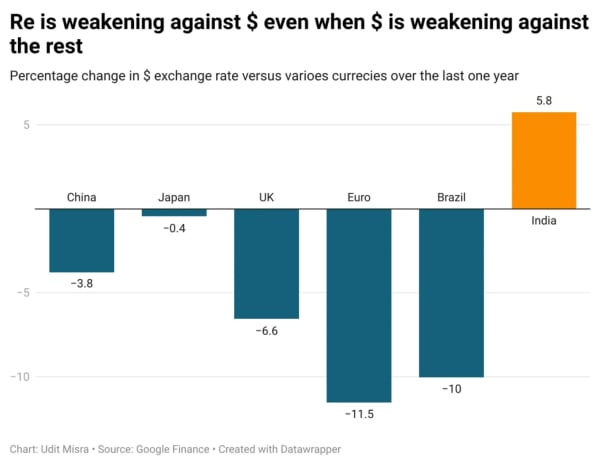 CHART 1
— Two, trade weakness has been worsened by the US singling out India for some of the highest tariffs, which make your goods even more costly for foreign customers, and their demand falls. This, in turn, further reduces the demand for your currency (and its exchange rate); after all, why do you want rupees when you don’t want anything made in India?
— Three, further worsening this situation is the fact that the India-US trade deal is hanging fire.
— Four, a lack of investor interest can also be seen in the shape of the dip in capital flows. But US tariffs are just one part of this problem. The fact is that investors have largely shunned Indian markets and patronised all others
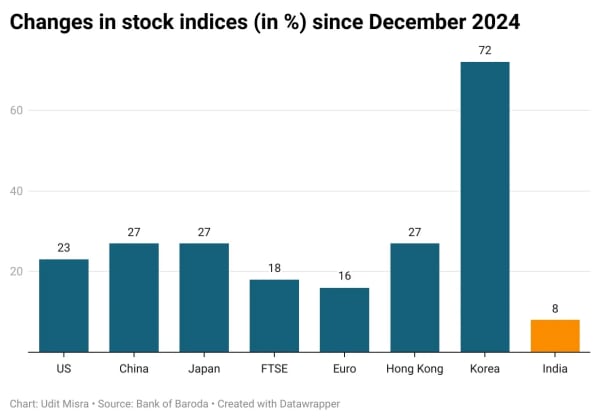 CHART 2
— Lastly, one can’t discount the role of the central bank, as witnessed on Wednesday. RBI’s actions (especially its purchase and sale of dollars) can influence not just the interest rate one earns (and the interest rate businesses pay) but also the rupee’s exchange rate (regardless of the macroeconomic fundamentals).
— It found that three factors appeared to explain the rupee’s exchange rate the most:
1> RBI’s spot intervention in the forex markets
2> Change in RBI’s position in a forward contract (or a contract where one agrees to buy or sell a currency in the future at a specific level).
3> Foreign Portfolio Inflows into India.
— Interestingly, “forwards have more significant role than spot intervention”. This means, RBI selling dollars in the forward market when the rupee is declining is a more effective option as there is strong messaging involved.
— Oddly enough, the trade deficit did not really have a bearing on the changes in the rupee.
Do You Know:
— The rate at which one can swap between currencies is the exchange rate. In other words, how many rupees would buy you a dollar or a euro.
— In such a market — also referred to as the currency market — each currency is like a commodity itself. The value of each currency relative to another currency is called the exchange rate. These values can stay the same over time but more often than not they keep changing.
Other Important Articles Covering the same topic:
📍Beyond headline number: Rupee’s fall is ‘real’ this time
Previous year UPSC Prelims Question Covering similar theme:
(5) With reference to the Indian economy, consider the following statements: (UPSC CSE 2022)
1. An increase in Nominal Effective Exchange Rate (NEER) indicates the appreciation of rupee.
2. An increase in the Real Effective Exchange Rate (REER) indicates an improvement in trade competitiveness.
3. An increasing trend in domestic inflation relative to inflation in other countries is likely to cause an increasing divergence between NEER and REER.
Which of the statements given above are correct?
(a) 1 and 2 only
(b) 2 and 3 only
(c) 1 and 3 only
(d) 1, 2 and 3
| ALSO IN NEWS | |
| ‘Not sustainable in the eyes of law’: SC says forest land can’t be leased or used even for agriculture without Centre’s prior approval | The Supreme Court said Thursday that leasing forest land for non-forestry purposes would be a violation of the Forest (Conservation) Act, which says it cannot be done without prior approval of the Centre, as it upheld the Karnataka Government’s decision to take back forest land given to a co-operative society for agricultural purposes.
The court also noted that the Karnataka Forest Department took possession of the forest land on January 23, 2007. The SC also directed the Karnataka Forest Department “to restore the forest on the 134 acres of released land by planting indigenous plants, trees in due consultation with the experts.” |
| Rs 466 crore KIIFB masala bond case: Inside ED’s forex violation case against Pinarayi Vijayan, former Kerala minister Thomas Isaac | In a show-cause notice to Kerala CM Pinarayi Vijayan and former Finance Minister T M Thomas Isaac, among others, last month, the Enforcement Directorate (ED) accused the two of forex violations to the tune of Rs 466 crore. The agency has noted that Vijayan chaired the meetings where the purchase of land from borrowed foreign funds was approved in violation of RBI rules. It has accused Thomas of diversion of the funds.
The case pertains to masala bonds issued by the Kerala Infrastructure Investment Fund Board (KIIFB) in 2019 to raise funds through external commercial borrowing to finance infrastructure projects in Kerala. Vijayan is KIIFB chairman and Isaac its vice-chairman. Masala Bonds are the rupee-denominated bonds issued to overseas buyers for raising money by the Indian corporates. The price of the bond is denominated in Indian currency. The International Finance Corporation (IFC), the investment arm of the World Bank, named them ‘masala’, literally meaning ‘blend of spices’, to reflect Indian culture. |
| PRELIMS ANSWER KEY |
| 1. (c) 2. (d) 3. (b) 4. (b) 5. (c) |
Subscribe to our UPSC newsletter. Stay updated with the latest UPSC articles by joining our Telegram channel – IndianExpress UPSC Hub, and follow us on Instagram and X.
🚨 Click Here to read the UPSC Essentials magazine for December 2025. Share your views and suggestions in the comment box or at manas.srivastava@indianexpress.com🚨


Read UPSC Magazine