


© IE Online Media Services Pvt Ltd
Tags:



🚨 Attention: UPSC Key is now all 7 Days a Week!🚨
Important topics and their relevance in UPSC CSE exam for July 28, 2024. If you missed the July 27th, 2024 UPSC CSE exam key from the Indian Express, read it here.

🚨 The Indian Express UPSC Essentials brings to you the July edition of its monthly magazine. Click Here to read. Share your views and suggestions in the comment box or at manas.srivastava@indianexpress.com🚨
UPSC Syllabus:
Preliminary Examination: Current events of national and international importance.
Mains Examination: GS-II, GS-III: Government policies and interventions, Infrastructure and environment
What’s the ongoing story- A high-powered committee (HPC), appointed by the National Green Tribunal (NGT) and tasked with revisiting the green clearance for the Great Nicobar infrastructure project, has concluded that a proposed transshipment port does not fall in the Island Coastal Regulation Zone-IA (ICRZ-IA), where ports are prohibited, but is in ICRZ-IB where these are permitted.
Prerequisites:
— Read about the Great Nicobar Island Project.
— Know about the Island Coastal Zone Regulation (ICRZ), 2019
— Know the Location, Extent and Major Islands in the Andaman and Nicobar groups.
Key takeaways:
— This conclusion is at variance with the information submitted by the Andaman & Nicobar (A&N) Coastal Management Authority during the green clearance process for the project. The Authority had stated that parts of the port, airport and township planned under the project are spread over 7 sq km in the ICRZ-IA area.
— The ICRZ-IA areas comprise ecologically sensitive areas such as mangroves, corals and coral reefs, sand dunes, mudflats, marine parks, wildlife habitats, salt marshes, turtle nesting grounds and bird nesting grounds among others.
— Only eco-tourism activities such as mangrove walks and natural trails, roads and roads-on-stilts in defence and strategic projects and public utilities are allowed in this area with permits from the UT and Centre.
— The Great Nicobar ‘Holistic Development’ Project was conceived by the NITI Aayog and the key plan includes construction of an international container transshipment terminal; township and area development, a 450 MVA gas and solar-based power plant, an airport for civilian and defence use.
— The project will be spread over an area of 166 sq km and environmentalists and activists are concerned it will impact leatherback turtle nesting sites, Nicobar megapode nesting mounds, corals, the particularly vulnerable Shompen tribes group and the ancestral lands of the Great Nicobarese Scheduled Tribe community.
For Your Information:
— The Andaman and Nicobar Islands are a cluster of 836 islands, split into two groups — the Andaman Islands to the north and the Nicobar Islands to the south — by the 150-km wide Ten Degree Channel.
— Great Nicobar is the southernmost and largest of the Nicobar Islands, a sparsely inhabited 910-sq-km patch of mainly tropical rainforest in southeastern Bay of Bengal.
— Great Nicobar has two national parks, a biosphere reserve, small populations of the Shompen and Nicobarese tribal peoples, and a few thousand non-tribal settlers.
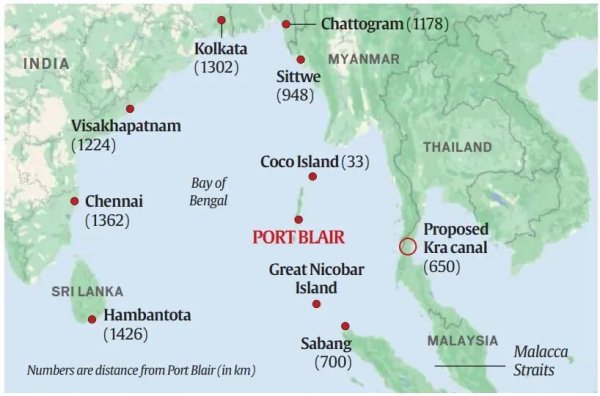
Reasons for the Slow Pace of Infrastructural Development in the A&N Islands:
— Distance from the mainland and difficulties in developing infrastructure.
— Complex procedures for obtaining environmental clearances.
— Significant coordination challenges among ministries, departments, and agencies.
Key areas to be focused on for the development of the A&N Islands:
— Development of separate airfields with long runways for monitoring and patrolling of sea areas by aircraft and surface platforms.
— Forest and environmental clearances must be accorded with minimum red tape.
— Planned habitation of uninhabited islands should be considered by providing incentives.
— Eco-friendly entrepreneurial efforts could be encouraged.
Points to Ponder:
— What is the significance of the Andaman and Nicobar Islands?
— What are the criticisms related to the Great Nicobar Project?
— What are the government initiatives for the development of Andaman and Nicobar Islands?
Post Read Question:
(1) Which one of the following pairs of islands is separated from each other by the ‘Ten Degree Channel’? (UPSC CSE 2014)
(a) Andman and Nicobar Islands
(b) Nicobar and Sumatra
(c) Maldives and Lakshadweep
(d) Sumatra and Java
Other Important Articles Covering the same topic:
Development of Great Nicobar: strategic imperative and ecological concerns
UPSC Syllabus:
Preliminary Examination: Current events of national and international importance
Mains Examination: GS-II: Regional groupings and agreements involving India and/or affecting India’s interests, Effect of policies and politics of developed and developing countries on India’s interests, Indian diaspora.
What’s the ongoing story- On the sidelines of the ASEAN meeting in Vientiane, External Affairs Minister S Jaishankar held a slew of meetings with his counterparts from Laos, Cambodia and Thailand on the issue of trafficking of Indian citizens through cyber scam centres and sought their early return. Hundreds of Indians are believed to be the victims of the cybercrime gangs operating in these countries.
Prerequisites:
— Read about human trafficking and cybercrime.
— Human trafficking and migrant smuggling-Connect the dot
— Read about the ASEAN) and United Nations Convention on Transnational Organised Crime.
— Map work: Location of Laos, Cambodia, Thailand, Myanmar
Key takeaways:
— Over 500 trapped Indian citizens have been rescued from the country so far, even as there is no official number on how many more are stuck. Last week, 13 Indians were rescued from cyber-scamming centres in Laos, as per the Indian Embassy statement.
— The concern spans many Southeast Asian nations, including Thailand, Cambodia and Myanmar, where Indians are being forced to work for gangs operating cyber scam centres.
— Probing a human trafficking, cheating and criminal conspiracy angle against cybercriminals from Southeast Asian countries, the CBI has alleged in its recent FIR that an international network is involved in trafficking of Indians to Cambodia, Laos and Myanmar, where they are forced into cybercrimes at “Chinese control scam centres”.
For Your Information:
— Analysis of data by the Indian Cyber Crime Coordination Centre (I4C), a division of the Ministry of Home Affairs (MHA), has revealed that around 7,000 cyber-related complaints on average are registered with the National Cybercrime Reporting Portal (NCRP) daily and most of the frauds have origin in three Southeast Asian countries — Cambodia, Myanmar and Laos.
From ‘Panel finds cracks that help hackers target jobseekers’
— The Centre’s high-level interministerial panel has identified loopholes in banking, immigration and telecom sectors that enable cyber scams originating from Southeast Asian countries.
— According to sources, three shortcomings in the system that have been identified include: Involvement of the senior bank managers of two nationalised banks to open mule accounts; around 30,000 unreturned passengers travelling on visitor visa to Cambodia, Thailand, Myanmar and Vietnam from January 2022-May 2024, and misuse of bulk SIM cards.
Points to Ponder:
— What is the Budapest Convention? Is India a party to it?
— What is the significance of the Southeast Asia region?
— What are the areas of cooperation between India and ASEAN?
— What are the initiatives taken by the government to tackle the cyber crimes?
(Thought Process: Know Cyber Security initiatives in India- Computer Emergency Response Team – India (CERT-IN), Cyber Surakshit Bharat Initiative, National Cyber Security Coordination Centre (NCCC), Cyber Swachhta Kendra, I4C)
Post Read Question:
Prelims
(2) In India, it is legally mandatory for which of the following to report on cyber security incidents? (UPSC CSE 2017)
1. Service providers
2. Data centres
3. Body corporate
Select the correct answer using the code given below:
(a) 1 only
(b) 1 and 2 only
(c) 3 only
(d) 1, 2 and 3
Mains
India’s proximity to the two of the world’s biggest illicit opium-growing states has enhanced her internal security concerns. Explain the linkages between drug trafficking and other illicit activities such as gunrunning, money laundering and human trafficking. What counter-measures should be taken to prevent the same? (UPSC CSE 2018)
Other Important Articles Covering the same topic:
Southeast Asia origin of at least 45% cyber frauds targeting Indians: Official
UPSC Syllabus:
Preliminary Examination: Current events of national and international importance
Mains Examination: GS-II: India and its neighbourhood- relations, bilateral, regional and global groupings and agreements involving India and/or affecting India’s interests.
What’s the ongoing story- The Maldives has resumed using a Dornier aircraft and two helicopters gifted by India for medical evacuations after the two countries reached an understanding over the repatriation of Indian military personnel operating the three aviation platforms in the archipelagic nation, media reports said on Saturday.
Prerequisites:
— India-Maldives: Historical evolution of the relationship, trade and economic ties, defence, recent MoUs.
— Read about the Neighbourhood First policy and SAGAR vision.
— Map work: Location of Maldives. (Refre Atlas)
Key takeaways:
— President Mohamed Muizzu, known for his pro-China stance, has thanked India for enabling the resumption of medical evacuation services with civilian aviation personnel from India.
For Your Information:
— Maldives’ proximity to the west coast of India, and its location at the hub of commercial sea lanes running through the Indian Ocean imbues it with significant strategic importance to India. The security scenario in India’s periphery in the Indian Ocean is very much linked to the maritime strength of Maldives.
— This is the reason why India invests on Maldives’ security by training its defence forces. Estimates suggest that almost 70 per cent of Maldives’ defence training is done by India…
— India is concerned at the expanding Chinese footprint there. So, from a purely strategic perspective, India needs Maldives on its side to secure its maritime periphery, keep an eye on the Indian Ocean, and check the influence of China in its neighbourhood.
Points to Ponder:
— What is the significance of India for Maldives?
(Thought Process: Mention the essentials that India supplies to Maldives, India’s support in Maldives’ education system, the economic dependence of Maldives on India–tourism–and India’s significant role during disasters.)
— What are the emerging challenges to the India-Maldives bilateral ties?
— What steps can be taken by India to strengthen the relationship?
Post Read Question:
Prelims
(3) India and Maldives are separated by which of the following channels?
(a) Seven Degree Channel
(b) Eight Degree Channel
(c) Nine Degree Channel
(d) Ten Degree Channel
Mains
In light of the Maldives’ growing closeness with China, what steps India must take to reinforce its historical bonds with Maldives and effectively implement its ‘Neighbourhood First Policy’ to mitigate potential security challenges.
Other Important Articles Covering the same topic:
Significance of Maldives’ pro-China President Muizzu’s New Delhi visit
UPSC Syllabus:
Preliminary Examination: Current events of national importance
Mains Examination: GS-II, GS-III: Government policies and interventions, Security challenges and their management, Science and Technology- developments and their applications and effects,
What’s the ongoing story- In its efforts towards becoming a technologically-intensive force by induction as well as through absorption of new and emerging technologies for meeting the needs for future warfare, the Army has identified 16 tech clusters comprising subject specialists, officials privy to the matter told The Indian Express.
Prerequisites:
— What are the emerging technologies having scope of greater use in the military?
— What is artificial intelligence (AI)?
— How has AI evolved over the past decade?
Key takeaways:
— As per officials, one of the planned tech clusters will be on certain emerging technologies which are at a conceptual stage, such as those concerning stealth and anti-stealth, sensing technology, energy and propulsion, nanotechnology, hypersonic and chemical, biological, radiological, and nuclear (CBRN).
— Deep research on some of these technologies are currently underway globally even as some global militaries have implemented some of these technologies.
— Other technology clusters would be on cyber, space, automation or digitisation, quantum, Internet of Things (IoT), along with 5G and 6G, Remotely Piloted Aircraft, directed energy weapons—which uses focused electromagnetic energy to take out enemy systems—among other counter unmanned aerial systems.
— The remaining tech clusters would be on artificial intelligence, machine learning, robotics, loitering munition system, mine detection and diffusion, camouflage and concealment and 3D printing infrastructure.
—Induction and absorption of niche technologies in the Army in line with the changing requirement of future warfare has been a priority for the top leadership of the force. This was among the key issues discussed in the Army Commanders Conference in April this year.
Points to Ponder:
— What are the reforms introduced in the defence sector in India?
— What are the challenges to India’s security?
— What steps have been taken by the government for the modernisation of armed forces?
— What are the challenges associated with the modernisation of armed forces?
Post Read Question:
Prelims
(4) With the present state of development, Artificial Intelligence can effectively do which of the following? (UPSC CSE 2020)
1. Bring down electricity consumption in industrial units
2. Create meaningful short stories and songs
3. Disease diagnosis
4. Text-to-Speech Conversion
5. Wireless transmission of electrical energy
Select the correct answer using the code given below:
(a) 1, 2, 3 and 5 only
(b) 1, 3 and 4 only
(c) 2, 4 and 5 only
(d) 1, 2, 3, 4 and 5
Mains
With the emerging technologies and unique challenges to India’s security, the modernization of the armed forces is the need of the hour. Explain.
Other Important Articles Covering the same topic:
To navigate through ‘turbulent times’, India must invest in modernisation of armed forces: IAF chief
UPSC Syllabus:
Preliminary Examination: Indian Polity
Mains Examination: GS-II: Indian polity and governance
What’s the ongoing story- As some groups in Meghalaya continue to press for regulations on entry of non-natives into the state, 10 members of one of these groups were detained by police on Friday for stopping tourist vehicles entering the state from Assam.
Prerequisites:
— Read about the Inner Line Permit (ILP) system.
— Mapwork: Location of Assam, Meghalaya, Sohra and Dawki.
Key takeaways:
— On Friday, members of the Hynniewtrep National Youth Federation set up a “check-point” at Umtyngngar, around 20 km from Shillong, and prevented vehicles with Assam registration numbers from moving towards tourist destinations such as Sohra and Dawki.
— Friday’s incidents happened after several weeks of different groups in the Khasi hills applying different pressure tactics to push for the introduction of an Inner Line Permit (ILP) system in the state to “safeguard and protect the rights of the people and the state”, Meghalaya Deputy CM and Home Minister Prestone Tynsong said.
For Your Information:
— An Inner Line Permit is a document that allows an Indian citizen to visit or stay in a state that is protected under the ILP system. The system is in force today in three Northeastern states — Arunachal Pradesh, Nagaland and Mizoram — and no Indian citizen can visit any of these states unless he or she belongs to that state, nor can he or she overstay beyond the period specified in the ILP. The concept comes from the colonial area. Under the Bengal Eastern Frontier Regulation Act, 1873, the British framed regulations restricting the entry and regulating the stay of outsiders in designated areas.
— . In 2013, the Home Ministry told Rajya Saha, “The main aim of ILP system is to prevent settlement of other Indian nationals in the States where ILP regime is prevalent, in order to protect the indigenous/tribal population.”
Points to Ponder:
— What are the benefits associated with Inner Line Permit (ILP) system.
— What is the significance of the ILP system?
— What are the issues and challenges associated with the ILP system?
Post Read Question:
(5) In which of the following states is the is the Inner Line Permit System in force?
1. Arunachal Pradesh
2. Nagaland
3. Mizoram
4. Meghalaya
Select the correct answer using the codes given below:
(a) 1 and 2 only
(b) 2 and 3 only.
(c) 1, 2, and 3 only
(d) 1 and 4 only
Other Important Articles Covering the same topic:
Explained: What is Inner Line Permit
UPSC Syllabus:
Preliminary Examination: Economic and Social Development
Mains Examination: GS-III: Indian Economy and issues relating to planning, mobilization, of resources, growth, development and employment.
What’s the ongoing story- The changes in the long-term capital gains (LTCG) tax regime, particularly the withdrawal of the indexation benefit, has emerged as one of the most contentious decisions announced in the Union Budget for 2024-25. The announcement initially led to confusion and trepidation among various sections, prompting the government to issue a string of clarifications and explanations, claiming that it will be beneficial in most cases.
Prerequisites:
— What is Capital Gain Tax?
— What is the difference between long and short-term capital gains tax?
— What is the tax structure in India? What are the different types of tax?
Key takeaways:
— Indexation is the process of adjusting the original purchase price of an asset or investment in order to neutralise the impact of inflation on it. Put simply, it involves revising upward the cost of acquisition of an asset based on the inflation over the period for which it was held.
— Inflation reduces the value of money over time, and therefore, when an asset is sold or an investment is redeemed, indexation helps in arriving at the cost of acquisition with the impact of inflation over the holding period factored in.
— The cost of acquisition thus arrived at, is called the indexed cost of acquisition. It resets the base for calculation of gains or losses from the sale or redemption. The returns calculated on the indexed cost of acquisition are generally seen as more realistic than absolute gains calculated on the basis of the actual price at the time of purchase.
— Without indexation, particularly in cases where the asset was held for an extended period, the gains may appear extremely high, but they may not paint a realistic picture. This is mainly because the inflationary impact on the asset’s value was not taken into account. Now, if the gains accrued on the sale of assets or redemption of investments are taxed, the absence of the indexation benefit would increase the tax outgo, assuming that the rate of tax stays the same
— The new LTCG regime proposed in the Union Budget for 2024-25 presented earlier this week by Finance Minister Nirmala Sitharaman does away with the indexation benefit available for calculation of LTCG on property, gold, and other unlisted assets, while reducing the LTCG tax rate to 12.5% from 20%.
— The government has justified its decision saying that it would simplify the capital gains tax structure without causing a loss to most taxpayers. This simplification, which removes the differential tax rates for various classes of assets, would help both taxpayers and tax authorities, the government has said.
Points to Ponder:
— What is the difference between regressive and degressive tax?
— What are the issues and challenges associated with the Indian tax system?
— What initiatives have been taken by the government to improve taxation in India?
Post Read Question:
Enumerate the indirect taxes which have been subsumed in the Goods and Services Tax (GST) in India. Also, comment on the revenue implications of the GST introduced in India since July 2017. (UPSC CSE 2019)
UPSC Syllabus:
Preliminary Examination: Current events of national and international importance
Mains Examination: GS-II, III: International Relations, Economy
What’s the ongoing story- The Finance Ministry is developing a new risk management system to prevent foreign exporters from claiming duty concessions under a Free Trade Agreement (FTA) by rerouting goods from a third country, thereby breaching value addition norms, Central Board of Indirect Taxes & Customs (CBIC) Chairman Sanjay Kumar Agarwal told The Indian Express.
Prerequisites:
— What is Free Trade Agreement (FTA)?
— What is the significance of FTAs?
Key takeaways:
— The risk assessment system will be crucial as India is increasingly signing FTAs, with annual exemptions worth Rs 75,000 crore to Rs 80,000 crore on the anvil, alongside major deregulation of customs procedures by providing an option of self-certification for the proof of origin of products imported from an FTA partner.
— The government has proposed an amendment to Section 28DA of the Customs Act, 1962, in the Union Budget 2024-2025, replacing ‘certificate’ of origin with ‘proof’ of origin, allowing self-declaration. While the amendment could facilitate trade agreements with developed nations such as the UK and EU, which favour liberal customs norms, it could also increase the risk of breaches, experts said.
For Your Information:
— A GTRI report highlighted a nearly 60-fold increase in silver imports last financial year from the United Arab Emirates (UAE), which is unusual since the country does not produce silver. This import surge may indicate a breach in the rule of origin finalised by India and the UAE under the FTA.
Points to Ponder:
— How many countries have India signed FTAs with?
— What was the need to implement the rule of origin in FTA?
— What are the challenges associated with the rule of origin?
Post Read Question:
(6) The term ‘Regional Comprehensive Economic Partnership’ often appears in the news in the context of the affairs of a group of countries known as (UPSC CSE 2016)
(a) G20
(b) ASEAN
(c) SCO
(d) SAARC
| ALSO IN NEWS | |
| Split & pay taking off: Combine payment methods for seamless high-value bills | A fintech innovation called ‘split & pay’ concept — where an individual can use various payment methods like credit cards, debit cards, net banking, UPI and reward points in one swipe to complete a single high value transaction – is slowly taking off. In this system, all that the customers need to do is a single swipe using the split & pay option on the digital payment checkout page. |
| From Ujjain to Greenwich: a brief history of prime meridians | The NCERT’s new social sciences textbook for Class 6 mentions an Indian prime meridian, predating the one in Greenwich. The chapter, titled ‘Locating Places on the Earth’, says the Greenwich Meridian “is not the first prime meridian” and that “many centuries before Europe, India had a prime meridian of its own” which passed through the city of Ujjain in Madhya Pradesh. This meridian became “a reference for calculations in all Indian astronomical texts,” the textbook says. The first mention of the Ujjain prime meridian can be found in the ancient Sanskrit treatise Surya Siddhanta, composed between the 4th and 8th centuries CE. |
| ANSWER KEY |
| 1. (a) 2. (d) 3. (b) 4. (b) 5. (c) 6. (b) |
Subscribe to our UPSC newsletter and stay updated with the news cues from the past week.
Stay updated with the latest UPSC articles by joining our Telegram channel – Indian Express UPSC Hub, and follow us on Instagram and X.
https://www.youtube.com/watch?v=nC4ckaj-dJI?si=KjQYlmpx5DTywayV


