8 min read
© IE Online Media Services Pvt Ltd
Latest Comment
Post Comment
Read Comments



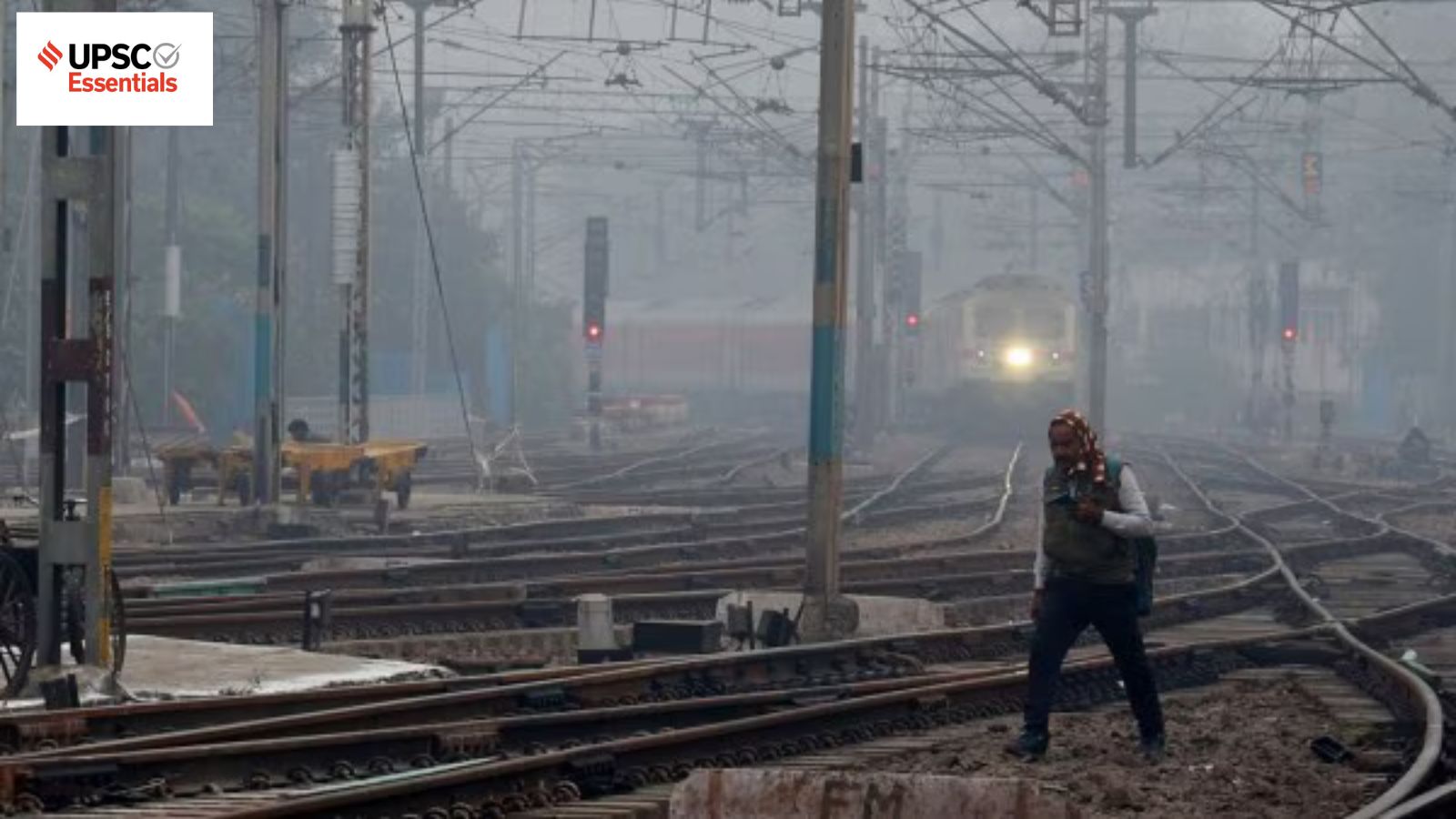 Are you preparing for the Civil Services Exam 2026? Attempt a question on the role of the Fog-induced disruptions in today's answer writing practice. (Express photo by Amit Mehra)
UPSC Essentials brings to you its initiative for the practice of Mains answer writing. It covers the essential topics of static and dynamic parts of the UPSC Civil Services syllabus covered under various GS papers. This answer-writing practice is designed to help you as a value addition to your UPSC CSE Mains. Attempt today’s answer writing on questions related to topics of GS-1 to check your progress.
🚨 Click Here to read the UPSC Essentials magazine for December 2025. Share your views and suggestions in the comment box or at manas.srivastava@indianexpress.com🚨
Fog-induced disruptions in northern India significantly impact both rail and air transport systems. Discuss the physical causes of dense fog in northern India and explain why this weather phenomenon disproportionately affects transport operations during winter.
Discuss the geographical and political factors that contributed to Kashmir’s significant role in the spread of Buddhism beyond the Indian subcontinent.

QUESTION 1: Fog-induced disruptions in northern India significantly impact both rail and air transport systems. Discuss the physical causes of dense fog in northern India and explain why this weather phenomenon disproportionately affects transport operations during winter.
Relevance: The question integrates physical geography (winter fog, temperature inversion) with human activities, testing the ability to connect climatic phenomena of northern India with their socio-economic and infrastructural impacts.
Note: This is not a model UPSC answer. It only provides you with a thought process which you may incorporate into the answers.
Introduction:
— Every winter, Indian travellers travelling out for the holiday season face a recurring issue in the form of severe fog. This seasonal phenomena lowers visibility, making safe and timely transit difficult, particularly in India’s northern plains.
— As a result, both airlines and the Indian Railways face frequent operational problems, such as delays and cancellations. The effect is especially noticeable in northern India, where prolonged low-visibility conditions during winter mornings and evenings significantly disrupt aviation operations and train travel.
Body:
You may incorporate some of the following points in your answer:
— The type of fog that affects flight and train operations the most in northern India is radiation fog — which forms under clear winter nights when the ground cools rapidly, moisture condenses and stagnant winds trap it. It can occur frequently and can cause extremely low visibility conditions.
— Smog adds to the fog’s severity, making it denser and dragging it closer to the ground level. Smog also makes low visibility conditions last much longer than just fog, which dissipates quickly with sunlight. Pilots and officials with Indian carriers say that the high pollution levels have, over the years, compounded fog-related disruptions in northern parts of India, particularly Delhi.
How do flights and airports operate in low-visibility?
— When visibility falls drastically due to fog, airports start operating under Low Visibility Procedures (LVP). These procedures involve specialised operations such as Low Visibility Take-Off (LVTO) and Instrument Landing System (ILS) CAT IIIB landings.
— ILS is a ground-based radio navigation system at airports that provides precise horizontal and vertical guidance to aircraft for landings and CAT IIIB, an ILS category, is one of the highest levels for precision approaches for aircraft landings in very low visibility conditions. It allows aircraft to land even when visibility is as low as 50 metres.
— To minimise fog-induced disruptions, airlines try to ensure that an adequate number of pilots trained for low-visibility operations are available to operate flights to and from fog-prone, LVP-equipped airports. The effort is also to have trained crew on standby.
Conclusion:
— While low visibility procedures can help prevent significant disruptions, they still cannot make operations fully immune to fog. Under LVP, the distance and time between aircraft movements — landings and take-offs — increase notably to ensure safe operations.
— India’s aviation regulator, the Directorate General of Civil Aviation (DGCA), has announced December 10-February 10 as the official fog window for this season. Airlines and airports monitor real-time meteorological data and use predictive analytics and artificial intelligence tools for better fog prediction.
(Source: Fogged out: How Railways and airlines tackle fog-induced disruptions)
Points to Ponder
Read more about Smog
Read about disruptions in airlines and railways
Related Previous Year Questions
How can Artificial Intelligence (AI) and drones be effectively used along with GIS and RS techniques in locational and aerial planning? (2025)
Troposphere is a very significant atmosphere layer that determines weather processes. How? (2022)
QUESTION 2: Discuss the geographical and political factors that contributed to Kashmir’s significant role in the spread of Buddhism beyond the Indian subcontinent.
Relevance: This question links ancient Indian history with cultural geography by highlighting Kashmir’s strategic location on trans-Asian routes and its political patronage under Kushanas, relevant for understanding India’s civilisational influence abroad.
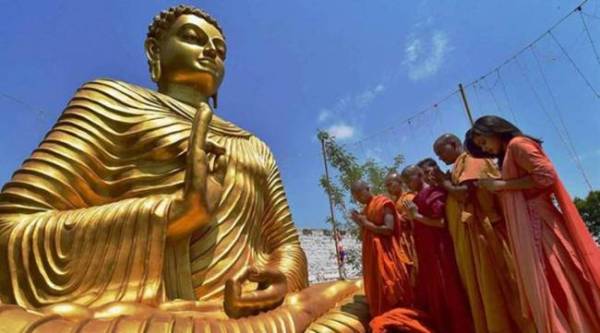 (PTI)
(PTI)
Note: This is not a model UPSC answer. It only provides you with a thought process which you may incorporate into the answers.
Introduction:
— For most people, Buddhism is anchored to four sacred sites: Lumbini (birth), Bodh Gaya (enlightenment), Sarnath (first sermon), and Kushinagar (mahaparinirvana). Yet Buddhism did not become a world religion merely through sacred geography; it spread through traditions, ideas, debates, translations, and institutions.
— Buddhism flourished in Kashmir during the Mauryan period, traditionally associated with Emperor Ashoka, who is believed to have founded the city of Srinagar and established monasteries and stupas in the region.
Body:
You may incorporate some of the following points in your answer:
Factors responsible for the spread of Buddhism from Kashmir to beyond the Indian subcontinent
— Kashmir’s location at the crossroads of the Indus-Gandhara region and the Himalayan corridor made it uniquely suited to act as a conduit between the Indian heartland and the wider Asian world.
— Early Buddhist chronicles and later Sanskrit sources consistently refer to Kashmir as a land of learning or Sharada Pitha, symbolising its role as one of the foremost seats of learning in the ancient and early medieval periods. The Kashmiri engagement with Buddhism was never merely devotional — it was analytical, dialectical, and intellectually rigorous.
— The Buddhist philosophical tradition reached its zenith in the figure of Nagarjuna, the founder of Madhyamaka (the Middle Way) philosophy. Nagarjuna travelled widely, and Kashmir emerged as one of the most important centres for the study, preservation, and elaboration of his thought.
— The significance of Kashmir in Buddhist history becomes noticeable during the Kushan period, precisely the era to which the Zehanpora remains are dated. Under Emperor Kanishka, Buddhism received unprecedented royal patronage. Tradition holds that Kanishka convened the Fourth Buddhist Council in Kashmir, presided over by the scholar Vasumitra, with Ashvaghosha among its luminaries. This council was decisive in the systematisation and spread of Mahayana Buddhism, a form that emphasised compassion, the Bodhisattva ideal, and universal liberation.
— Kashmir was not peripheral to global Buddhism — it was one of its crucial launchpads. The Gilgit Manuscripts, among the oldest surviving Buddhist texts in the world, written in Sanskrit and Prakrit, reveal Kashmir and its neighbouring regions as custodians of Buddhist knowledge.
— Buddhism’s philosophical emphasis on the “Middle Path” — a rejection of extremes — found a striking afterlife in Kashmir’s later spiritual traditions. The Sufi-Rishi movement, particularly the teachings of Lal Ded (1320–1392 CE) and Sheikh Noor-ud-din Noorani (1377–1440 CE), reflects an ethic of moderation, compassion, and inner discipline that resonates deeply with Buddhist values.
Conclusion:
— For decades, Kashmir has been maligned globally by terrorism and conflict, eclipsing its deeper civilisational identity. The excavation at Zehanpora is an invitation to reframe J&K not as a land that has been struggling to find calm, but as a region that once shaped the moral and philosophical vocabulary of half the world.
(Source: Kashmir was a crucial launchpad for global Buddhism)
Points to Ponder
Read more about Buddhism
Read more about excavation at Zehanpora
Related Previous Year Questions
Pala period is the most significant phase in the history of Buddhism in India. Enumerate. (2020)
Early Buddhist Stupa-art, while depicting folk motifs and narratives successfully expounds Buddhist ideals. Elucidate. (2016)
UPSC Essentials: Mains answer practice — GS 3 (Week 134)
UPSC Essentials: Mains answer practice — GS 3 (Week 135)
UPSC Essentials: Mains answer practice — GS 2 (Week 134)
UPSC Essentials: Mains answer practice — GS 2 (Week 135)
UPSC Essentials: Mains answer practice — GS 1 (Week 133)
UPSC Essentials: Mains answer practice — GS 1 (Week 133)
Subscribe to our UPSC newsletter and stay updated with the news cues from the past week.
Stay updated with the latest UPSC articles by joining our Telegram channel – IndianExpress UPSC Hub, and follow us on Instagram and X.


Read UPSC Magazine