14 min read

© IE Online Media Services Pvt Ltd



 Over five years after they were cleared by Parliament, the Centre on 21st November implemented the four long-pending labour codes covering wages, industrial relations, social security and working conditions. (Image: Abhishek Mitra)
UPSC Issue at a Glance is an initiative by UPSC Essentials aimed at streamlining your UPSC Current Affairs preparation for the prelims and mains examinations by focusing on issues making headlines. This week, we cover the recently implemented 4 new labour codes from a broader perspective. Let’s get started.
More than five years after Parliament cleared the four labour codes, replacing 29 central labour laws, the government has moved ahead with their implementation. Effective from November 21, the four labour codes seek to ease regulations and compliance norms for employers and ensure uniformity in wage structure and social security protection for workers. In this context, it becomes essential to know about it from a broader perspective.
(Relevance: UPSC Syllabus: General Studies-II, III: Government policies and interventions for development in various sectors and issues arising out of their design and implementation, Indian Economy and issues relating to planning, mobilisation of resources, growth, development and employment.
Previously, in 2024, UPSC had asked a question on the merits and demerits of the four ‘Labour Codes’ in the context of labour market reforms in India. After these codes have been implemented it becomes important to stay updated about them.)
What will you learn from this article? |
|
The recently implemented four labour codes – Code of Wages (2019), Industrial Relations Code (2020), Code on Social Security (2020) and Occupational Safety, Health and Working Conditions Code (2020) – replaced 29 fragmented laws with a unified, modern framework.
Notably, India’s old labour laws were too many, too complex, and outdated. They increased the compliance burden and discouraged businesses from hiring. Many workers, especially gig, platform, MSME, and migrant workers, had no uniform social security.
Also, as labour is a Concurrent List subject, and while most states have finalised rules aligned with the four codes, central-level implementation was pending. This delay resulted in uneven social security coverage for workers and compliance complexity for employers operating across multiple states. Thus, the new labour codes are introduced to try to fix all this.
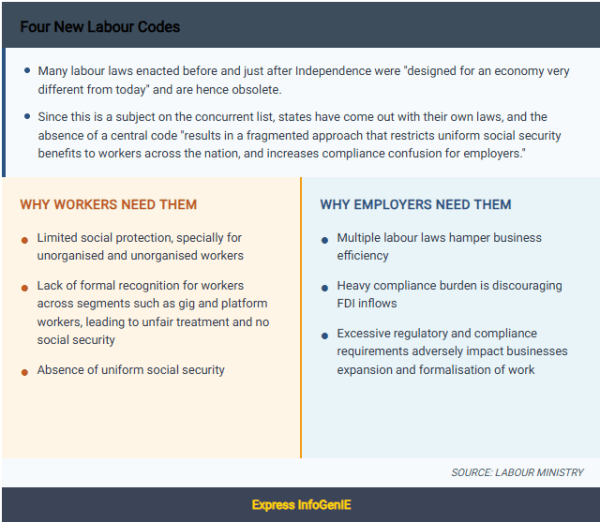
Parliament passed the Code on Wages in July-August 2019. Three other labour reform Bills — the Industrial Relations Code, Social Security Code, and Occupational Safety, Health and Working Conditions Code — were passed by both Houses of Parliament in September 2020. The key highlights of these codes are:
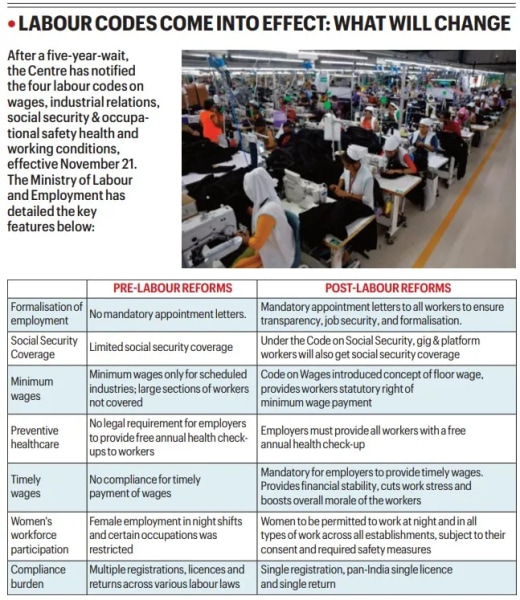
📍Code on Wages: It amalgamates four wages and payment related labour laws. Defines wage, employee, minimum wage to cover all employees irrespective of industry, sector, wage or gender. Earlier, these rules were for employees in scheduled employment only and those below the monthly wage of Rs 24,000.
— A National Floor Wage will now be the baseline wage, to be followed by all states. Wage includes basic pay, dearness allowance and retaining allowance, and is to be the basis for calculation of benefits and social security contributions.
— Deductions are to not exceed 50 per cent of the total pay. Overtime wage is fixed at at least twice the normal wage for any work beyond normal working hours.
— The government has said that working hours will be between 8-12 hours/day and no employee shall be required to work for more than 48 hours a week. If an employee works for less than six days a week, or flexibility in working is provided in the rules, working hours shall not exceed 12 hours in a day including the interval for rest.
— Time limit set for wage payments: end of the shift (for daily); before weekly holiday (for weekly); within 2 days of the end of the fortnight (for fortnightly); within 7 days of next month (for monthly); within 2 days (for resignation or termination).
— Wage slips, electronic or physical, have to be issued by every employer to employees on or before payment of wages. This will ensure documentary proof of employment, wages, allowances, deductions, and net pay to workers.
📍Code on Social Security: The new code merges nine existing social security laws to cover both organised and unorganised sectors.
— Defines gig and platform workers legally for the first time.
— National registration and a social security fund for unorganised and gig workers is stipulated.
— Social security schemes to be funded wholly or partly by central and state governments or corporate social responsibility contributions. Aggregators for gig workers to contribute 1-2 per cent of annual turnover for social security, capped at 5 per cent of the amount payable by the aggregator to gig workers.
— Fixed-term employees (FTE), appointed for shorter terms, to be at par with permanent workers. Under FTE:
* Workers receive the same benefits as permanent staff.
* Wages must be equal to permanent employees.
* Gratuity eligibility starts after one year instead of five.
* Leave, working hours and medical benefits are fully regulated.
* The government argues that FTE promotes formalisation, shifts workers to company payrolls and expands social security coverage.
— Employees’ Provident Fund Organisation (EPFO) coverage extended to all establishments having 20 or more employees, regardless of the industry type.
— There is pan-India ESIC (Employees’ State Insurance Corporation) coverage, versus certain notified areas currently. ESIC cover to be mandatory even if a single person is engaged in hazardous occupation, as against the minimum 10 workers norm at present.
— Plantation owners can join ESIC voluntarily now. Provision to add parents-in-law to family definition of female employees, with income cap.
— Appointment of ‘inspector-cum-facilitators’. Governments to notify inspection scheme that may provide for web-based inspection and calling of information.
📍Industrial Relations Code: The new code merges three industrial laws. It defines worker as any person (except an apprentice) employed in any industry to do any manual, unskilled, skilled, technical, operational, clerical or supervisory work for hire or reward. Includes sales promotion employees, working journalists, and those employed in supervisory capacity drawing wages less than Rs 18,000.
— Introduction of fixed-term employment: facilitates hiring for shorter tenures, linked to the industry’s seasonality. Notably, Trade unions have objected to this norm.
— Threshold for seeking prior government approval for layoff, retrenchment and closure in factories, mines and plantations hiked to 300 workers from 100. While industry states that this gives flexibility in hiring, unions have said that this provision eases hiring and firing.
— Extends conditions for a legal strike from public utility services to all industrial establishments. At present, workers of public utilities, like water, electricity, natural gas, telephone and other essential services, have to give a strike notice within six weeks before striking or within 14 days of giving such notice.
— The Code states that workers cannot strike without giving notice within 60 days before striking or within 14 days of giving such notice.
— The definition of strike has been amended to include mass casual leave, wherein casual leave has been taken by more than 50 per cent of the workers on a given day. The government said this has been done to discourage flash strikes.
— The new code also Introduces ‘negotiating union or council’ — a trade union with 51 per cent membership of workers will be the ‘sole negotiating union’. If there is more than one trade union in an establishment, then the negotiating council will be formed with representatives of unions having 20 per cent of workers as members, granting one seat for each 20 per cent of verified membership. Notably, Trade unions have said this limits powers of small unions.
📍OSH Code: The new code merges 13 central labour laws. The government said it will streamline compliances via single registration, common licences and electronic filings.
— Threshold for obtaining a factory licence increased from 10 workers to 20 for manufacturing aided with power; from 20 to 40 for units without power.
— Contract labour norms to apply on contractors employing 50 workers, versus 20 workers earlier. Core and non-core activities (sanitation, catering etc.) of an establishment have been defined and employers given flexibility to employ contract labour even in the core activities, subject to conditions.
— The new code permits women to work in night shifts, before 6 am and beyond 7 pm, subject to their consent and provisions for safety.
— The definition of inter-state migrant worker has been expanded to include those employed by an employer directly as against through contractors only at present.
— Mandatory appointment letters to be issued by employers to every employee. Earlier, laws did not explicitly mandate such letters, especially for casual workers. The prescribed format is likely to have employee details, designation, category, wages, and details of social security.
— Every employer is required to provide annual health examinations or tests free of cost to employees.
— Every factory employing 500 or more workers, employers employing 250 or more construction workers and employers employing 100 or more mine workers will need to constitute a safety committee consisting of employers’ and workers’ representatives.
The new labour codes will affect different groups of workers in different ways. Some of the key changes for each group are:
#Gig & platform workers
— Legally defined for the first time.
— Aggregators must contribute 1–2% of turnover (capped at 5% of payouts) to a welfare fund.
— Commuting accidents are covered as employment-related.
— Aadhaar-linked UAN enables portability of benefits across states.
#Contractual workers
— Health and social security benefits are ensured by the principal employer.
— Free annual health check-ups.
#Women workers
— Equal pay and prohibition of gender discrimination.
— Consent-based night work permitted with safety protocols.
— Up to 26 weeks maternity leave, crèche facilities, medical bonus.
— Parents-in-law included in the family definition.
#Migrant workers
— Equal wages and welfare benefits.
— PDS portability.
— Claims allowed for pending dues up to three years.
— Double wages for overtime.
#Sector-specific provisions
— Covers workers across MSMEs, plantations, beedi and cigar, audio-visual, textile, mines, IT, hazardous industries, ports and export hubs.
— Major benefits include regulated working hours, double overtime, appointment letters, safety standards, ESI coverage, PPE, annual health check-ups and stronger workplace protections.
The new labour codes have drawn mixed reactions; understanding the full picture requires looking at all perspectives.
Asad Rehman of The Indian Express writes- “Several experts point to the gaps between what the new labour laws intend to do and their application on the ground. Some of them also believe that trade unions may also push back by demanding the implementation of the codes in letter and spirit.”
Manish Sabharwal writes- “The four labour codes are not perfect; there should be only one. But they represent a huge leap in making India a better habitat for good job creation. They also offer us a small peek into a legislative future when India’s regulatory cholesterol is replaced by a regime of trust, which abandons ineffective notions of jail provisions as a deterrent, replaces prior approvals or licences with perpetual self-registration, acknowledges that arming inspectors to enforce the unenforceable breeds corruption, accepts that everything is permitted till prohibited, and concedes that process is punishment only for the innocent.
The labour codes embrace a trust-based regulatory regime that will, hopefully, restrict the administrative state to two instruments: Acts passed by Parliament and Rules notified in the Gazette.”
Express View: New labour codes are long overdue & welcome– “The issue of factor market reforms — in particular, land and labour — has been at the heart of policy debates in India for decades…The new codes, which replace 29 existing laws, seek to modernise labour market regulations, ease compliance burden, widen the security net for workers, including for gig and platform workers, and encourage formalisation. They also seek to boost female labour force participation and bring fixed-term employees on parity with permanent employees. This marks a welcome transition to a simpler and more predictable framework.
The complex web of labour regulations that existed till now has imposed huge costs on businesses and the wider economy. Regulations which have to do with firm size, for instance, have tended to limit the emergence of large firms, especially in labour intensive manufacturing sectors.
With firms disincentivised to expand and hire more workers, it has led to too few firms scaling up — as per a study by ICRIER, a majority of firms in the manufacturing sector have less than 10 workers. This has had implications for manufacturing and formal job creation. The compliance costs of onerous regulations have also led to firms operating in the informal sector. Workers have thus remained trapped in low-productivity jobs. The reforms being carried out now should help address some of these issues.
The government’s move to notify the four codes should, however, be just the first step in undoing the regulatory maze. The Union Budget 2025-26 had spoken about regulatory reforms, “especially in matters of inspections and compliances”. These should be tackled urgently.”
Prelims
(1) Consider the following statements: (UPSC CSE 2017)
1. The Factories Act, 1881 was passed with a view to fix the wages of industrial workers and to allow the workers to form trade unions.
2. N.M. Lokhande was a pioneer in organizing the labour movement in British India.
Which of the statements given above is/are correct?
(a) 1 only
(b) 2 only
(c) Both 1 and 2
(d) Neither 1 nor 2
(2) In India, which one of the following compiles information on industrial disputes, closures, retrenchments and lay-offs in factories employing workers? (UPSC CSE 2022)
(a) Central Statistics Office
(b) Department for Promotion of Industry and Internal Trade
(c) Labour Bureau
(d) National Technical Manpower Information System
Mains
1. Discuss the merits and demerits of the four ‘Labour Codes’ in the context of labour market reforms in India. What has been the progress so far in this regard? (UPSC CSE 2024)
2. “Success of ‘Make in India’ programme depends on the success of ‘Skill India’ programme and radical labour reforms.” Discuss with logical arguments. (UPSC CSE 2015)
| Prelims Answer Key |
| 1. (b) 2. (c) |
(Sources: Articles from the Indian Express- Labour codes: What changes for workers and employers, By Aanchal Magazine (Explained) How India’s 4 labour codes aim to improve wages and worker safety As new labour codes spark a row, a look at rise and fall of trade unions in India, By Asad Rehman (Political Pulse), What new labour codes mean for workers & employers, in 12 points, By Aanchal Magazine, (Explained), Four labour codes, one big leap by Manish Sabharwal)
Subscribe to our UPSC newsletter. Stay updated with the latest UPSC articles by joining our Telegram channel – Indian Express UPSC Hub, and follow us on Instagram and X.
🚨 Click Here to read the UPSC Essentials magazine for November 2025. Share your views and suggestions in the comment box or at manas.srivastava@indianexpress.com🚨


Read UPSC Magazine