


© IE Online Media Services Pvt Ltd
Tags:


UPSC Essentials brings to you its initiative for the practice of Mains answer writing. It covers essential topics of static and dynamic parts of the UPSC Civil Services syllabus covered under various GS papers. This answer-writing practice is designed to help you as a value addition to your UPSC CSE Mains. Attempt today’s answer writing on questions related to topics of GS-2 to check your progress.
🚨 Click Here to read the UPSC Essentials magazine for November 2025. Share your views and suggestions in the comment box or at manas.srivastava@indianexpress.com🚨

Discuss the significance of celebrating Constitution Day every year for a democratic society like India.
What are the key components of the Mission 300 platform adopted under the G20 declaration, and what problem does it seek to solve?
Introduction
— The introduction of the answer is essential and should be restricted to 3-5 lines. Remember, a one-liner is not a standard introduction.
— It may consist of basic information by giving some definitions from the trusted source and authentic facts.
Body
— It is the central part of the answer and one should understand the demand of the question to provide rich content.
— The answer must be preferably written as a mix of points and short paragraphs rather than using long paragraphs or just points.
— Using facts from authentic government sources makes your answer more comprehensive. Analysis is important based on the demand of the question, but do not over analyse.
— Underlining keywords gives you an edge over other candidates and enhances presentation of the answer.
— Using flowcharts/tree-diagram in the answers saves much time and boosts your score. However, it should be used logically and only where it is required.
Way forward/ conclusion
— The ending of the answer should be on a positive note and it should have a forward-looking approach. However, if you feel that an important problem must be highlighted, you may add it in your conclusion. Try not to repeat any point from body or introduction.
— You may use the findings of reports or surveys conducted at national and international levels, quotes etc. in your answers.
Self Evaluation
— It is the most important part of our Mains answer writing practice. UPSC Essentials will provide some guiding points or ideas as a thought process that will help you to evaluate your answers.
QUESTION 1: Discuss the significance of celebrating Constitution Day every year for a democratic society like India.
Note: This is not a model answer. It only provides you with thought process which you may incorporate into the answers.
Introduction:
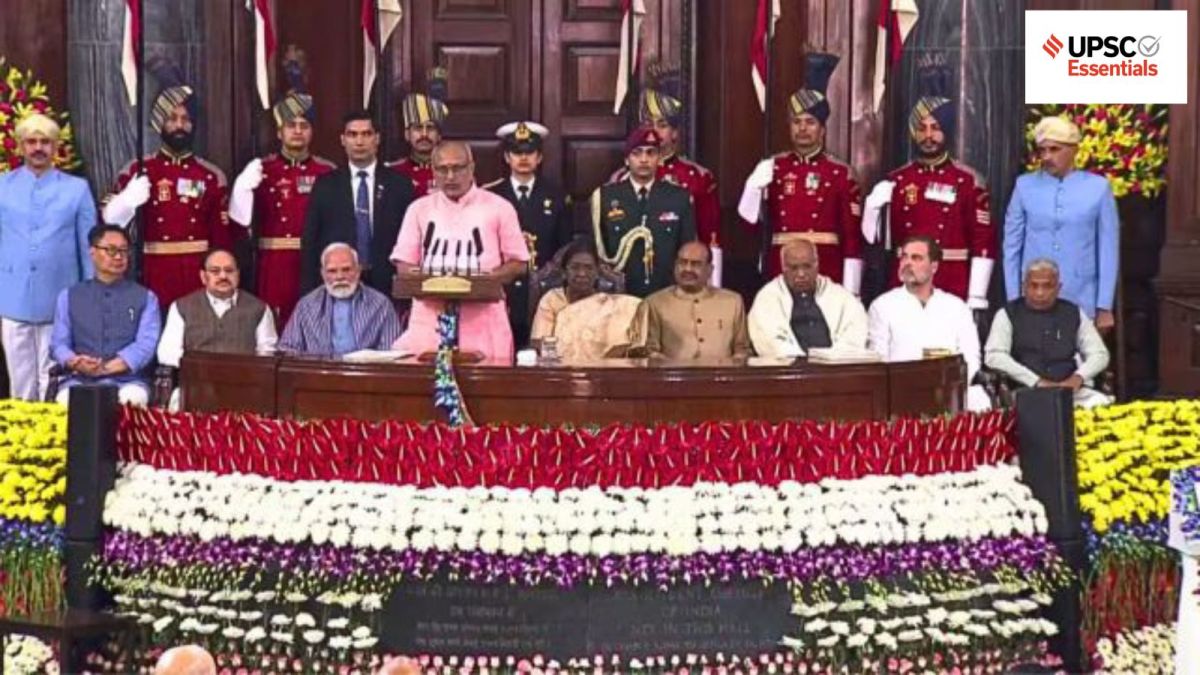
— Samvidhan Divas, or Constitution Day of India, is an annual observance that commemorates the official adoption of the Indian Constitution on November 26, 1949, establishing India as a sovereign and democratic republic.
— The government of India declared November 26 as Constitution Day in 2015, under the Ministry of Social Justice and Empowerment, to promote constitutional values and commemorate Ambedkar’s 125th birth anniversary.
— Constitution Day commemorates the adoption of the Indian Constitution by the Constituent Assembly, whose last session ended on November 26, 1949.
Body:
You may incorporate some of the following points in your answer:
Significance of Constitution Day
— Constitution Day is celebrated as a national festival of constitutional values with Indians in every corner of the country.
— The day reflects on the country’s transformative journey and promotes and reaffirms its commitment to constitutional ideals and democratic traditions.
— The major goal is to enhance public awareness of the relevance of the Constitution, its key values, and citizens’ rights and duties. The government promotes constitutional literacy through initiatives in schools, colleges, and public entities.
— The day was officially established in 2015, during Dr. Ambedkar’s 125th birth anniversary year, to commemorate his tremendous contribution as Chairman of the Draughting Committee.

— It provides an opportunity to reaffirm the nation’s dedication to the Preamble’s values of justice, liberty, equality, and fraternity.
— The observance serves as a reminder to citizens of their fundamental duties and encourages active engagement in the growth of Indian democracy.
Conclusion:
— In order to commemorate the 75th year of India as a republic and the adoption of India’s constitution, the Department of Justice implemented a pan-India, year-long nationwide campaign titled ‘Hamara Samvidhan Hamara Samman’ (Our Constitution, Our Honour) for simplifying the constitutions for the general public.
(Source: Constitution Day of India 2025: Why is it celebrated on November 26? Know history, significance, and more about Samvidhan Diwas, http://www.pib.gov.in, mygov.in)
Points to Ponder
Read about Preamble
Read more about Constitution of India
Read about the borrowing part of the Indian Constitution
Related Previous Year Questions
“Constitutional morality is the fulcrum which acts as an essential check upon the high functionaries and citizens alike…” In view of the above observation of the Supreme Court, explain the concept of constitutional morality and its application to ensure balance between judicial independence and judicial accountability in India. (2025)
“The Constitution of India is a living instrument with capabilities of enormous dynamism. It is a constitution made for a progressive society.” Illustrate with special reference to the expanding horizons of the right to life and personal liberty. (2023)
QUESTION 2: What are the key components of the Mission 300 platform adopted under the G20 declaration, and what problem does it seek to solve?
Note: This is not a model answer. It only provides you with thought process which you may incorporate into the answers.
Introduction:
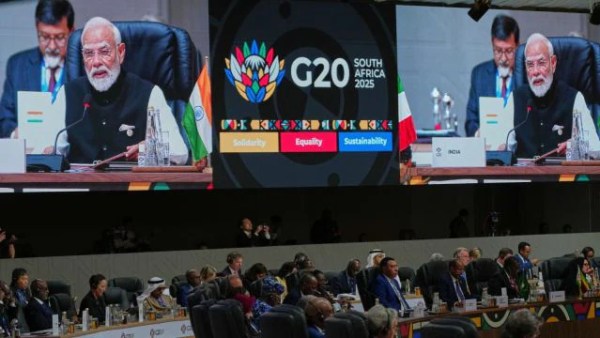
— The 20th G20 Leaders’ Summit was held at the Johannesburg Expo Centre on November 22-23. The summit was most notable for the absence of the US President.
— The Indian Prime Minister participated in the G20 Leaders’ Summit hosted by South Africa. Addressing the Opening Session on “Inclusive and sustainable economic growth leaving no one behind”, the Prime Minister appreciated the work done by the group under the South African presidency in the areas of skilled migration, tourism, food security, AI, digital economy, innovation and women empowerment.
Body:
You may incorporate some of the following points in your answer:
What is the Mission 300 platform?
— Mission 300 is an ambitious initiative to connect 300 million people to electricity in the region by 2030. It will provide access to reliable, affordable, and sustainable energy is critical for powering economies, delivering essential services, and spurring job creation for Africa’s growing population.
— The mission has been led by the World Bank Group (WBG) and the African Development Bank (AfDB). It is a unique initiative that brings together African governments, the private sector, and development partners to deliver affordable power, expand electricity access, boost utility efficiency, attract private investment and improve regional energy integration that drives economic transformation.
Key components
— Mission 300 is fueled by strong political will to transform Africa’s energy sector. Under the Dar es Salaam Energy Declaration, African governments have committed to important sector reforms that are being implemented through country-led Energy Compacts.
— Partnerships play an essential role in ensuring Mission 300’s success. Many development partners and development finance institutions (DFIs) are also supporting Mission 300 projects through co-financing and technical assistance.
— To unlock private investment across Africa’s energy sector, the WBG is building upon its new guarantee platform to create innovative financing and de-risking facilities.
— In Eastern and Southern Africa, the Accelerating Sustainable and Clean Energy Access Transformation (ASCENT) Program will provide energy access to 100 million Africans across 20 countries over the next five years, placing the region on the path to universal energy access.
— Countries in Eastern and Southern Africa have already made significant strides to connect more people and communities to the grid.
— In Western and Central Africa, Nigeria DARES supports the deployment of solar home systems and mini-grids that will benefit over 17.5 million Nigerians, or 20% of the country’s currently unserved population.
Conclusion:
— The G20 supports efforts to triple renewable energy capacity globally and double the global rate of energy efficiency improvements by 2030. The declaration welcomed the Mission 300 platform, led by the World Bank Group and the African Development Bank, dedicated to connecting 300 million people to electricity in Africa by 2030. This commitment includes mobilising varied financial sources to facilitate low-cost financing for energy transitions in developing countries.
(Source: Africa, climate, debt sustainability, UNSC reform: 10 key takeaways from the G20 leaders’ declaration, http://www.worldbank.org)
Points to Ponder
Read about other important developments of G20 summit, 2025
Read about G20 member countries
Why did the United States not participate in the summit?
Related Previous Year Questions
India-Africa digital partnership is achieving mutual respect, co-development and long-term institutional partnerships. Elaborate. (2025)
India-Africa digital partnership is achieving mutual respect, co-development and long-term institutional partnerships. Elaborate. (2022)
UPSC Essentials: Mains answer practice — GS 3 (Week 130)
UPSC Essentials: Mains answer practice — GS 3 (Week 129)
UPSC Essentials: Mains answer practice — GS 2 (Week 128)
UPSC Essentials: Mains answer practice — GS 2 (Week 129)
UPSC Essentials: Mains answer practice — GS 1 (Week 129)
UPSC Essentials: Mains answer practice — GS 1 (Week 128)
Subscribe to our UPSC newsletter and stay updated with the news cues from the past week.
Stay updated with the latest UPSC articles by joining our Telegram channel – IndianExpress UPSC Hub, and follow us on Instagram and X.


