6 min read
© IE Online Media Services Pvt Ltd
Latest Comment
Post Comment
Read Comments



UPSC Essentials brings to you its initiative of subject-wise quizzes. These quizzes are designed to help you revise some of the most important topics from the static part of the syllabus. Attempt today’s subject quiz on Environment and Geography to check your progress.
🚨 Click Here to read the UPSC Essentials magazine for November 2025. Share your views and suggestions in the comment box or at manas.srivastava@indianexpress.com🚨
With reference to Cyclone Senyar, consider the following statements:
1. It has been formed due to a cyclonic circulation over the Arabian Sea.
2. The name ‘Senyar’ has been submitted by Sri Lanka.
Which of the statements given above is/are correct?
(a) 1 only
(b) 2 only
(c) Both 1 and 2
(d) Neither 1 nor 2
Explanation
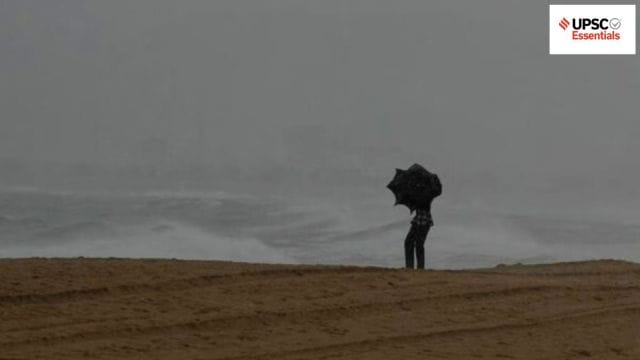
— The India Meteorological Department (IMD) has issued an alert for the Andaman and Nicobar Islands due to a cyclonic circulation over the Bay of Bengal, which is likely to intensify from November 21, an official said. Heavy to very heavy rainfall (7–20 cm) is very likely at one or two places in the Nicobar Islands, and heavy rainfall (7–11 cm) is also expected in the Andaman Islands. Sea conditions are also likely to be rough. Hence, statement 1 is not correct.
— The name “Senyar,” meaning “lion,” was submitted by the United Arab Emirates and is part of the pre-approved list of tropical cyclone names used in the region. Hence, statement 2 is not correct.
Therefore, option (d) is the correct answer.
With reference to the Volcano eruption, consider the following statements:
1. The explosivity of an eruption depends on the composition of the magma.
2. Thick and sticky magma does not allow gases to escape, and is thus much more explosive.
Which of the statements given above is/are correct?
(a) 1 only
(b) 2 only
(c) Both 1 and 2
(d) Neither 1 nor 2
Explanation
— Mount Semeru, one of Indonesia’s 120 active volcanoes, erupted, spewing hot clouds of volcanic ash and debris.
— Volcanoes erupt because of how heat moves beneath Earth’s surface. Deep within the planet, it is so hot that rocks slowly melt to become a thick flowing substance called magma. Since it is lighter than the solid rock around it, magma rises, collecting in chambers near the surface.
— The explosivity of an eruption depends on the composition of the magma. Thin, runny magma allows gasses to escape easily; upon eruption, such magma simply flows out of the volcano (like in Hawai’i). Thick, sticky magma does not allow gasses to escape, and is thus much more explosive. Such eruptions see magma blast into the air, solidifying into deadly tephra, which can range in size from fine dust to massive, house-sized boulders (like with Semeru). Hence, statements 1 and 2 are correct.
Therefore, option (c) is the correct answer.
Kuno National Park was recently in the news. The park is located in:
(a) Rajasthan
(b) Madhya Pradesh
(c) Gujarat
(d) Uttar Pradesh
Explanation
— Abandoned by its mother at birth and doted on by wildlife officials at Madhya Pradesh’s Kuno National Park, India-born cheetah Mukhi has given birth to five cubs, officials said.
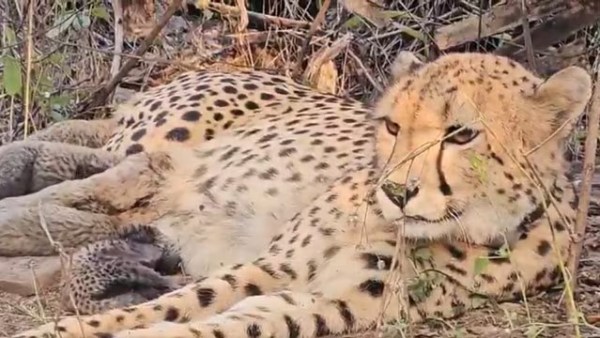 (X/DrMohanYadav)
— Mukhi is the sole surviving cheetah cub born in India at Kuno, a landmark for the country’s cheetah reintroduction project. Born on March 29, 2023, to Namibian cheetah Jwala, Mukhi survived against extreme odds, including the death of its three siblings due to severe summer heat – a key challenge faced in adapting cheetahs to the Indian habitat.
— At present, India has 34 cheetahs, including 10 adults and 24 cubs. The big cat had been extinct in the wild in India before 20 individuals were transported from southern Africa in two batches in 2022 and 2023.
Therefore, option (b) is the correct answer.
The Carbon Border Adjustment Mechanism (CBAM) initially will apply to a certain number of products with a high risk of carbon leakage. Which of the following is/are included in the list of products?
1. Iron/Steel
2. Aluminium
3. Fertilisers
4. Hydrogen
Select the correct answer using the codes given below:
(a) 1 and 2 only
(b) 2 only
(c) 1 and 3 only
(d) 1, 2, 3 and 4
Explanation
— The introduction of the EU’s Carbon Border Adjustment Mechanism (CBAM) with the goal of reducing carbon emissions, putting a fair price on carbon emitted during the production of carbon-intensive goods imported into the EU, and encouraging cleaner industrial production through a methodology for calculating embedded emissions based on the Paris Agreement.
— The EU’s Carbon Border Adjustment Mechanism (CBAM) is planned to be completely operational by 2026, but it will initially apply only to a limited range of items with a high risk of carbon leakage, including iron/steel, cement, fertilisers, aluminium, hydrogen, and electricity.
Therefore, option (d) is the correct answer.
(Source: trade.ec.europa.eu)
With reference to the marine wasting disease, consider the following statements:
1. The starfish and sunflower sea stars were dying off from a wasting disease.
2. In this disease, the limbs of the starfish fell off, and their bodies melted away.
Which of the statements given above is/are correct?
(a) 1 only
(b) 2 only
(c) Both 1 and 2
(d) Neither 1 nor 2
Explanation
— The starfish, or sea stars, of various species were dying off from a wasting disease, in which their limbs fell off and their bodies melted away to leave just a pile of gunk. The epidemic was found along the Pacific coast of North America, all the way from the freezing waters off Alaska to the warmer shores of Mexico. Hence, statement 2 is correct.
— The wasting disease was impacting whole populations of starfish, but the worst affected were sunflower sea stars, which lost almost 90 per cent of their population. Hence, statement 1 is correct.
— Starfish perform a vital function in the marine ecosystem, maintaining a stable food chain. When billions of starfish died, the population of sea urchins, which they feed on, exploded. These sea urchins started eating away whole forests of kelp, a seaweed other marine animals thrive on and which helps sequester carbon.
Therefore, option (c) is the correct answer.
Daily Subject-wise quiz — History, Culture, and Social Issues (Week 132)
Daily subject-wise quiz — Polity and Governance (Week 137)
Daily subject-wise quiz — Science and Technology (Week 137)
Daily subject-wise quiz — Economy (Week 136)
Daily subject-wise quiz — Environment and Geography (Week 136)
Daily subject-wise quiz – International Relations (Week 136)
Subscribe to our UPSC newsletter and stay updated with the news cues from the past week.
Stay updated with the latest UPSC articles by joining our Telegram channel – IndianExpress UPSC Hub, and follow us onInstagramand X.

Read UPSC Magazine