9 min read
© IE Online Media Services Pvt Ltd
Latest Comment
Post Comment
Read Comments



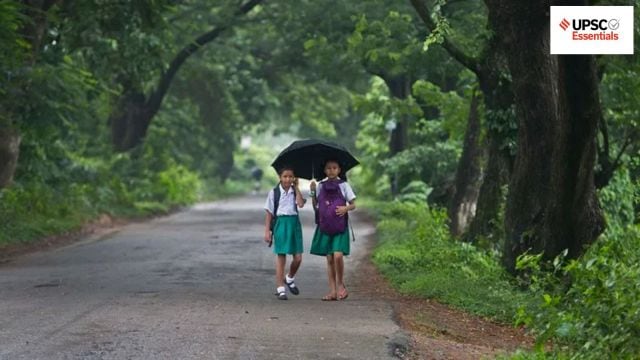 Check your progress and revise your topics through this quiz on the Environment and Geography. Find a question on the Northeast Monsoon in today's quiz. (AP Photo/Anupam Nath)
UPSC Essentials brings to you its initiative of subject-wise quizzes. These quizzes are designed to help you revise some of the most important topics from the static part of the syllabus. Attempt today’s subject quiz on Environment and Geography to check your progress.
🚨 Click Here to read the UPSC Essentials magazine for October 2025. Share your views and suggestions in the comment box or at manas.srivastava@indianexpress.com🚨
With reference to the Northeast Monsoon, consider the following statements:
1. It is shorter and less widespread as compared to the Southwest Monsoon.
2. It is known as the retreating monsoon.
3. It is important for southern India.
4. This monsoon is especially important for crops like cotton and sugarcane.
How many of the statements given above are correct?
(a) Only one
(b) Only two
(c) Only three
(d) All four
Explanation
— As the southwest monsoon begins to fade, the northeast monsoon sets in by October. This is also called the retreating monsoon. It is shorter and less widespread but still important, especially for southern India. Hence, statements 1, 2 and 3 are correct.
— By October, the land begins to cool more quickly than the ocean. This results in a high-pressure zone over the Indian subcontinent and a low-pressure zone over the surrounding oceans. Wind flow reverses direction. Now, winds blow from land to sea. These are called northeasterlies.
— Because these winds travel over the Bay of Bengal before reaching the southeastern shore, they take up moisture. As they travel across Tamil Nadu, south Andhra Pradesh, and parts of Sri Lanka, they supply ample moisture for rainfall activity. This rain is crucial for areas such as Tamil Nadu, which do not receive much during the southwest monsoon. Weather systems originating over the south Bay of Bengal bring ample rainfall to the south Peninsula.
— The southwest monsoon is especially important for crops like rice, cotton, and sugarcane. Hence, statement 4 is not correct.
Therefore, option (c) is the correct answer.
(Source: pib.gov.in)
With reference to the tigers and leopards, consider the following statements:
1. Tigers are bulkier, stronger, and built for power, whereas leopards are known for agility, stealth, and tree-climbing.
2. Leopards often become nocturnal or stick to rocky or higher terrain to avoid tigers.
Which of the statements given above is/are correct?
(a) 1 only
(b) 2 only
(c) Both 1 and 2
(d) Neither 1 nor 2
Explanation
Comparison of leopard and tiger
— When it comes to size, tigers are in a completely different weight class. A full-grown male Bengal tiger can weigh over 220 kg (485 lbs) and stretch more than 3 metres (10 feet) from nose to tail. A male leopard, by comparison, usually tops out around 60–70 kg (130–150 lbs) and is about 2 metres (6.5 feet) long.
— Tigers are bulkier, stronger, and built for power, whereas leopards are known for agility, stealth, and tree-climbing. Hence, statement 1 is correct.
 (file)
— Tigers are apex predators. They take down prey much bigger than themselves, like wild boars, sambar deer, even baby elephants in rare cases. Leopards, on the other hand, hunt smaller animals (impalas, monkeys, birds) and often drag their kill up trees to protect it from scavengers. This means they’re more stealthy and incredibly strong for their size.
— In the wild, tigers and leopards usually avoid each other. They might share the same forest (like in parts of India), but they’ve figured out ways to co-exist.
— Leopards often become nocturnal or stick to rocky or higher terrain to avoid tigers. They know better than to compete for the same space or prey. Hence, statement 2 is correct.
Therefore, option (c) is the correct answer.
The phenomenon ‘Turbidity island effect’ is related to:
(a) Water pollution
(b) Air pollution
(c) Soil salinisation
(d) Radioactive contamination
Explanation
— Local topography is particularly essential in determining air quality. Delhi is located in a bowl-shaped location inside the Indo-Gangetic plains (IGP), bordered by the Himalayas to the north, the Aravalli hills to the south-west, and the Malwa and Deccan plateaus to the south.
— Such geography makes it more difficult for contaminants to disseminate. The Himalayas obstruct the northward dispersal of heavy and filthy winter air, causing it to move eastward across the northern plains to the Bay of Bengal.
— Furthermore, post-monsoon air has lower moisture levels, temperatures, and wind speeds. During this time, pollutants are trapped near the ground, lowering their’mixing height’, or the height to which pollutants can diffuse.
— During the winter, temperature inversion circumstances occur when a layer of warm air lies on top of cold air and fog. This fog, when mixed with contaminants, forms smog, further reducing vision – a phenomenon known as the Turbidity island effect.
— The Turbidity Island Effect describes how urban/industrial regions act as an “island” of higher atmospheric turbidity (dust, smoke, aerosols) than adjacent rural areas.
Therefore, option (b) is the correct answer.
With reference to the Tropical Forest Forever Facility (TFFF), which of the following statements is not correct?
1. The TFFF is officially part of the UN Framework Convention on Climate Change (UNFCCC).
2. TFFF is the first global mechanism that recognises the value of forest ecosystem services and offers permanent incentives for their preservation.
3. It is a self-financing vehicle through which net returns will be awarded to up to 74 developing tropical forest countries.
Select the correct answer using the codes given below:
(a) 1 and 2 only
(b) 1 only
(c) 2 and 3 only
(d) 3 only
Explanation
— The TFFF is an investment fund designed as a permanent, self-financing vehicle through which net returns will be awarded to up to 74 developing tropical forest countries for keeping their existing old-growth forests intact. Hence, statement 3 is correct.
— The fund will look to raise $25 billion from wealthy governments and philanthropists, and an additional $100 billion in private investment. Then, the amount will be invested into a mixed portfolio of investments, including public and corporate market bonds, with annual returns used as a reward to tropical forest nations for conserving their forests. Note that payments to countries will be based on satellite remote sensing data that track forest canopy cover annually in a low-cost and transparent manner.
— The TFFF is designed to change this and pay for the conservation of the world’s major tropical forests, which provide a range of ecosystem services, including carbon storage. Put simply, the fund will help landowners to conserve forests by ensuring that the value they bring as standing forests is more than from cutting them down.
— Marina Silva, Brazil’s Minister of the Environment and Climate Change, during the launch event, said, “The launch of the TFFF at COP30 marks a turning point in the history of tropical forest conservation. For the first time, we have a global mechanism that recognises the value of forest ecosystem services and offers permanent incentives for their preservation.” Hence, statement 2 is correct.
— The TFFF is not officially part of the UN Framework Convention on Climate Change (UNFCCC), and is not subject to the same responsibilities that govern the UN climate negotiations, where the onus falls on developed countries. Hence, statement 1 is not correct.
Therefore, option (b) is the correct answer.
With reference to the direction of the wind in the cyclones, consider the following pairs:
1. In the Northern Hemisphere, the direction of wind circulation is clockwise.
2. In the Southern Hemisphere, the direction of wind circulation is anticlockwise.
Which of the pairs given above is/are correctly marked?
(a) 1 only
(b) 2 only
(c) Both 1 and 2
(d) Neither 1 nor 2
Explanation
— Cyclones are a type of atmospheric disturbance where wind circulates around a low-pressure centre. The source of energy for the genesis, development, and intensity of the tropical cyclones is the heat and moisture generated by the warm ocean waters.
— In the Northern Hemisphere, the direction of wind circulation is anticlockwise, while in the Southern Hemisphere, it circulates clockwise. Based on their location, cyclones are classified as tropical cyclones (forming over warm tropical oceans) and extratropical cyclones (occurring in temperate and high-latitude regions). Hence, pairs 1 and 2 are not matched correctly.
— Tropical cyclones are known by different names around the world – Hurricanes in the Atlantic, Typhoons in China, and Willy-willies in Australia. Most of the Indian landmass and the surrounding North Indian Ocean is located between the equator and the tropic of cancer, thus prone to some of the most devastating tropical cyclones.
Therefore, option (d) is the correct answer.
Daily Subject-wise quiz — History, Culture, and Social Issues (Week 131)
Daily subject-wise quiz — Polity and Governance (Week 136)
Daily subject-wise quiz — Science and Technology (Week 136)
Daily subject-wise quiz — Economy (Week 136)
Daily subject-wise quiz — Environment and Geography (Week 135)
Daily subject-wise quiz – International Relations (Week 135)
Subscribe to our UPSC newsletter and stay updated with the news cues from the past week.
Stay updated with the latest UPSC articles by joining our Telegram channel – IndianExpress UPSC Hub, and follow us onInstagramand X.


Read UPSC Magazine