8 min read
© IE Online Media Services Pvt Ltd
Latest Comment
Post Comment
Read Comments



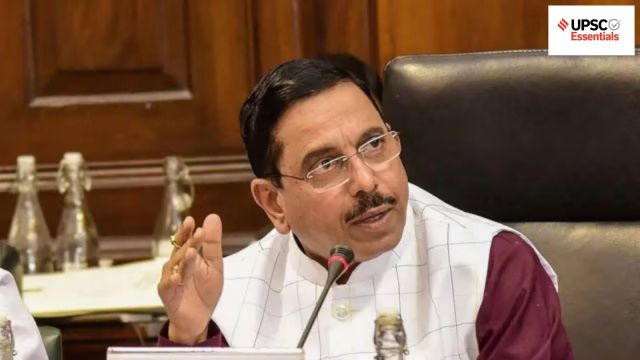 Here is the image of the Union Minister of New and Renewable Energy, Pralhad Joshi. Check your progress and revise your topics through this quiz on Economy. Find a question on the solar capacity in today's quiz. (File Image)
UPSC Essentials brings to you its initiative of subject-wise quizzes. These quizzes are designed to help you revise some of the most important topics from the static part of the syllabus. Attempt today’s subject quiz on the Economy to check your progress.
🚨 Click Here to read the UPSC Essentials magazine for November 2025. Share your views and suggestions in the comment box or at manas.srivastava@indianexpress.com🚨
Which of the following is/are the unclaimed deposits?
1. balances in savings accounts that remain inoperative for ten years
2. balances in current accounts that remain inoperative for five years
3. term deposits not claimed within two years from their maturity date
Select the correct answer using the codes given below:
(a) 1 and 2 only
(b) 1 only
(c) 2 and 3 only
(d) 1, 2 and 3
Explanation
— India’s banking sector has witnessed a significant transformation, shifting from a paper-based, branch-centric model to a highly advanced digital ecosystem. On October 4, 2025, the government launched the national campaign “Aapki Poonji, Aapka Adhikar — Your Money, Your Right”, aimed at creating awareness about unclaimed financial assets and assists citizens in tracing and claiming their dues.
— Balances in savings and current accounts that remain inoperative for ten years, as well as term deposits not claimed within ten years from their maturity date, are classified as unclaimed deposits.
— Unclaimed amounts are subsequently transferred by banks to the Depositor Education and Awareness (DEA) Fund maintained by the Reserve Bank of India (RBI).
Therefore, option (b) is the correct answer.
With reference to the solar capacity, consider the following statements:
1. In the last 11 years, the country’s solar capacity has grown from 2.8 GW to around 130 GW.
2. Between 2022 and 2024, India became the third-largest contributor to global solar additions.
Which of the statements given above is/are correct?
(a) 1 only
(b) 2 only
(c) Both 1 and 2
(d) Neither 1 nor 2
Explanation
— In the last 11 years, the country’s solar capacity has grown from 2.8 GW to around 130 GW, a rise of more than 4,500%. Between 2022 and 2024 alone, India contributed 46 GW to global solar additions, becoming the third-largest contributor. Hence, statements 1 and 2 are correct.
— Despite having the world’s fifth-largest coal reserves and being known as the second-largest consumer of coal, the Union minister said the country is steadily balancing coal with renewable energy as part of the transition process. Joshi said India’s shift towards renewable energy has become even more urgent and strategically important considering the global scenario.
Therefore, option (c) is the correct answer.
With reference to the World Inequality Report 2026, consider the following statements:
1. In India, the top 10 per cent of earners capture 58 per cent of the national income.
2. In India, the richest 10 per cent hold around 65 per cent of total wealth.
Which of the statements given above is/are correct?
(a) 1 only
(b) 2 only
(c) Both 1 and 2
(d) Neither 1 nor 2
Explanation
— Income inequality in India remains among the highest in the world, with top 10 per cent of earners capturing 58 per cent of national income, while bottom 50 per cent receive only 15 per cent, according to the latest World Inequality Report 2026, edited by economists Lucas Chancel, Ricardo Gómez-Carrera, Rowaida Moshrif, and Thomas Piketty. Hence, statement 1 is correct.
 (File photo/Canva)
— Wealth inequality is even greater in India, with the richest 10 per cent holding around 65 per cent of total wealth and the top 1 per cent holding about 40 per cent, the report released by the World Inequality Lab said. Hence, statement 2 is correct.
— As per the earlier World Inequality Report 2022, the top 10 per cent in India held 57 per cent of the total national income while the bottom 50 per cent’s share was 13 per cent in 2021.
Therefore, option (c) is the correct answer.
Which of the following are the factors responsible for the fall in the Indian rupee?
1. Weakening Foreign Direct Investment inflows
2. Investors pulling money out of Indian equity markets
3. Sharp tightening of monetary policy by the RBI
4. High tariffs on Indian goods
Select the correct answer using the codes given below:
(a) 1 and 2 only
(b) 1, 2 and 3
(c) 3 and 4 only
(d) 1, 2 and 4
Explanation
— The Reserve Bank of India (RBI) seemingly loosening its grip on the rupee, amid a host of other factors such as the delay in the India-US trade deal, the 50 per cent tariff on India, weakening Foreign Direct Investment inflows, and investors pulling out money from the equity markets. Hence, statements 1, 2 and 4 are correct.
— The result has been that the rupee has depreciated by around 5 per cent against the US dollar in 2025, falling past the 90-per-dollar last week to new all-time lows.
— A weaker rupee makes all of this more expensive. For example, an annual tuition fee of $100,000 would be Rs 85 lakh at an exchange rate of 85-per-dollar. When the rupee weakens to 90, the same fee becomes Rs 5 lakh higher in rupee terms – more than twice India’s nominal per capita income of Rs 2.05 lakh in 2024-25.
— Rising interest rates tend to attract foreign capital, which supports rather than weakens the rupee. Hence, statement 3 is not correct.
Therefore, option (d) is the correct answer.
Consider the following statements about the Monetary Policy Committee (MPC):
1. The first MPC was established in 2019.
2. The Union Finance Minister is the Chairperson or ex officio of the MPC.
3. The MPC determines the policy repo rate required to achieve the inflation target.
4. The quorum for the meeting of the MPC is three members.
How many of the statements given above are correct?
(a) Only one
(b) Only two
(c) Only three
(d) All four
Explanation
— The Reserve Bank of India’s Monetary Policy Committee (MPC) unanimously cut the repo rate by 25 basis points (bps) to 5.25 per cent, a move that is likely to bring down lending and deposit rates across the banking system.
— The reduction — the first after two consecutive pauses — signals a calibrated shift towards supporting growth at a time when the rupee has depreciated and breached the 90-mark against the dollar.
— Section 45ZB of the modified RBI Act of 1934 establishes an empowered six-member monetary policy committee (MPC) to be appointed by the Central Government via announcement in the Official Gazette.
— The first such MPC was established on September 29, 2016. Hence, statement 1 is not correct.
— The Governor of the Reserve Bank of India is the Chairperson or ex officio of the MPC. Hence, statement 2 is not correct.
— The MPC determines the policy repo rate required to achieve the inflation target. Hence, statement 3 is correct.
— The MPC is required to meet at least four times a year. The quorum for the meeting of the MPC is four members. Hence, statement 4 is not correct.
— Each member of the MPC has one vote, and in the event of an equality of votes, the Governor has a second or casting vote.
Therefore, option (a) is the correct answer.
(Other Source: rbi.org.in)
Daily Subject-wise quiz — History, Culture, and Social Issues (Week 135)
Daily subject-wise quiz — Polity and Governance (Week 140)
Daily subject-wise quiz — Science and Technology (Week 140)
Daily subject-wise quiz — Economy (Week 139)
Daily subject-wise quiz — Environment and Geography (Week 139)
Daily subject-wise quiz – International Relations (Week 139)
Subscribe to our UPSC newsletter and stay updated with the news cues from the past week.
Stay updated with the latest UPSC articles by joining our Telegram channel – IndianExpress UPSC Hub, and follow us on Instagram and X.

Read UPSC Magazine