Why in the news?
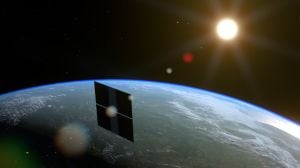
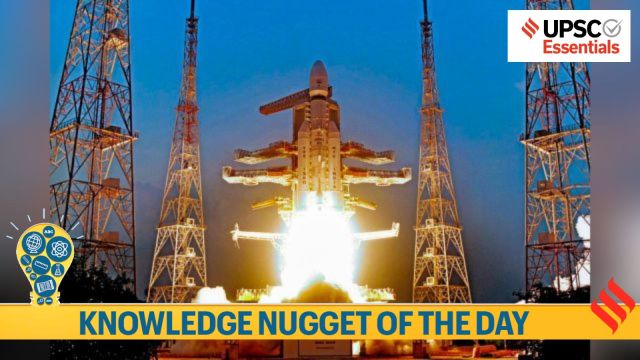
The India Space Research Organisation (ISRO) successfully completed the launch of LVM3-M5, breaking another record by launching the heaviest communication satellite from Indian soil, the CMS-03. As it is the demonstration of ISRO’s steadily improving capabilities, let’s know about it in detail to understand its significance.
Key Takeaways :
1. The LVM3-M5 launch marks the first time ISRO has placed a communication satellite weighing over 4,000 kg into a distant geosynchronous transfer orbit (GTO) from Indian soil.
2. The payload, CMS-03, is a multiband communication satellite weighing 4,410 kg. It is a multi-band communication satellite that will provide services over a wide oceanic region, including the Indian landmass. It is designed to provide services for at least 15 years.
3. Also known as the GSAT-7R, the CMS-03 is the replacement for GSAT-7 satellite, launched in 2013 on Ariane-5 rocket, which has reached the end of its lifespan.
4. The satellite will primarily serve the purposes of the Indian Navy, augmenting its space-based communications and maritime domain awareness capabilities.
Story continues below this ad
5. “GSAT-7R will provide robust telecommunication coverage across the Indian Ocean Region. Its payload includes transponders capable of supporting voice, data, and video links over multiple communication bands. This satellite will significantly enhance connectivity with high-capacity bandwidth, enabling seamless and secure communication links between ships, aircraft, submarines, and Maritime Operations Centres of the Indian Navy,” said a Defence Ministry statement.
6. Notably, ISRO has launched a satellite that was heavier than this. The GSAT-11 launched in 2018 weighed over 5,800 kg but had used the European Ariane-5 rocket. ISRO had been relying on the European rocket for sending all its heavier satellites, weighing more than 3,000 kg.
7. With CMS-03, ISRO has demonstrated the heavy-lift capability of the LVM3 rocket. Thus, the LVM3-M5 launch is an important step towards reducing foreign dependence for space programmes and bringing down costs of the upcoming missions. It is also a demonstration of ISRO’s growing strategic autonomy and technological independence in executing more and more complex missions.
Launch Vehicle Mark-3 (LVM3)
8. The LVM3, formerly GSLV Mk-3, is ISRO’s most powerful rocket. It is capable of carrying up to 8,000 kg to low Earth orbit and 4,000 kg to geosynchronous orbit.
Story continues below this ad
9. LVM3 uses a combination of solid, liquid, and cryogenic engines and has already launched key missions like Chandrayaan-2, Chandrayaan-3, and OneWeb satellites. For this mission, the targeted orbit was lower (around 29,970 km at its highest point) to accommodate the heavier satellite.
10. ISRO modified the rocket to increase its payload capability by 10 per cent compared to the previous LVM3 launch (LVM3-M4) carrying the Chandrayaan 3. The vehicle has been dubbed ‘Bahubali’ for its weight capacity. The vehicle’s cryogenic upper stage was upgraded from the C25 (carrying 28,000 kg fuel and generating 20 tonnes thrust) to a more powerful C32 stage (carrying 32,000 kg of fuel and producing 22-tonne thrust).
BEYOND THE NUGGET: ISRO’s launch Vehicles
1. Satellites don’t go into space on their own. They have to be carried there by launch vehicles, or rockets, like the PSLV. The rockets have powerful propulsion systems that generate the huge amount of energy required to lift heavy objects like satellites into space, overcoming the gravitational pull of the earth.
ISRO launch vehicles PSLV and GSLV.
2. ISRO’s Small Satellite Launch Vehicle (SSLV) is a three-stage Launch Vehicle configured with three Solid Propulsion Stages. It also has a liquid propulsion-based Velocity Trimming Module (VTM) as a terminal stage, which can help adjust the velocity as it prepares to place the satellite.
Story continues below this ad
3. The Polar Satellite Launch Vehicle (PSLV) is the third generation of Indian satellite launch vehicles. first used in 1994. More than 50 successful PSLV launches have taken place to date. It has also been called “the workhorse of ISRO” for consistently delivering various satellites into low earth orbits (less than 2,000 km in altitude) with a high success rate.
4. Geosynchronous Satellite Launch Vehicles (GSLVs) have been instrumental in launching communication satellites in the geosynchronous transfer orbit. According to the European Space Agency (ESA), telecommunications satellites are usually placed in geostationary Earth orbit (GEO). It is a circular orbit 35,786 kilometres above Earth’s equator.
5. GSLVs have a higher capacity because sending satellites deeper into space requires greater power. Therefore, cryogenic engines consisting of liquid hydrogen and liquid oxygen are used in GSLVs as they provide greater thrust than the engines used in the older launch vehicles.
Post Read Question
With reference to India’s satellite launch vehicles, consider the following statements : (UPSC CSE 2018)
Story continues below this ad
1. PSLVs launch the satellites useful for Earth resources monitoring whereas GSLVs are designed mainly to launch communication satellites.
2. Satellites launched by PSLV appear to remain permanently fixed in the same position in the sky, as viewed from a particular location on Earth.
3. GSLV Mk III is a four-staged launch vehicle with the first and third stages using solid rocket motors; and the second and fourth stages using liquid rocket engines.
Which of the statements given above is/are correct?
(a) 1 only
(b) 2 and 3 only
(c) 1 and 2 only
(d) 3 only
(Sources: Five things to know about LVM3-M5, ISRO launches heaviest satellite from India in a show of growing strategic autonomy)
Story continues below this ad
Subscribe to our UPSC newsletter. Stay updated with the latest UPSC articles by joining our Telegram channel – Indian Express UPSC Hub, and follow us on Instagram and X.
🚨 Click Here to read the UPSC Essentials magazine for October 2025. Share your views and suggestions in the comment box or at manas.srivastava@indianexpress.com🚨


 6 min read



 ISRO launch vehicles PSLV and GSLV.