12 min read


© IE Online Media Services Pvt Ltd



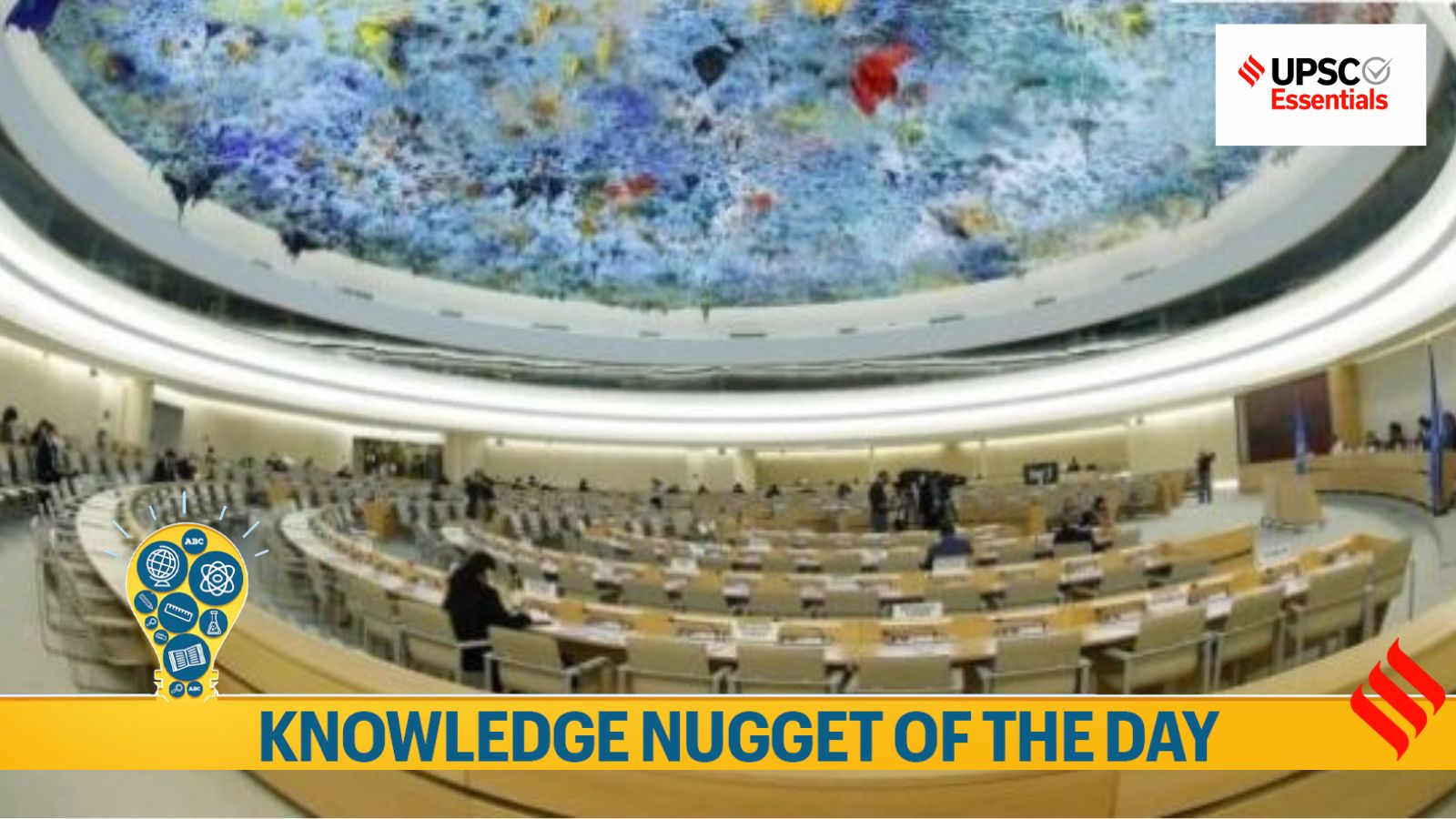 A general view during a session of the Human Rights Council at the United Nations in Geneva, Switzerland.
Take a look at the essential concepts, terms, quotes, or phenomena every day and brush up your knowledge. Here’s your UPSC current affairs knowledge nugget on Human Rights and Human Rights Day for today.
(Relevance: This article strengthens conceptual clarity on human rights which is an important theme in Polity, Governance, and Ethics. It aids preparation for GS-II (rights issues, statutory bodies, UN bodies) and GS-I (modern history, world events). Insights on UDHR, Human Rights Day, HRC, UHRI, and NHRC help in prelims, mains, and essay writing. It also supports understanding of India’s institutional mechanisms, crucial for answer enrichment and case studies.)
What are Human Rights?
1. According to UN: Human rights are rights inherent to all human beings, regardless of race, sex, nationality, ethnicity, language, religion, or any other status. Human rights include the right to life and liberty, freedom from slavery and torture, freedom of opinion and expression, the right to work and education, and many more. Everyone is entitled to these rights, without discrimination.
Human rights and sustainable development are correlated to Sustainable Development Goals (SDGs) in the sense that human rights are driven by progress on all SDGs and SDGs are driven by advancements on human rights.
2. As per Section 2 of the Protection of Human Rights Act, 1993 (the Act), “human rights” means rights relating to life, liberty, equality, and dignity of the individual guaranteed under the Constitution or embodied in international covenants and enforceable by courts in India.
“International Covenants” refers to the International Covenant on Civil and Political Rights and the International Covenant on Economic, Social and Cultural Rights, both adopted by the United Nations General Assembly on 16 December 1966.
What is Human Rights Day and Universal Declaration of Human Rights?
1. Human Rights Day is observed on December 10 every year. It is the day when the United Nations General Assembly adopted the Universal Declaration of Human Rights (UDHR). The theme for the year 2025 is ‘Human Rights, Our Everyday Essentials’
2. UDHR is a document proclaiming the inalienable rights which everyone is entitled to as a human being, irrespective of race, colour, religion, sex, language, political or other opinion, national or social origin, property, birth or any other status. It is the most translated document in the world, and is available in over 500 languages.
3. On December 10, 1948, the UNGA approved the Universal Declaration of Human Rights at a meeting in Paris – laying one of the foundation stones of the international order that emerged following the horrors of World War II.
4. The declaration was proclaimed as “a common standard of achievement for all peoples and all nations.” In practice, it hasn’t always turned out that way over the subsequent decades. As the document turns 75, U.N. human rights chief Volker Türk said that the world is at a “somber moment in history,” wracked by conflicts and crises. But he insisted that “human rights have not failed.”
5. A relatively compact document, the declaration consists of a preamble and 30 articles setting out fundamental rights and freedoms.
6. Article 1 states that “all human beings are born free and equal in dignity and rights.” And Article 2 says that everyone is entitled to all the rights and freedoms the declaration sets out, “without distinction of any kind, such as race, colour, sex, language, religion, political or other opinion, national or social origin, property, birth or other status.”
7. Other articles state that “everyone has the right to life, liberty and the security of person,” and that no one “shall be held in slavery or servitude” or “subjected to torture or to cruel, inhuman or degrading treatment or punishment.”
8. The declaration says that “all are equal before the law” and that everyone is entitled to “a fair and public hearing by an independent and impartial tribunal.” And it says that “everyone has the right to seek and to enjoy in other countries asylum from persecution.” The declaration enshrines the rights to freedom of religion; to freedom of opinion and expression; and to freedom of peaceful assembly. And it says that everyone has the right to education.
9. The declaration was born of the “never again” sentiment among political leaders after two world wars and the Holocaust.
10. A formal drafting committee was chaired by Eleanor Roosevelt, the widow of U.S. President Franklin D. Roosevelt, and consisted of members of the new Commission on Human Rights from eight countries, selected to reflect geographical distribution.
11. Over 50 U.N. member countries participated in the final drafting in 1948, and the U.N. General Assembly approved the result on Dec. 10, 1948, with eight countries abstaining but none voting against.
12. Human rights group Amnesty International notes that the declaration was drawn up at a time when much of the world’s population lived under colonial rule but says that “its drafting ultimately could not be controlled by the powerful alone.” It says that smaller nations “outmaneuvered the large,” ensuring that the final text promised human rights for all without distinction, and that female delegates ensured equal rights for men and women were affirmed.
13. The declaration isn’t a treaty and isn’t legally binding in itself, but the principles it sets out have been incorporated into many countries’ laws and it is viewed as the basis for international human rights law.
What are Human Rights Council and Universal Human Rights Index (UHRI)?
1. The Human Rights Council (HRC): It is the UN’s main intergovernmental body dedicated to promoting and protecting human rights worldwide. Created in 2006 by the General Assembly, it replaced the former Commission on Human Rights and meets regularly at the UN Office at Geneva.
The Council provides a global forum for dialogue among states, UN experts, and civil society on human rights issues. It adopts resolutions that signal the international community’s position, convenes special sessions in response to urgent crises, reviews every Member State’s human rights record through the Universal Periodic Review (UPR), appoints independent experts to monitor thematic and country situations, and can authorize investigations into serious violations.
The HRC consists of 47 Member States elected by the General Assembly for three-year terms, with seats distributed across regional groups and one-third of members renewed annually. States are expected to uphold the highest human rights standards, and the General Assembly may suspend members involved in systematic violations. The Council is led by a president and four vice-presidents representing each region.
2. The Universal Human Rights Index (UHRI) : The UHRI facilitates access to human rights recommendations issued by three key pillars of the United Nations human rights monitoring system: the Treaty Bodies established under the international human rights treaties as well as the Special Procedures and the Universal Periodic Review (UPR) of the Human Rights Council.
It is central repository of human rights information and aim at assisting States in the implementation of these recommendations and to facilitate the work of national stakeholders such as National Human Rights Institutions (NHRIs), non-governmental organisations, civil society and academics as well as the United Nations in support of such implementation efforts and for human rights analysis including to identify who may be at risk of being left behind and mapping of systematic, recurring and unresolved human rights issues.
— The National Human Rights Commission (NHRC) of India was established on 12 October, 1993.
— The statute under which it is established is the Protection of Human Rights Act (PHRA), 1993 as amended by the Protection of Human Rights (Amendment) Act, 2019.
— Inquiring into complaints is one of the major activities of the Commission. As per FAQs answered on NHRC website, “In several instances, individual complaints have highlighted broader issues related to violations of rights, enabling the Commission to urge the concerned authorities to implement systemic improvements.
The Commission actively seeks out significant human rights issues either suo motu or when brought to its attention by civil society, the media, concerned citizens, or expert advisers. Its focus is to strengthen the extension of human rights to all sections of society, particularly vulnerable groups.”
— Upon completion of an inquiry, the Commission may:
— The authority/ State Government, or Central Government is required to provide their comments or report the action taken on the Commission’s reports or recommendations within one month for general complaints and within three months for complaints related to the armed forces.
— The Commission’s autonomy derives, inter-alia, from the method of appointing its Chairperson and Members, their fixed tenure, statutory guarantees, the status accorded to them, and the manner in which its staff (including the investigative agency) is appointed and operates.
— The financial autonomy of the Commission is specified in Section 32 of the Act. The Chairperson and Members are appointed by the President based on recommendations from a Committee comprising the Prime Minister (as the Chairperson), the Speaker of the Lok Sabha, the Home Minister, leaders of the opposition in the Lok Sabha and Rajya Sabha, and the Deputy Chairman of the Rajya Sabha.
— The chairperson and members of State Human Rights Commission are appointed by the Governor of the state on the recommendations of a committee consisting of the chief minister as its head, the speaker of the Legislative Assembly, the state home minister and the leader of the opposition in the Legislative Assembly.
— The Commission has its own investigative staff headed by a Director General of Police for investigating human rights violation complaints. Under the Act, the Commission may also utilize the services of officers or investigation agencies from the Central or State Governments. Additionally, the Commission has involved non-governmental organizations in investigations in several cases.
According to nhrc.nic.in:
— “India’s human rights framework is deeply rooted in its cultural ethos, constitutional mandates, diverse legislation, institutional structures, and international obligations. The Constitution of India exemplifies its commitment to democratic values through the universal adult franchise, ensuring voting rights regardless of caste, gender, religion, or socio-economic background.
Fundamental Rights and Directive Principles of State Policy enshrined in the Constitution form the cornerstone of human rights protections in the country. The judiciary plays a vital role in upholding these rights through landmark judgments and proactive interventions.
Additionally, Public Interest Litigations (PILs) have emerged as a powerful tool to address pressing human rights challenges, including child labour, environmental degradation, access to healthcare, prisoners’ welfare, and migrant rights. The courts further safeguard individual freedoms by issuing writs that enforce constitutional protections and provide remedies against violations.”
— Various statutory and constitutional bodies, including the National Human Rights Commission (NHRC), play a vital role in promoting and safeguarding human rights in India.
Some of them are: National Commission for Women (NCW), National Commission for Protection of Child Rights (NCPCR), National Commission for Scheduled Castes (NCSC), National Commission for Scheduled Tribes (NCST), National Commission for Minorities (NCM), and National Commission for Backward Classes (NCBC).
POST READ QUESTION
Q. With reference to Human Rights and related institutions, consider the following statements:
1. Human Rights Day is observed on December 10 to mark the adoption of the Universal Declaration of Human Rights by the UN General Assembly.
2. The Universal Declaration of Human Rights (UDHR) is a legally binding treaty on all UN Member States.
3. The National Human Rights Commission (NHRC) in India is established under the Protection of Human Rights Act, 1993.
4. The Human Rights Council (HRC) conducts the Universal Periodic Review of human rights performance of all UN Member States.
Which of the statements given above are correct?
(a) 1, 3 and 4 only
(b) 1 and 2 only
(c) 2, 3 and 4 only
(d) 1 and 4 only
| Answer |
| (a) |
(Sources: un.org, ohchr,What is the Universal Declaration of Human Rights, which is marking its 75th anniversary?, nhrc.nic.in)
Subscribe to our UPSC newsletter. Stay updated with the latest UPSC articles by joining our Telegram channel – IndianExpress UPSC Hub, and follow us on Instagram and X.
🚨 Click Here to read the UPSC Essentials magazine for November 2025. Share your views and suggestions in the comment box or at manas.srivastava@indianexpress.com🚨

Read UPSC Magazine