7 min read
© IE Online Media Services Pvt Ltd
Latest Comment
Post Comment
Read Comments



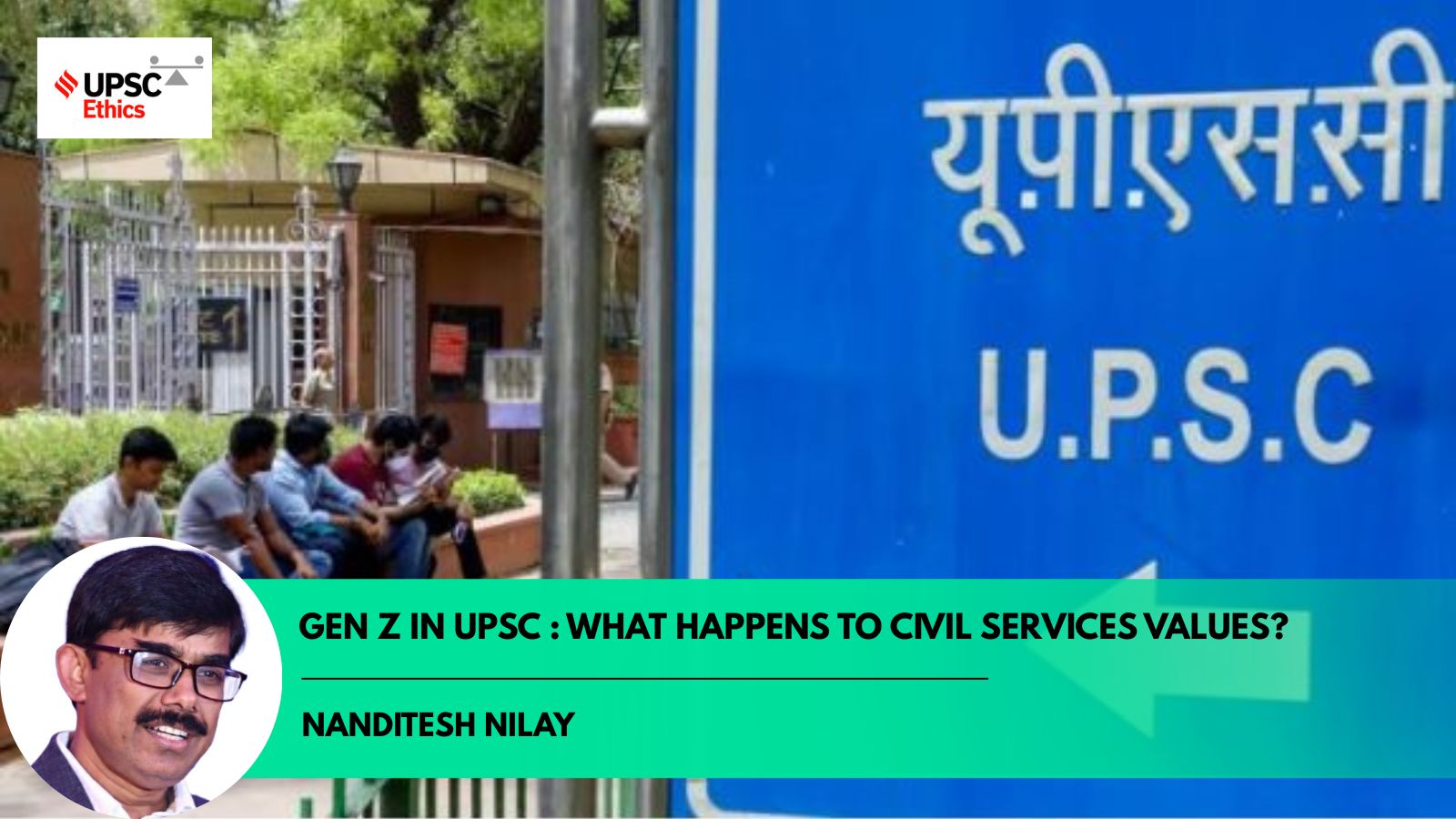 Gen X, Millennials and Gen Z must moderate ego, aggression and all other attitudinal aspects which may not be productive for governance and a healthy work culture.
 (UPSC Ethics Simplified is a special series under UPSC Essentials by The Indian Express. It examines news and syllabus themes from an ethical perspective, integrates real-life or hypothetical case studies, and revisits static concepts of ethics. The series aligns current affairs with core ethical principles for an ethical understanding of life, helping aspirants build clarity, application skills, and value-based understanding for GS-IV. In this article, Nanditesh Nilay, our ethicist, takes us through Gen Z in Civil Services and explores whether it will change how we view ethics.)
The world is talking about Gen Z in different spheres. But have you noticed that even in UPSC a growing share of aspirants today come from Generation Z (born 1997–2012)? While Gen X (born 1965–1980) and Millennials (born 1981–1996) remain in the system at senior levels, it is Gen Z who are the new aspirants and entrants in the civil services, and they are also becoming role models for many future candidates. Why does this shift matter? For two reasons:
1. Each generation carries its own communication style, value system, and expectations from institutions. A recent study comparing Millennials and Gen Z found that while Millennials communicate cautiously (verifying information and maintaining politeness), Gen Z prefers informal, fast, and emotionally honest communication, often expressed through sarcasm, abbreviations, and emojis. Verification may sometimes take a back seat to authenticity.
The study also shows that both generations express concerns such as inequality, discrimination, and social pressure, but their styles differ, creating what scholars call an “Angry Community.” This reflects not only digital behaviour but deeper social stress.
2. The core values of the Civil Services remain the same, but society and its challenges are changing rapidly. With a new generation possessing unique characteristics taking charge, the obvious question arises: Do the values of the older generations remain the same for them, and are they sufficient to tackle contemporary challenges?
From an ethics perspective, this generational shift raises important questions:
Can core values like trust, humility, respect, and compassion remain consistent across home and office?
Will Gen Z officers carry traditional values taught by parents, or redefine them through digital culture?
In governance, values cannot be compartmentalised. An officer’s communication pattern (whether empathetic or abrupt, reflective or impulsive) shapes citizen trust and administrative legitimacy. Since most senior officers remain Millennials, Gen Z will have to balance their digital-first instincts with workplace expectations of patience, deliberation, and institutional respect.
Gen Z bureaucracy is comfortable with virtual platforms and rapid communication. But speed must be matched with ethical leadership. The world still looks for the moral clarity once embodied by Mahatma Gandhi, his principles of non-violence, truth, self-restraint, and responsibility. The Chauri Chaura incident showed that youth energy needs direction; without ethical leadership, anger can drift into aggression.
If this gap is not addressed, young officers risk becoming over-reliant on AI tools, ignoring human judgment, or maintaining a sense of superiority that damages teamwork.
Gen Z brings valuable qualities like speed, creativity, and commitment. These should be channelled to drive innovation, not impatience. Ethics is inherent to good governance. It should not be treated as a compliance tick-box or a theory which is not supposed to be practiced.
What becomes essential is the framework of principlism. This framework includes:
1. Respect for autonomy which means listening to diverse voices especially the “last person” in society.
2. Beneficence which involves using creativity for public good.
3. Non-maleficence which means avoiding harm through careless communication or digital haste.
4. Justice, a very essential component that ensures fairness in decisions.
Gen X, Millennials and Gen Z must moderate ego, aggression and all other attitudinal aspects which may not be productive for governance and a healthy work culture. They must function from a balanced adult state which means to be rational, empathetic, and ethical. Governance works only when each generation presumes good intent in the other, accepts their strengths, and collaborates.
Gen Z civil servants can redefine governance. What they must do is to integrate their digital fluency with India’s enduring ethical ideals. We often think that the challenge is choosing between tradition and modernity. That is not always the case. The real challenge is combining value-based leadership with innovative governance. The success of the civil services is not to adapt to a new generation. In fact what counts is how it evolves into a more responsive, ethical, and people-centric institution, in today’s time under Gen Z, the new civil servants.
With a rising number of Gen Z entrants in the civil services, the challenge lies in balancing digital-age behaviour with traditional ethical values. Discuss how generational differences in communication and value systems can impact ethical governance. Suggest measures to ensure value-based public service in a multi-generational bureaucracy.
(The writer is the author of ‘Being Good’, ‘Aaiye, Insaan Banaen’, ‘Kyon’ and ‘Ethikos: Stories Searching Happiness’. He teaches courses on and offers training in ethics, values and behaviour. He has been the expert/consultant to UPSC, SAARC countries, Civil services Academy, National Centre for Good Governance, Central Bureau of Investigation (CBI), Competition Commission of India (CCI), etc. He has PhD in two disciplines and has been a Doctoral Fellow in Gandhian Studies from ICSSR. His second PhD is from IIT Delhi on Ethical Decision Making among Indian Bureaucrats. He writes for the UPSC Ethics Simplified (concepts and caselets) fortnightly.)
Can compassion bridge the gap between humans and animals?
How and why Civil Servants should be ‘enablers’ of growth, not mere ‘regulators’
Politicians, Athletes, UPSC Aspirants: Do Results Matter? Aristotle has an answer
How must a police officer choose between a VVIP and a common man at ‘Ram Lalla’ Darshan?
Subscribe to our UPSC newsletter and stay updated with the news cues from the past week.
Stay updated with the latest UPSC articles by joining our Telegram channel – Indian Express UPSC Hub, and follow us on UPSC section of The Indian Express on Instagram and X.
For your queries and suggestions write at manas.srivastava@indianexpress.com

Read UPSC Magazine