


© IE Online Media Services Pvt Ltd
Tags:


As the two-day talks between India and the US trade team in New Delhi concluded on Thursday (December 12), Prime Minister Narendra Modi and US President Donald Trump also emphasised the importance of sustaining momentum in the efforts to enhance bilateral trade in a phone call.
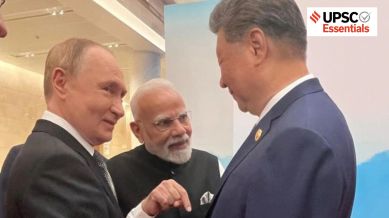
India also signed a wide-ranging set of agreements with Russia during President Vladimir Putin’s visit to Delhi last week. Concurrently, relations between India and China have been relatively stable for over a year since the two sides agreed on disengagement and patrolling arrangements along the LAC in October 2024.

This diplomatic openness on the part of states like India signals the kind of flexibility needed for a more multipolar world. But what exactly is multipolarity?
Multipolarity refers to a world or system with three or more great powers. In comparison to the bipolar order dominated by two superpowers (the US and the Soviet Union during the Cold War) or the unipolar system dominated by a single superpower (the US after the end of the Cold War), a multipolar world doesn’t allow a state to translate its greater military and economic strength into overwhelming superiority. Weaker states usually band together to neutralise the stronger states.
For instance, there are countries that refuse to buckle under the pressure of US tariffs. Similarly, there are countries carefully walking the tightrope and balancing ties with powers like the US, China, and Russia without getting aligned with one against the other.
Against this backdrop of the shifting power dynamics in international relations, alongside the waning global influence of the US, scholars debate whether the post-Cold War order is ushering in a bipolar or multipolar world, and its implications for stability.
Multipolar system is often associated with instability due to the increased number of actors compared to bipolar (two dominant powers) or unipolar (one hegemon) setups. But scholars have cited the Congress of Vienna in 1815, an entente between Europe’s great powers (Austria, Britain, France, Prussia, Russia) that lasted for nearly a century, as an example of a stable multipolar system.
However, the question of stability in any world order hinges on the distribution of power. Classical realist scholar Hans J Morgenthau lists the elements of power as geography, natural resources, industrial capacity, military preparedness, population, national character and morale, and quality of diplomacy and government.
Now, how states exercise power, and how others perceive it, defines the nature of a system. In a multipolar system, a number of states possess the power to achieve their goals in international relations. Since states seek power to ensure their survival in the anarchical international system, a multipolar order demands constant adjustment and readjustment of power relations.
We would love to hear what you think about this new initiative. Send your comments at ashiya.parveen@indianexpress.com.
Click Here to read the UPSC Essentials magazine for November 2025. Subscribe to our UPSC newsletter and stay updated with the news cues from the past week.
Stay updated with the latest UPSC articles by joining our Telegram channel – IndianExpress UPSC Hub, and follow us on Instagram and X.


