4 min read


© IE Online Media Services Pvt Ltd



 Explore the top 10 countries with the highest and lowest employment rates in 2024. Understand the economic factors and global trends shaping these rankings and India global position in the report. (Source: Freepik)
List of Countries by ILO’s Employment Report 2024: Employment serves as the pathway to economic development, social inclusion, and well-being.
The 2030 Agenda for Sustainable Development emphasizes it as a central element, particularly through Goal 8, which promotes productive employment and decent work for all.
However, the ILO’s 2024 global employment outlook presents a complex picture, with the unemployment rate worldwide projected to be 4.9%, a slight decrease from 5.0% in 2023.
This presents a paradoxical outlook; with improvements showcasing resilience, the labour market continues to confront persistent challenges amid deteriorating economic conditions.
The ILO’s World Employment and Social Outlook: September 2024 report highlights increasing pressure on inequality as the labour income share stagnates.
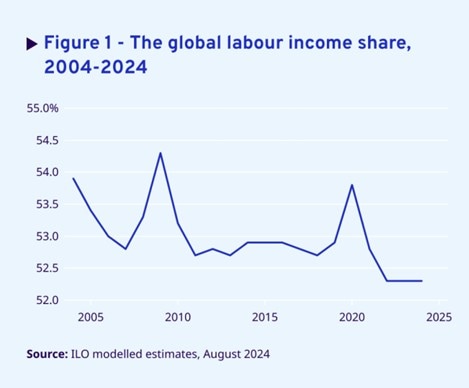 As demonstrated, there has been a substantial decrease in the labour share of national income over the last two decades. (Credit: ILO)
This signals slow progress toward the Sustainable Development Goals (SDGs) as the 2030 deadline approaches, with challenges like escalating geopolitical tensions, economic instability, and ongoing inflation collectively contributing to widening inequalities in employment rates across countries worldwide.
The employment-to-population ratio, a key metric from the ILO, serves as an important indicator of a country’s job prospects.
This ratio represents the fraction of the employed population compared to the working-age population.
A high employment-to-population ratio generally indicates more work availability, but it does not always imply higher wages or job satisfaction—many high-ranking countries have major informal industries.
Qatar has the highest employment rate at 88.8%, making it an attractive choice for those seeking job security.
The government’s investments in key industries such as natural gas, oil, construction, and finance, along with low unemployment policies and job opportunities in engineering, healthcare, and education for expats, have significantly boosted high employment rates in 2024.
Additionally, attractive remuneration packages have further enhanced this positive trend.
| Rank | Country | Employment-to-Population Ratio | Labour Dependency Ratio (Dependents/Employment) |
| 1 | Qatar | 88.80% | 0.34 |
| 2 | Madagascar | 83.60% | 0.95 |
| 3 | Solomon Islands | 83.10% | 0.97 |
| 4 | United Arab Emirates | 80.20% | 0.47 |
| 5 | Tanzania | 79.30% | 1.22 |
| 6 | Burundi | 78.10% | 1.33 |
| 7 | Ethiopia | 77.60% | 1.12 |
| 8 | Mozambique | 76.10% | 1.32 |
| 9 | Cambodia | 75.60% | 0.85 |
| 10 | Liberia | 74.70% | 1.23 |
Source: International Labour Organisation
Contrastingly, countries like Yemen, Somalia, and Afghanistan will have the lowest employment-to-population ratio rates in 2024.
Largely owing to the ongoing geopolitical conflicts, these countries are impacted by prolonged instability, resulting in hindered job creation, economic growth, and opportunities.
| Rank | Country | Employment-to-Population Ratio | Labour Dependency Ratio (Dependents/Employment) |
| 1 | Djibouti | 23.70% | 5.03 |
| 2 | Yemen | 27.00% | 5.07 |
| 3 | Somalia | 27.60% | 5.85 |
| 4 | Afghanistan | 31.30% | 3.85 |
| 5 | Jordan | 31.90% | 3.57 |
| 6 | Syrian Arab Republic | 33.40% | 3.25 |
| 7 | Occupied Palestinian Territory | 34.00% | 3.8 |
| 8 | Iraq | 35.00% | 3.56 |
| 9 | Nepal | 36.00% | 2.88 |
| 10 | Mauritania | 36.80% | 3.62 |
Source: International Labour Organisation
India is positioned as the fifth-largest economy globally, boasting a GDP that surpasses $3.94 trillion in 2024, driven by its vast and well-educated workforce.
The International Labour Organization (ILO) indicates that India’s employment-to-population ratio stands at a mere 52.8%, accompanied by a labour dependency ratio of 1.52; this underscores a significant gap between the country’s economic potential and the realities of its job market.
Furthermore, the Periodic Labour Force Survey (PLFS) recently reported that the youth unemployment rate in India is 10.2%, with females facing a higher rate of 11% compared to 9.8% for males.
 Status of unemployment of youths and adults in India. (Source: India Employment Report 2024, Institute for Human Development and International Labour Organisation)