4 min read
© IE Online Media Services Pvt Ltd



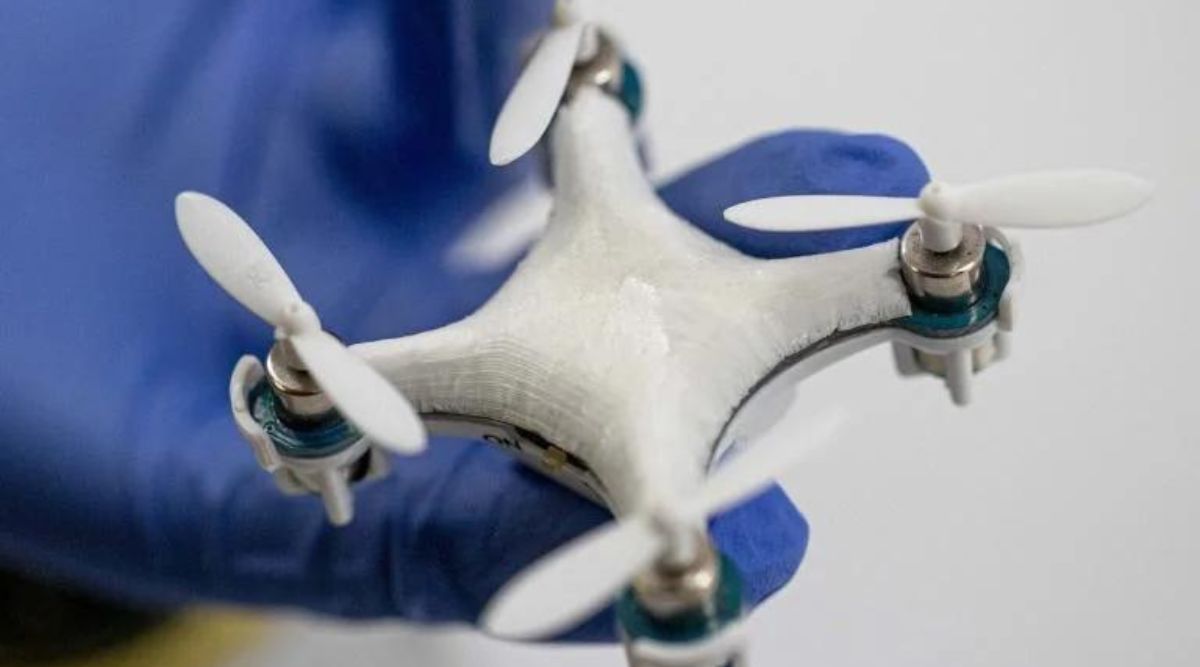 Here, the sensor is embedded into a drone. (Image credit: Silklab / Tufts School of Engineering)
 Researchers have developed a way to detect bacteria, toxins and dangerous chemicals using a biopolymer sensor that can be printed like ink, according to the Tufts School of Engineering. The sensor uses an enzyme similar to that found in fireflies to glow when it detects threats.
The biopolymer sensor is based on proteins and silk fibroin extracted from the cocoons of a silk moth called Bombyx Mori. it can be printed on a wide range of materials including wearable items like gloves, masks or clothing. It can also be embedded in films, sponges and filters or even moulded like plastic to help users sample and detect airborne and waterborne threats. It can potentially even be used to signal infections or even cancer in our bodies according to Tufts.
Using the technology, researchers were able to demonstrate how the sensor emits light within minutes when it detects the SARS-CoV-2 virus that causes Covid. They also demonstrated its use in detecting anti-hepatitis B virus antibodies, the foodborne toxin botulinum neurotoxin B and the human epidermal growth factor receptor 2 (HER2), which is an indicator for breast cancer.
In its current form, the sensor requires users to spray it with a non-toxic chemical after being potentially exposed to these bacteria, toxins and dangerous chemicals. At this point, the sensor will generate light when it detects a target. According to the researchers, the intensity of the light emitted by the device provides a quantitive measure of the concentration of the bacteria, toxins or other chemicals.
“The combination of lab-designed proteins and silk is a sensor platform that can be adapted to detect a wide range of chemical and biological agents with a high degree of specificity and sensitivity. For example, SARS-CoV-2 and anti-hepatitis B antibodies can be measured at levels that approach clinical assays,” said Fiorenzo Omenetto, co-author of the research paper published in the journal Advanced Materials, in a press statement.
The active component of the sensor is a “molecular switch” that acts with the same principle as a lock and key. When a virus, toxin or any other kind of target molecule comes close, it binds to the switch and opens a “cover”. Once this cover is opened, another part of the switch, the molecular key can then fit into the “lock”.
Together, this combination forms the enzyme luciferase, which lights up fireflies and glowworms. The more the amount of the target molecules present, the brighter the glow.
The active component of the biopolymer sensor, which was developed by David Baker, Henrietta and Aubrey Davis Endowed Professor in Biochemistry at the Institute for Protein Design at the University of Washington, is a molecular switch made of proteins that act like a lock and key, but with a cover.
When a virus, toxin, or other target molecule comes near, it binds to the switch and opens the cover. Another part of the switch—a molecular key—can then fit into the lock, and the combination forms a complete luciferase enzyme, similar to the enzyme that lights up fireflies and glowworms. The more virus, toxin, or other chemicals that bind to the sensor, the brighter the glow.
This switch is embedded in a mixture of proteins that is derived from silk cocoons. The silk fibroin in the sensor is an inactive component, but it has unique features that make it appropriate for the purpose. These features include the ability to be processed and manufactured using safe, water-based methods, and the versatility to be fabricated into different materials through an inkjet printer. Also, the silk fibroin stabilises the molecular glow switch and extends its shelf life.