The biggest use cases for 5G will probably be a pair of smart glasses, predicts Kedar Kondap, VP of product management at Qualcomm. Even though 5G is at a nascent stage and use cases are still being developed, Kondap says he sees a bright future in augmented reality glasses in context to 5G.
Kondap, who flew down from San Diego to attend the launch of Qualcomm’s new chipsets in India, lends his support to a 5G-powered extended-reality (XR) platform through which Qualcomm wants to bring new experiences by merging augmented reality and virtual reality together. It’s essentially a new augmented reality chipset for the next generation of AR headsets.

“This year you will see a lot more innovation in terms of untethered devices,” Kondap told Indianexpress.com in an interview. “Today, they are getting paired with smartphones, which will drive some amazing use cases,” he said.
Not all but most first-generation augmented reality glasses need to be paired to mobile devices like smartphones to handle computing and rendering of visuals. The use of smartphones for core processing is central to AR glasses and that’s probably the reason why Kondap isn’t ready to give an exact timeline on when smart glasses will replace smartphones.
“Yes, all of the processing happens on the phone and it’s rendered on your glass, but over time it will see much more innovation,” he explains.
While AR glasses are seen as the next big thing after smartphones, the biggest hurdle is obviously lack of consumer-focused content. Magic Leap, one of the heavily funded and hyped startups in the augmented reality, failed to sell its $2000 Leap One headset to consumers due to a lack of killer apps and immersive AR content.
Kondap did acknowledge that AR headsets lack exciting applications, but that might change this year. Without revealing the name of developers, Kondap revealed that a lot of new augmented reality content is currently being made that could increase the penetration of AR glasses.
Story continues below this ad
The hype around AR glasses is real, but the fact remains that we are in the early adoption phase of augmented reality technology. Industry experts believe that the first true augmented reality glasses that consumers would want to use haven’t come yet. The argument they are marking is that existing AR headsets are just an extension to smartphones.
Even Kondap admits that it will take a few years from these headsets can reach mainstream adoption. And the question of AR headsets replacing smartphones is too far from reality, considering mobile phones will initially drive sales of smart glasses in the near term.
Panasonic showed a futuristic-looking VR headset at CES 2020. (Image credit: Nandagopal Rajan/Indian Express)
Future AR glasses will be different from a smartphone. They will have a new type of manufacturing process, a significantly larger field of view, AR-focused apps and games, and will be designed in such a way that you can wear them all day.
Despite initial challenges that have negatively affected the mainstream adoption of AR headsets, Kondap hopes to see some positive momentum going forward. At this year’s CES, N-real, the Chinese start-up, got rave reviews for its augmented reality glasses that deliver an experience where virtual objects are superimposed onto the real-world environments. The headset, which resembles a lot like regular glasses, is powered by Qualcomm’s XR platform and uses an Android smartphone for the processing and rendering visual to the glasses.
Story continues below this ad
But Qualcomm isn’t the only one eyeing the augmented reality market. For the past few years, major tech companies including Apple, Facebook, Google, and Microsoft have shown interest in augmented reality. While Google failed to find a market for its AR glasses, Microsoft just recently started selling its $3500 HoloLens 2 to consumers. Apple and Facebook are yet to launch their respective AR headsets. But the rumours of both Apple and Facebook getting to the AR headset market have intensified in recent months.
Samsung, too, is interested in making AR glasses. Earlier this month, at CES 2020, Samsung showed off its first pair of augmented reality glasses. They don’t have a name, price or exact release date yet.


 5 min read


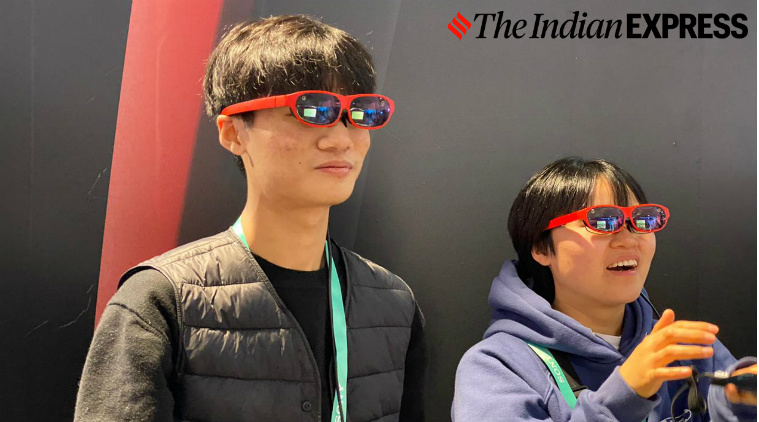 Visitors trying out Nreal Light augmented reality glasses at the Consumer Electronics Show (CES) 2020 in Las Vegas, Nevada. (Image credit: Nandagopal Rajan/Indian Express)
 Panasonic showed a futuristic-looking VR headset at CES 2020. (Image credit: Nandagopal Rajan/Indian Express)