The story of how world’s first self-learning Braille device ‘Annie’ was made
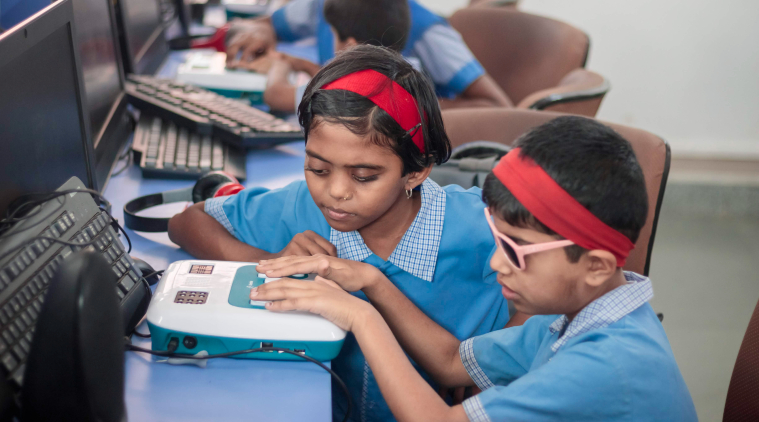
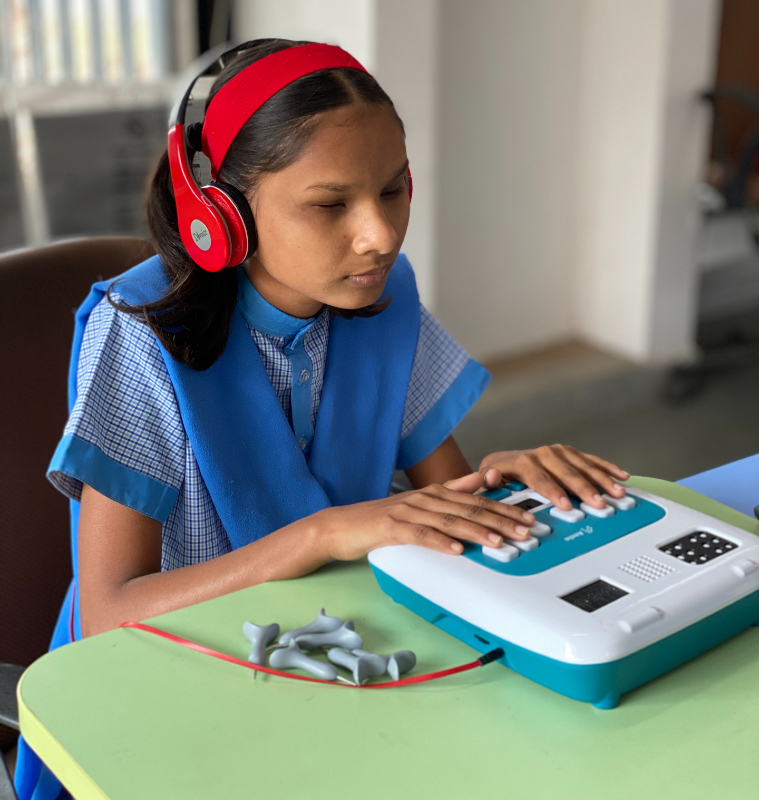
Srivastava, co-founder of Thinkerbell Labs, describes Annie as a Wi-Fi-enabled electronic Braille device that helps a child with low vision to read, write and type.
Annie is essentially a computer but designed for visually impaired students. (Image credit: Thinkerbell Labs)
Listen to this articleYour browser does not support the audio element.
A conversation that started at a breakfast table between Aman Srivastava and three of his friends from BITS Pilani, Goa, soon took the shape of a research project. It eventually led to a prototype far from the friends’ realm to imagine. That’s how Bengaluru-based Tinkerbell Labs developed “Annie,” the world’s first self-learning device for teaching Braille to visually impaired kids.
Although there has been a global push towards inclusive education, Srivastava, 28, saw a gap between teachers not adequately trained and the lack of the right tools needed to provide early education for the visually impaired. “When you teach your child ABC, the child doesn’t learn ABC just because of your teaching. It is constantly shown the letters and alphabets everywhere, in every book, every signboard and that was completely missing in case of teaching children with visual impairments,” he explains.
You’ve Read Your Free Stories For Now
Sign up and keep reading more stories that matter to you.
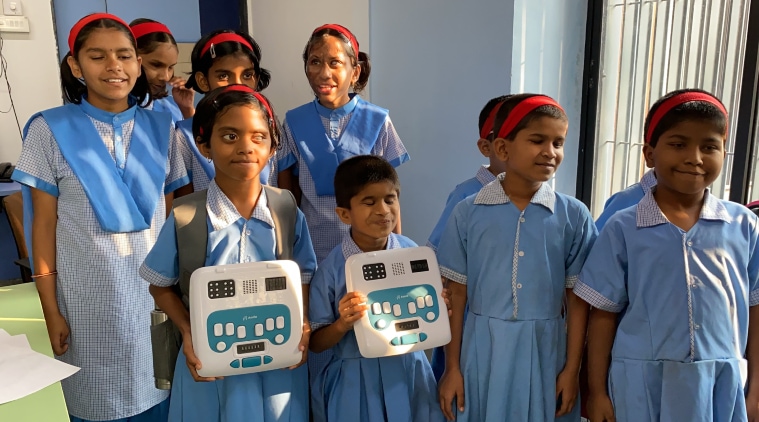
Srivastava says designing a hardware product is still a challenge in India due to the few electronic component manufacturers and the lack of a hardware ecosystem in India. (Image credit: Thinkerbell Labs)
Srivastava says when he and his team started working on Annie in 2016, they found that the traditional teaching method for visually impaired students required one-to-one hand-holding, which could be extensive in nature. “We realised that we could build something that amplifies the effectiveness of a special educator by developing a solution designed to cater to not one but multiple students at the same time. What would that world look like?” he told indianexpress.com in an interview.
Srivastava describes Annie as a literacy tool, a Wi-Fi-enabled electronic Braille device that helps a child with low vision to read, write and type. It has been designed around the concept of audio-tactile, which makes learning more interactive for a child with visual impairments. The device teaches Braille—an embossed reading system which allows blind or visually impaired students to read using their fingers—in English, Hindi or whichever local language they are comfortable in. The idea is to cover all the basic aspects of language first and once a child becomes literate, they use that knowledge of literacy to learn other things like vocabulary, sentences, comprehension, etc.
The learning method to educate visually impaired students is still old, but a device like Annie has the potential to change that, claims Srivastava. (Image credit: Thinkerbell Labs)
The design of Annie has gone through multiple iterations, which Srivastava says is a common practice in designing a product from the ground up. In the early versions of Annie developed in-house, the device had only one large Braille cell with audio but later it was decided to add a few standard cells. “The design has evolved based on functional requirements, which is if you have to educate from classes 1 to 8, what all do you need hardware-wise?” Srivastava says.
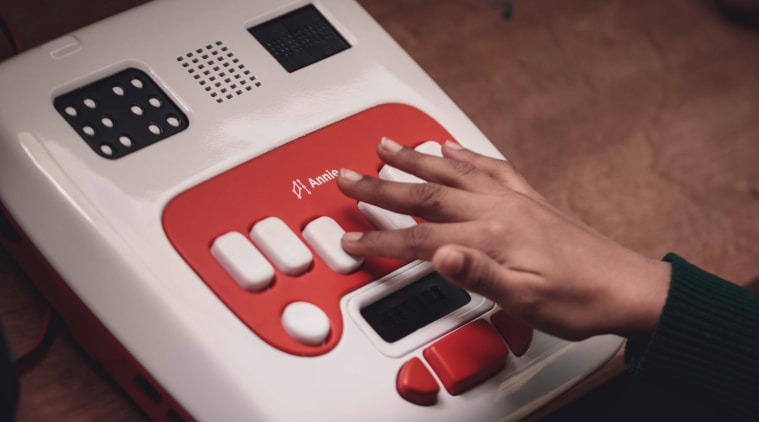
Srivastava recalls the team built 50 to 60 prototypes across five to six versions before commercially starting deploying Annie in 2018. Early prototypes of Annie were completely white and the vibe was exactly the same as a washing machine from IFB. But during the design process, Srivastava and the team wanted Annie to go beyond that white colour. “We really wanted Annie to have a playful, colourful, console-type design. We were inspired by Xbox and Nintendo consoles of the past and the design worked for Annie,” he adds. In fact, Annie’s middle portion, where the typing module is, mimics a video game console. “Most assistive gadgets have been boring, but we wanted to change that with Annie,” says Srivastava.
The design of Annie has been inspired by Nintendo consoles of the past. (Image credit: Thinkerbell Labs)
Srivastava sees Annie as a full-fledged computer which can be updated just like a smartphone. The device controls the tactile display that children can touch and feel which then shows words, alphabets and letters to them. There are different buttons for different tasks, similar to how a laptop works. Annie is a connected device and can be remotely enabled—it is possible to keep track of students’ performance.
Story continues below this ad
But Annie isn’t just a hardware device, clarifies Srivastava. In fact, Annie has a hardware layer, a content layer, and a software layer to it. Srivastava and team worked with the UK’s Royal National Institute of Blind People (RNIB) as well as India’s National Institute for the Empowerment of Persons with Visual Disabilities to develop the content which is as per different grades of Braille that works on Annie. The content, which consists of alphabet learning, listening to sentences and games, is fully digitised and made interactive in nature. “We had to design a new system where if a child goes wrong, Annie can correct them instantaneously in real-time and then the progress is recorded and that can be given to a teacher, parent or school authority as and when required,” he says.
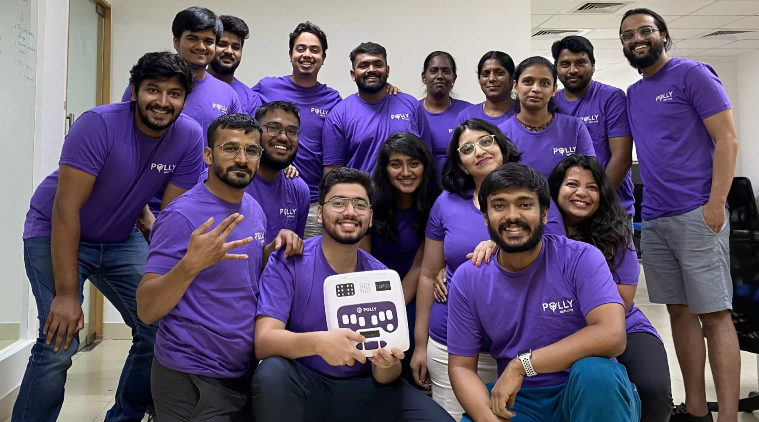
Thinkerbell Labs is a young, Bengaluru-based startup, which focuses on assistive tech. (Image credit: Thinkerbell Labs)
The perception towards assistive tech is changing quickly and more people, especially investors, are rooting for accessible platforms and hardware. “People [Investors] want to invest in hardware, they now want to look at tangible things,” Srivastava says. “When we initially started, everyone would ask to replicate the concept of [Annie] on a mobile phone app but the things functionally required for a child to learn can’t be put on a smartphone because a phone is not tactile in nature.”
“In tech, inclusion has to come to tech. It should be seen as yet another customer problem and solving leads to value creation and eventually business,” he says.
For Srivastava, the acceptance of Annie—sold as Polly in the US—has opened new opportunities for the young startup in the west. TIME Magazine recently named Polly one of the best inventions in 2022. The hardware of Annie and Polly are the same—the only difference comes when it comes to the software and content designed keeping the US curricula in mind.
Srivastava says the idea behind Annie was to design a solution which could help visually impaired children learn faster. (Image credit: Thinkerbell Labs)
Since its launch, as many as 400 units of Annie are up and running across schools. Just recently, Srivastava’s company signed a deal with the American Printing House for the Blind, a non-profit organisation, where Tinkerbell Labs will provide 700 units of Annie every year for three years. Rather than selling the hardware individually, Srivastava makes money by deploying Annie on the basis project. “It’s exactly like supplying and setting up computers in school labs,” he says. “One Annie project costs around 7.5 to 9 lakh depending on a school, how many students are there, how many teachers have to be trained and how many devices have to be deployed,” he adds.
Srivastava and his team are currently working on a few new versions of Annie with more content. There are also plans to expand the regional language support on Annie, including Malayalam, Oriya, Gujarati, and Punjabi.
Anuj Bhatia is a seasoned personal technology writer at indianexpress.com with a career spanning over a decade. Active in the domain since 2011, he has established himself as a distinct voice in tech journalism, specializing in long-form narratives that bridge the gap between complex innovation and consumer lifestyle.
Experience & Career: Anuj has been a key contributor to The Indian Express since late 2016. Prior to his current tenure, he served as a Senior Tech Writer at My Mobile magazine and held a role as a reviewer and tech writer at Gizbot. His professional trajectory reflects a rigorous commitment to technology reporting, backed by a postgraduate degree from Banaras Hindu University.
Expertise & Focus Areas: Anuj’s reporting covers the spectrum of personal technology, characterized by a unique blend of modern analysis and historical context. His key focus areas include:
Core Technology: Comprehensive coverage of smartphones, personal computers, apps, and lifestyle tech.
Deep-Dive Narratives: Specializes in composing longer-form feature articles and explainers that explore the intersection of history, technology, and popular culture.
Global & Local Scope: Reports extensively on major international product launches from industry titans like Apple and Google, while simultaneously covering the ecosystem of indie and home-grown tech startups.
Niche Interests: A dedicated focus on vintage technology and retro gaming, offering readers a nostalgic yet analytical perspective on the evolution of tech.
Authoritativeness & Trust
Anuj is a trusted voice in the industry, recognized for his ability to de-jargonize trending topics and provide context to rapid technological advancements. His authority is reinforced by his on-ground presence at major international tech conferences and his nuanced approach to product reviews. By balancing coverage of the world's most valuable tech brands with emerging startups, he offers a holistic and objective view of the global technology landscape.
Find all stories by Anuj Bhatia here.
You can find Anuj on Linkedin. ... Read More