5 min read
© IE Online Media Services Pvt Ltd



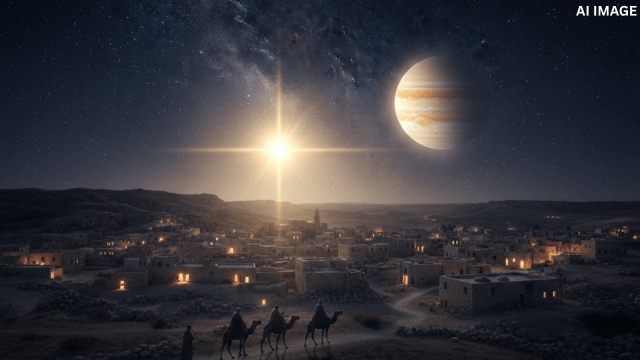 An AI representation of the Magi following the 'Star of Bethlehem' (Created with Gemini).
For centuries, the ‘Star of Bethlehem’ has captivated believers, scholars, and skywatchers alike. The Biblical account in the Gospel of Matthew describes a brilliant star that the Magi (The three Wise Men) saw rising in the east — a celestial sign they followed to Bethlehem after informing King Herod of the birth of a new “king of the Jews”. But what exactly did they see? And does modern astronomy offer any real clues to this ‘Star of Bethlehem’?
Ahead of Christmas this year, Jupiter is drawing attention once again. The giant planet rises bright in the east shortly after dark and will reach opposition on January 10, 2026. The Jupiter opposition is an astronomical event where the Earth aligns between the Sun and Jupiter, making Jupiter appear brightest, largest, and visible all night.
As it approaches its closest point, Jupiter brightens from magnitude –2.4 at the beginning of the month to – 2.5 by year’s end, dominating the winter sky and prompting some to liken it to a “Christmas Star”, as per Live Science. The lower the number, the brighter the object is. For context, the Sun has an apparent magnitude of −27. Yet astronomers caution that this cannot fully explain the Biblical event, as Jupiter reaches opposition every 13 months.
The broader question: what the “Christmas Star” really was that has been debated for more than 2,000 years. Scholars have long examined historical records and astronomical reconstructions for clues. As per an article published by the University of Cambridge, some suggest the Star of Bethlehem may have been a rare planetary conjunction, such as the close pairing of Jupiter and Saturn that reoccurred three times in 7 BC. Others point to the striking Jupiter-Venus conjunction of 3 BC, where the planets appeared almost to merge in the dawn sky, as per an article published by astronomy.com. Events like these could have caught the attention of ancient astrologers, though the biblical account does not perfectly match the motion or visibility of such alignments.
Multiple historian accounts say Jesus might have been born between 6 BC and 5 BC. This is because Herod the Great, who appears in the biblical narrative, died in or before 5 BC.
Other theories focus on more dramatic celestial events. Supernovae, for example, can make previously invisible stars flare into view. But no known supernova remnant aligns with the timeframe of Jesus’ birth, and ancient observers, especially in China, recorded no such explosion, the University of Cambridge article quotes a bye-fellow at Girton College. Comets, too, have long been considered a possibility. One was noted by Chinese astronomers in 5 BC and described as a “broom star”, but comets were typically seen as omens of misfortune, making them an unlikely herald of a savior’s birth, the fellow said.
Modern astronomers still field questions about the mystery. Dr Matt Bothwell of the University of Cambridge explains that the most discussed possibilities remain a supernova (the explosion of star), a comet, or a planetary conjunction, though each has weaknesses. The Magi, likely astrologers themselves, would have recognised Jupiter or other planets, diminishing the likelihood of confusion. Yet the persistence of a bright, unfamiliar comet remains a compelling scenario for some researchers, especially given the 5 BC sighting.
Planetary scientist at NASA Mark Matney, too, says in a study the mysterious “star” may have been a comet that came extremely close to Earth just over 2,000 years ago.
Matney says a comet was recorded in Chinese imperial archives, which was visible for more than 70 days in the spring of 5 BC. Matney created models of possible orbits for this comet based on the observations recorded in those times. One of his models shows that the object could have passed very close to Earth. In fact, it could have been so close that its apparent motion almost might have briefly cancelled out the Earth’s observable rotation.
Satellite engineers today refer to this as “temporary geosynchronous motion”. From the ground, the comet could have appeared to pause overhead for a short time before continuing on its path. And this might have been the ‘Star’, he says. However, this is not conclusive and the Star of Bethlehem continues to fascinate people world over.
Thus, the story remains unresolved. Planetary cycles, ancient records and astrophysical evidence offer intriguing hints but no definitive answer. For many, including Vatican Observatory astronomer Br. Guy Consolmagno, the significance of the ‘Star’ lies less in scientific certainty and more in the enduring fascination it inspires, as per the University of Cambridge article.
And while December 2025 brings no comets or rare alignments, Jupiter’s brilliance offers skywatchers a timely reminder of why the heavens have long stirred wonder. Whether or not it played a role in the Nativity story is a mystery that could be revealed in the future.