3 min read
© IE Online Media Services Pvt Ltd



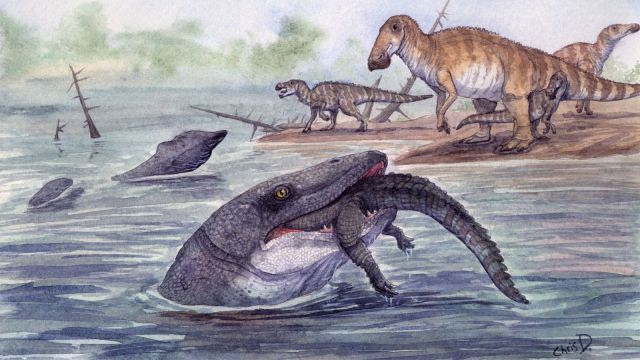 Additional mosasaur teeth from slightly older nearby sites showed similar freshwater signals, strengthening the conclusion that some mosasaurs occupied rivers during the final million years before their extinction. (Image: Christopher DiPiazza)
Large marine reptiles that dominated the seas might have inhabited river systems during their final years, according to recent studies indicating that certain mosasaurs evolved to thrive in freshwater environments at the end of the dinosaur era.
Researchers examining a solitary fossil tooth unearthed in North Dakota have uncovered strong proof that these gigantic predators were not limited to oceanic habitats, but also lived in freshwater river systems approximately 66 million years ago.
The tooth, discovered in 2022 from a river deposit, quickly baffled researchers. It was discovered near a Tyrannosaurus rex tooth and the jawbone of a crocodylian, in a region previously recognised for fossils of duck-billed dinosaurs like Edmontosaurus. Mosasaurs are commonly considered marine reptiles, so finding their remains in a river environment prompted a clear question: why was a massive sea creature in freshwater?
In response, scientists from Uppsala University led an international team that examined the chemical composition of the mosasaur’s tooth enamel. The researchers reconstructed the environment where the mosasaur existed by comparing it with nearby fossils of T. rex and crocodylians, all of which are approximately the same age. Isotope analysis targeting oxygen, strontium, and carbon showed a trend more aligned with freshwater environments than with marine ones.
The tooth exhibited elevated amounts of the lighter oxygen isotope linked to rivers, while strontium ratios also indicated a non-oceanic source. Carbon isotopes offered additional insights. In contrast to most mosasaurs, which display chemical markers associated with deep diving, this specimen exhibited elevated carbon values, indicating it foraged closer to the surface and might have scavenged submerged dinosaurs.
Additional mosasaur teeth from slightly older nearby sites showed similar freshwater signals, strengthening the conclusion that some mosasaurs occupied rivers during the final million years before their extinction.The researchers believe this shift was driven by environmental change. As freshwater increasingly flowed into the Western Interior Seaway, a vast inland sea that once split North America, the water gradually became less salty.
A layered system likely formed, with freshwater sitting above denser saltwater. Lung-breathing animals such as mosasaurs would have occupied this upper layer, unlike gill-breathing marine species that remained in saltier conditions below.
The size of the North Dakota tooth suggests an animal up to 11 metres long, comparable to a bus and rivalling the largest modern killer whales. Such a predator roaming river systems challenges long-held assumptions about where these reptiles lived. The findings reveal mosasaurs as adaptable hunters capable of exploiting new habitats as their world changed right up until the moment that world came to an abrupt end.