


© IE Online Media Services Pvt Ltd
Tags:


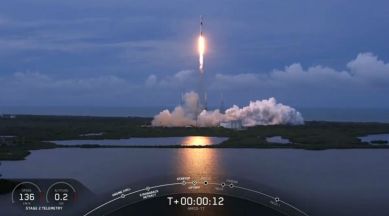
SpaceX has launched its third batch of mini-satellites into orbit, consisting of 60 mini-satellites. The satellite cluster was launched on-board the Falcon 9 rocket from Cape Canaveral, Florida. This is a part of its plan to build a giant constellation of thousands of satellites that form a global broadband Internet system.
The cluster separated from Falcon 9 above the ocean between Australia and Antarctica an hour after its launch. This brings the total number of satellites that are a part of SpaceX’s Starlink network to just under 180.


As of now, there are around 2,100 active satellites, which orbit Earth according to the Satellite Industry Association.
Musk has stated, that with his Starlink network wants to control three to five per cent of the global Internet market, which is currently valued at $30 billion per year. SpaceX in a statement said that its satellite constellation will be operational for Canada and the northern US by next year.
As of now, SpaceX has received US authorisation to launch 12,000 satellites in several different orbits. It has also applied to launch 30,000 more.
Also Read: This is how Elon Musk’s SpaceX will send astronauts to space
One more thing people are sceptical about having so many satellites is that this will result in expensive collisions between satellites, which will create thousands of pieces of new space junk.
To this SpaceX has responded saying that the Starlink satellites deploy at an altitude of 290 kilometres and then engage their ion thrusters to reach an orbit of 550 kilometres. When then life-time is almost up, they will use their propulsion systems to de-orbit over the course of a few months and if they fail they will burn up naturally in the atmosphere in under five years.


