


© IE Online Media Services Pvt Ltd
Tags:


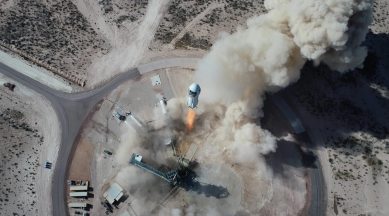
On July 11, British businessman Richard Branson hurtled into space aboard his own rocket and billionaire entrepreneur, Jeff Bezos, completed a spaceflight on July 20. With space tourism the new buzz word, here is a quick look at the difference between the different human spaceflight missions.
Type of vehicle


Jeff Bezos’ Blue Origin: New Shepard’s rocket-and-capsule was launched vertically into the suborbital space. They then separated and the rocket returned to the launchpad, while the capsule fell back to earth with parachutes assisting it make the landing in the West Texas desert.
Elon Musk’s SpaceX: The Dragon capsule will be launched by a reusable Falcon rocket. The spacecraft is also equipped with parachutes to stabilise the spacecraft during reentry and splashdown.
Time duration:
Richard Branson’s trip to space and back lasted about 90 minutes from take-off to landing. The SpaceShip was separated 45 minutes after takeoff and after reaching the required height, those on board experienced a few minutes of weightlessness before descending to the Spaceport in New Mexico.
Blue Origin’s flight lasted around 10 minutes from launch to capsule touchdown in the desert.
Elon Musk’s SpaceX is not aiming for short trips lasting minutes. Instead, the all-civilian missions are expected to last about three to four days from take-off to landing.
Space or edge of space?
The Kármán line or most widely accepted boundary of space, is located 100km above mean sea level. The US uses 80km as the cutoff point.
Branson’s Virgin Galactic flight reached a height of 86km while Jeff Bezos’ Blue Origin flight went about 107km high. SpaceX’s Earth Orbit mission promises to take a look at our planet from over 300km up.
Crew
Virgin Galactic: SpaceShipTwo is designed to carry two pilots and six passengers. The three mission specialists who travelled with Branson were: Beth Moses, Chief Astronaut Instructor at Virgin Galactic Colin Bennett, Lead Operations Engineer at Virgin Galactic. Sirisha Bandla, Vice President of Government Affairs and Research Operations at Virgin Galactic.
The pilots for the mission were Dave Mackay and Michael Masucci flying VSS Unity, and CJ Sturckow and Kelly Latimer flying VMS Eve.
Blue Origin: It can carry six passengers, is entirely automated and does not require a pilot. Bezos travelled with his brother Mark Bezos, aviation pioneer Wally Funk and 18-year-old high school graduate Oliver Daemen. He is Blue Origin’s first paying customer but the company has not disclosed his ticket cost.
SpaceX: The Dragon spacecraft can carry up to seven passengers. The first all-civilian rocket trip will include Jared Isaacman, a billionaire who bought the ride, Hayley Arceneaux, a physician assistant and pediatric bone cancer survivor, Sian Proctor, science communicator and Christopher Sembroski, a U.S Air Force veteran. Reports have mentioned that Elon Musk had expressed interest in joining Japanese billionaire Yusaku Maezawa on his week-long trip around the moon in 2023.


