5 min read
© IE Online Media Services Pvt Ltd



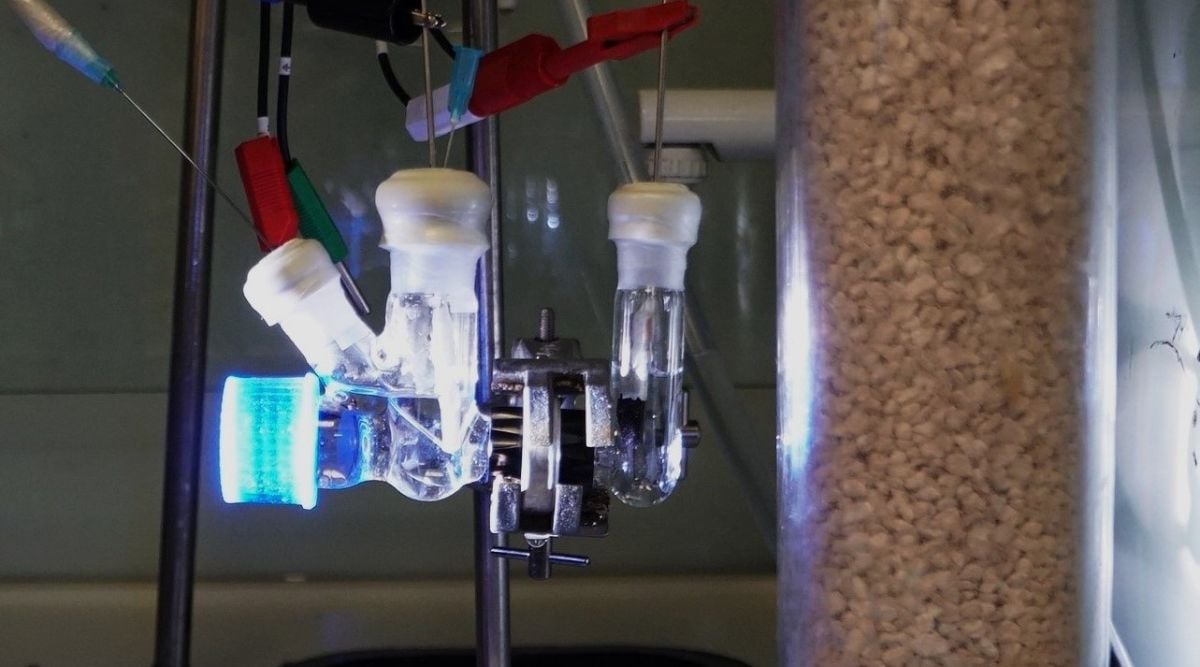 The lab-scale reactor can be seen here in this handout image. (Ariffin Mohamad Annuar via University of Cambridge)
 Scientists at the University of Cambridge have developed a solar-powered reactor that can convert captured carbon dioxide and plastic waste into a sustainable fuel, producing some other useful chemicals in the process.
The reactor converted carbon dioxide into syngas or synthetic gas. Syngas itself is combustible and can directly be used as fuel. Some kinds of syngas were supplied to residents of many industrialised cities in the 20th century. But it is a challenging fuel to work with and is better used to create other fuels.
The plastic bottles used in the test, meanwhile, were converted into glycolic acid. Glycolic acid finds a variety of uses in the healthcare industry. It is used by people for treating acne premature skin ageing, dark skin patches and acne scars, according to WebMD.
A particularly interesting aspect of the research, whose results were published in the peer-reviewed journal Joule on Monday, is that the reactors used carbon dioxide from real-world sources, including industrial exhaust and normal air.
“In the medium term, this technology can be used to decrease carbon emissions by capturing them from industry (power plants, cement factory, biogas plant) and turning them into fuel using sunlight and plastic waste. In the long term, it can be used for direct air capture (DAC) and conversion of CO2, to achieve a circular carbon economy,” said Sayan Kar, co-first author of the Joule article, to indianexpress.com in an email.
The research was conducted by Erwin Reisner’s research group in the Yusuf Hamied Department of Chemistry at the University of Cambridge. Reisner is a Professor of Energy and Sustainability at the department. Kar is a post-doctoral scientist at the department.
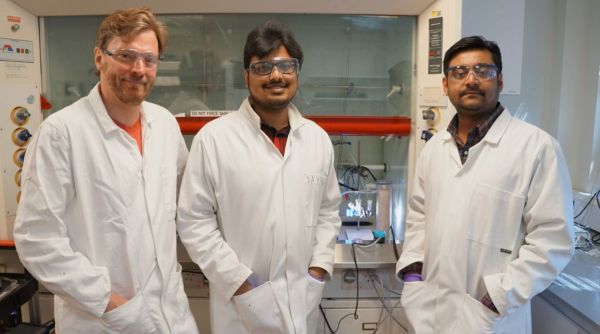 From left to right, Erwin Reisner, Sayan Kar, Motiar Rahaman, researchers who worked on the reactor. (Ariffin Mohamad Annuar via University of Cambridge)
For years, the research group has had prolific success in creating technologies that create net-zero carbon fuels inspired by photosynthesis. This includes “artificial leafs” unveiled by the team last month, which can convert carbon dioxide into propanol and ethanol.
But till now, all of their solar-powered experiments have used pure, concentrated carbon dioxide from a cylinder. Using the highly diluted carbon dioxide in the air is a massive technological challenge. To figure this out, the team looked to carbon capture and storage, a polarising technology, for inspiration.
According to Reisner, carbon capture and storage is a technology that is popular with the fossil fuel industry. Instead of capturing and storing carbon dioxide, if it could be captured and utilised, it could lead to making something useful instead of burying carbon underground, he asserts.
The conversion process begins with bubbling either air or flue gas (gas produced by burning fuel) thorough an alkaline solution. The solution traps carbon dioxide while other gases like nitrogen and oxygen bubble out. This method concentrates the carbon dioxide in the air, making it easier to work with.
The integrated system that then converts the carbon dioxide contains a photocathode and an anode. The anode is an electrical conductor into which electricity moves. The cathode is the electrical conductor through which electricity moves out. A photocathode is a cathode that emits electrons when light is shone on it.
The system has two compartments–on one side, carbon dioxide is the alkaline solution that captures carbon dioxide, which gets turned into syngas. On the other side, plastics are converted into glycolic acid.
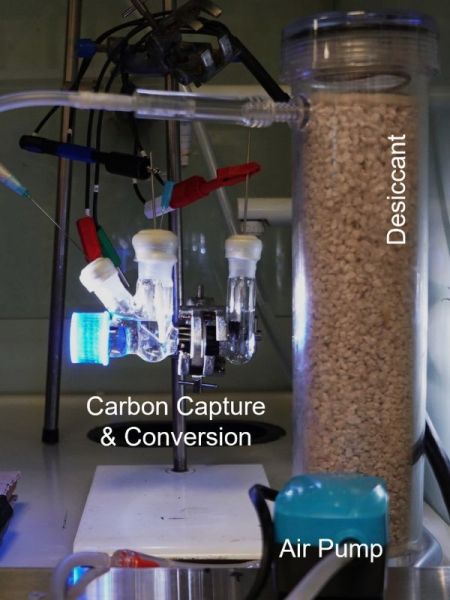 An annotated image showing the parts of the reactor. (Ariffin Mohamad Annuar)
According to Motiar Rahaman, co-first author of the article, the plastic is an important component of the system. The chemistry of capturing and using carbon dioxide from air is quite difficult. But the plastic in the plastic waste used donates electrons to the carbon dioxide. The plastic then breaks down into glycolic acid as the carbon dioxide gets turned into syngas. Rahaman is a senior postdoc at the department.
Now, the researchers are working on improving the efficiency, stability and durability of the system. This includes optimising the carbon capture process and the light absorption process.
Interestingly, the artificial leafs developed by the same research group initially made syngas from solar power, before it was modified to produce propanol and ethanol. The latter can directly be used as an additive in the petrol that goes into cars.
Rahaman, in an email to indianexpress.com, did not rule out such a possibility for the reactor. “This technology is quite versatile- selective product formation from the captured CO2 can be tuned by changing the CO2 reduction catalyst according to our need,” he said.