4 min read
© IE Online Media Services Pvt Ltd



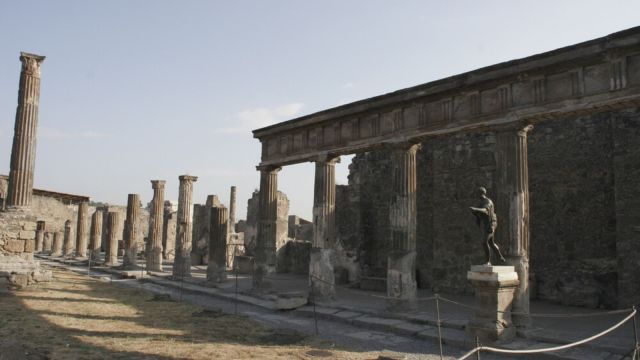 The clue lies in Pompeii itself, where the volcanic disaster preserved an active building site almost perfectly in place. (Image: UNESCO)
A fresh investigation of an ancient construction site at Pompeii is prompting researchers at Massachusetts Institute of Technology (MIT) to re-examine our understanding of ancient Rome’s most celebrated innovations: concrete. Roman architecture usually evokes images of sweeping arches, towering columns, and monumental arenas—all built on the strength of a construction material long associated with the engineer Vitruvius.
His surviving work, De Architectura, has been treated for centuries as the definitive guide to Roman building practices. But new evidence suggests that the empire’s famed formula for concrete may have been more complex and more advanced than his written instructions imply.
The MIT team, led by engineer Admir Masic, published an article titled Hot mixing: Mechanistic insights into the durability of ancient Roman concrete in Science Advances in 2023. Their analysis of ancient structures showed that Roman builders mixed chunks of lime with volcanic ash and other dry components before adding water. This triggered a chemical reaction known as “hot-mixing”, creating intense heat and leaving behind tiny lime fragments locked inside the hardened material. As cracks formed over time, those embedded lime particles could dissolve and resolidify, effectively stitching fractures together and giving Roman concrete its legendary ability to repair itself.
But Masic’s findings contradicted Vitruvius, who insisted that lime needed to be fully slaked with water before being blended with other ingredients. “Having a lot of respect for Vitruvius, it was difficult to suggest that his description may be inaccurate,” Masic was quoted by the Popular Science website as saying in a statement, noting that Vitruvius’ writings inspired his own fascination with Roman engineering.
A newly published study, however, has strengthened the case that the ancient author’s famous recipe may not tell the whole story. The clue lies in Pompeii itself, where the volcanic disaster preserved an active building site almost perfectly in place. “We were blessed to be able to open this time capsule of a construction site and find piles of material ready to be used for the wall,” Masic said.
Laboratory tests on those remnants confirmed that workers there were using hot mixing. The samples showed both the lime clasts characteristic of the method and the dry components prepared before water was finally added. The analysis pointed to a process in which quicklime was ground to size, combined with dry volcanic ash, and only then hydrated to form the binding matrix.
The researchers also found that the use of volcanic pumice was more than a matter of geography. Chemical reactions between pumice particles and the surrounding mixture produced new minerals over strengthening the concrete. These reactions, preserved for two millennia, highlight the dynamic nature of Roman materials.
Such discoveries resonate beyond archaeology. Modern engineers are actively exploring self-healing approaches to concrete, and the Roman example offers a rare template. “This is relevant because Roman cement is durable, it heals itself, and it’s a dynamic system,” Masic said. “The way these pores in volcanic ingredients can be filled through recrystallization is a dream process we want to translate into our modern materials. We want materials that regenerate themselves.”
Despite challenging a long-trusted ancient source, Masic emphasised that Vitruvius’ legacy remains secure. The architect may have misunderstood or simplified the dominant method of his time, but his treatise still aligns with aspects of hot mixing.
“We don’t want to completely copy Roman concrete today,” said Masic. “We just want to translate a few sentences from this book of knowledge into our modern construction practices.”