3 min read
© IE Online Media Services Pvt Ltd



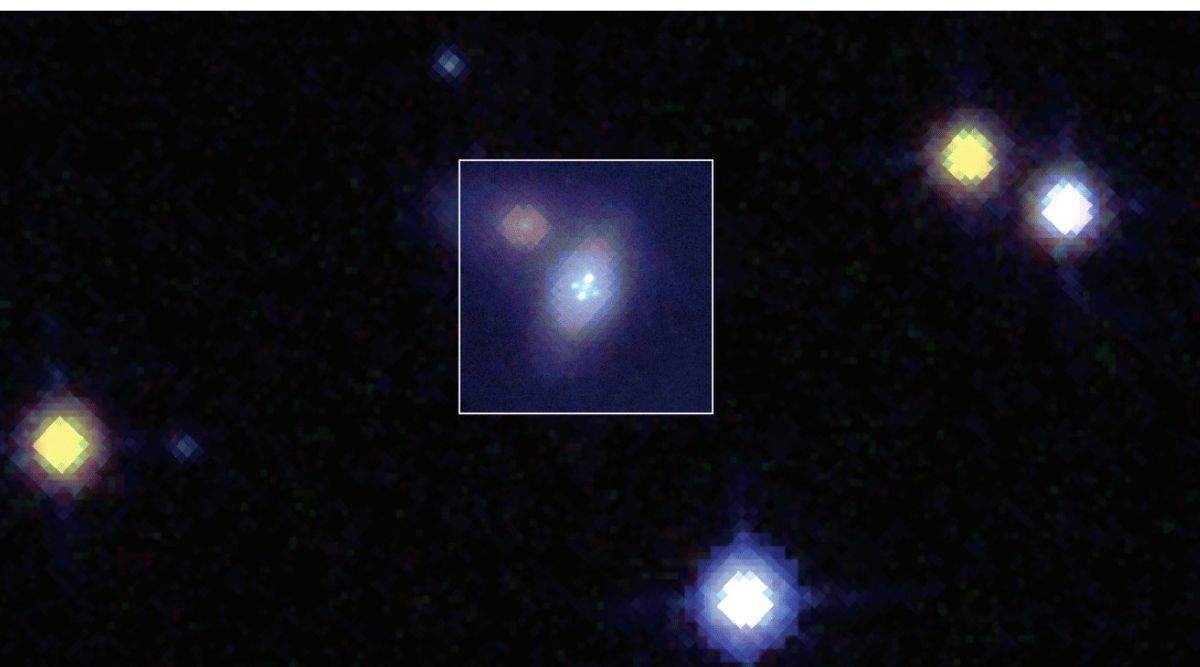 If gravitational lensing gets very strong, the distant object can appear magnified and split into multiple images. (Image credit: Ariel Goobar et. al.)
 A supernova, the powerful and dramatic explosion of a star, is a spectacular sight in itself. But astronomers have captured something even more special—a distorted image of a supernova whose light was extremely warped by the gravity of another galaxy. Interesting, its light was so warped that it appeared as multiple images in the sky.
The supernova has been named SN Zwicky and it was sported by the Zwicky Transient Facility (ZTF) at the Palomar Observatory in California, according to Stockholm University. Its image was warped due to an effect called gravitational lensing. This happens when the gravity of a dense object distorts and brightens the light of an object behind it.
Interestingly, this phenomenon was predicted by Albert Einstein more than a century ago. When an extremely massive object, like a galaxy exists, it can warp the space-time fabric around it, as per Einstein’s theory of relativity. This bent space-time fabric can act as a sort of lens that bends and focuses the light coming from an object behind the galaxy from our perspective.
If this lensing gets very strong, the light from the distant object can get so distorted that it will be magnified and split into many copies of the same image.
This gravitational lensing has been observed since 1919 for many cosmic objects. But since supernovae last for a relatively short period of time in cosmic terms, they are very hard to spot even using these gravity lenses. Even though scientists have spotted lensed duplicated images of quasars (an active galactic nucleus powered by a supermassive blackhole), only a handful of supernovae have been observed in such a state, according to Caltech.
SN Zwicky has been classified as a Type Ia supernova, which is a particular kind of supernova that happens in systems where one star orbits another. Type Ia supernovas usually have the same brightness from event to event. Interestingly, according to the US Department of Energy, the accelerated expansion of the universe was proven using Type Ia supernovae.
“Strongly lensed Type Ia supernovae allow us to see further back in time because they are magnified. Observing more of them will give us an unprecedented chance to explore the nature of dark energy,” says Joel Johansson, co-author of a study on the supernova published in Nature Astronomy, in a press statement. Johannson is a postdoctoral fellow at Stockholm University.
According to Ariel Goobar, who led the study, SN Zwicky is the smallest resolved gravitational lens system found with optical telescopes.