3 min read
© IE Online Media Services Pvt Ltd



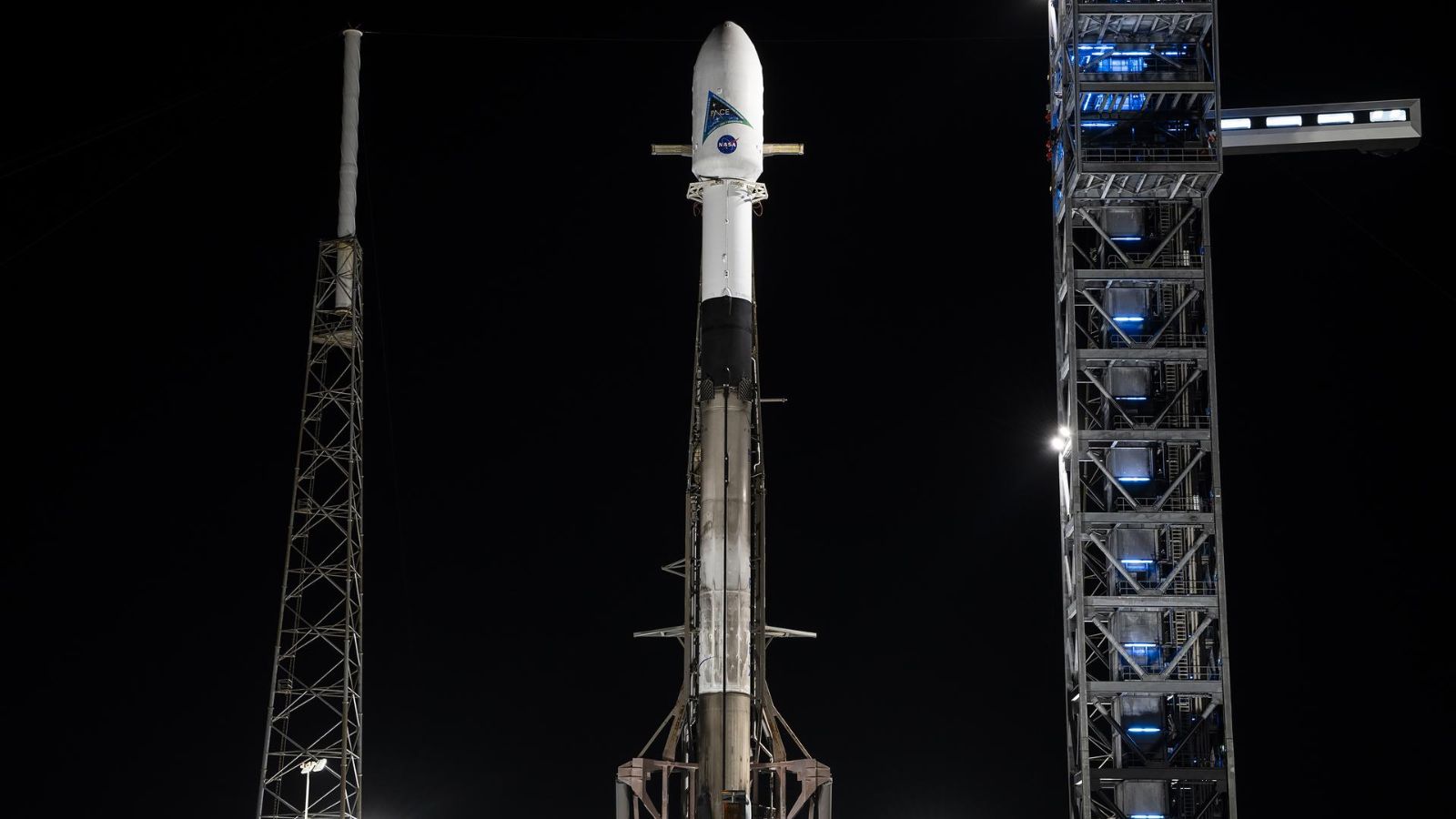 A SpaceX Falcon 9 rocket with NASA's PACE mission on top. (SpaceX, NASA)
Update (12.21 PM IST. February 7) : NASA on Wednesday announced the PACE mission’s launch has been delayed for a second time. The launch is now scheduled to happen at 12.03 PM IST on Thursday, February 8. The original article published after the first delay continues below.
NASA on Tuesday said that it is standing down from the launch of its Plankton, Aerosol, Cloud, ocean Ecosystem (PACE) mission today because of unfavourable weather conditions. The space agency and Elon Musk-led SpaceX now plan to launch the mission at 12.03 PM IST on Wednesday, February 7.
The PACE mission was initially scheduled to launch today at the same time but there is a good reason why the satellite is being launched when it is past midnight at Cape Canaveral in Florida. The launch will happen so early in the morning to accommodate the satellite’s orbit around the Earth.
The mission will be in a Sun-synchronous orbit. This means that it will always be synced to the same position relative to the Sun. Because of this, it will cross Earth’s equator at the same local time for each orbit. Also, the angle at which the sun illuminates Earth will be consistent throughout each image it takes.
Generally, it is ideal for Earth-observing satellites to have the Sun well overhead during observations, according to Scott Patano, flight dynamics system development lead for PACE at NASA’s Goddard Space Flight Center in Greenbelt, Maryland.
Essentially, PACE would want the Sun to be almost behind it as it observed the Earth. If the Sun is exactly behind the satellite, it could cause glares or reflections from the ocean, which is a less-than-ideal situation since the mission’s main aim is to collect data. This means that PACE will be slightly offset from the Sun.
Some satellites will launch into a temporary orbit before moving into their permanent orbits but not PACE — the NASA mission will be directly injected into its final orbit, which ,according to NASA, is “an effectively instantaneous launch.”
Since it will launch from the south of Florida on the dark side of the Earth, it will be right in place on the approaching Indian subcontinent as it crosses the equator for the first time on the daylight side of Earth.