3 min read
© IE Online Media Services Pvt Ltd



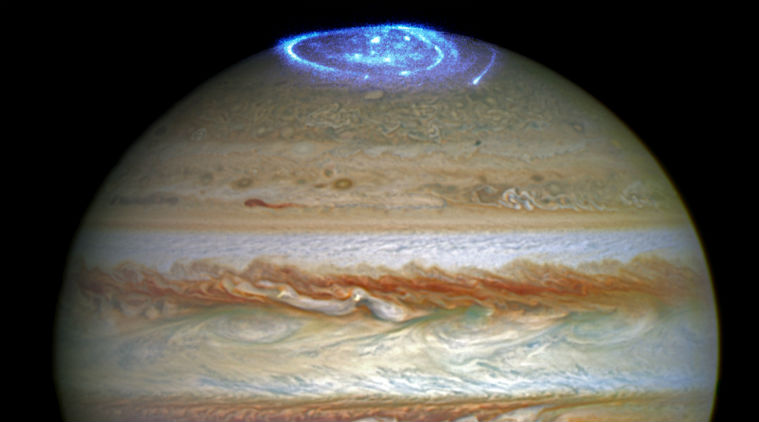 Auroras over Jupiter’s poles are far brighter than the one’s over Earth
The NASA/ESA Hubble Space Telescope is being used by astronomers to study auroras on the poles of Jupiter. Observations that are being made by the astronomers is supported by the measurements made by Juno – NASA’s spacecraft that is currently flying towards Jupiter. The giant planet is best known for the Great Red Spot – an anticyclonic storm that has persistently lasted for at least 186 years.
Astronomers are now witnessing the vivid glows of the auroras using the Hubble’s UV capabilities. Auroras are created when high energy particles collide with gas atoms as they enter the atmosphere of a planet near the magnetic poles.
The aim of the programme is to determine the components of these auroras in their response to different conditions of the solar winds. While observations are being made on the auroras with the Hubble telescope, the Juno spacecraft is studying the properties of solar wind. Juno is scheduled to enter Jupiter’s orbit in early July 2016.
Watch the video of NASA’s Juno mission
“These auroras are very dramatic and among the most active I have ever seen”, said Jonathan Nichols from the University of Leicester, U.K., and principal investigator of the study. “It almost seems as if Jupiter is throwing a firework party for the imminent arrival of Juno.”
Using the Hubble’s Imaging Spectrograph, it is possible for astronomers to document videos of the movement of these auroras – some covering areas larger than Earth. The auroras being witnessed on Jupiter are are hundreds of times more energetic than the ones on Earth. Auroras glow red, purple and green on Earth – when charged particles streak across the upper atmosphere.
The auroras on Jupiter however are more intense, as the planet’s strong magnetic field grabs the charged particles from its surroundings. This not only pulls the charged particles in the solar wind, but also the particles around the planet that are thrown by its moon, Io. These observations and their analysis will take several months and will help understand how the sun and solar winds affect auroras.