


© IE Online Media Services Pvt Ltd
Tags:


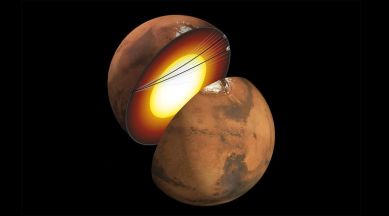
Scientists have made the most precise measurement ever of Mars’ rotation and have for the first time detected how the planet “wobbles” as its molten core “sloshes around.” They also found that the planet’s rotation is accelerating.
The findings were made using data from NASA’s InSight lander, which spent four years on the Martian surface before running out of power in December 2022.


But they are proposing a few possibilities—it could be because of ice accumulating on the polar caps or post-glacial rebound, when landmasses rise after being buried by ice. This shift in the planet’s mass distribution can cause it to accelerate. Think about how an ice skater can change the speed of how fast they are spinning by extending their arms outwards or pulling them in.
Have you noticed how the pitch of an ambulance changes as it approaches and gets farther away? Astronomers can use the same principle that causes this, called the Doppler effect, to measure the rotation speed of a planet.
For example, with the InSight lander, scientists can beam a radio signal to the lander using the Deep Space Network. The RISE instrument, which consists of a radio transponder and antennae, would reflect the signal back. Scientists can look for small changes in frequency caused by an effect, called Doppler shift, to measure how fast the planet is rotating.


