


© IE Online Media Services Pvt Ltd
Tags:


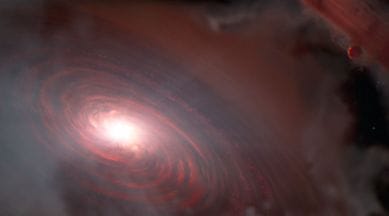
Life as we know it would not exist without water. But there is still a lot of debate surrounding how it came to our planet and whether distant rocky planets could also get water through the same process. The James Webb Space Telescope has made a discovery that might give scientists a better idea.
The discovery was made in the planetary system PDS 70, which is about 370 light-years away. The system’s star hosts an inner and outer disk of gas and dust, both of which are separated by an 8 billion-kilometre gap. That gap is inhabited by two gas-giant planets.


PDS 70 is a K-type star that is about 5.4 million years old. It is cooler than our Sun and also relatively old for a star that has planet-forming disks.
This makes the discovery of water vapour quite surprising since over time, the gas and dust content of planet-forming discs decline. Usually, the star’s radiation and winds blow out such material or the material coalesces into larger objects that eventually become planets.
Even though scientists are yet to detect any planets forming within the inner disk of PDS 70, they did detect raw materials in the form of silicates. Based on the detection of water vapour, scientists believe that rocky planets forming in the region will have water available from the beginning.
The next question is finding how the water vapour came to the location—there are two possible scenarios for how this could have happened. One scenario is that of water molecules forming there as hydrogen and oxygen atoms combine in the region. The second possibility is that ice-coated dust particles are being transported from the cool outer disk to the warm inner disc, where the water turns into vapour.
The discovery raises another question—how can water molecules survive so close to the star? In theory, the star’s strong ultraviolet radiations should break apart water molecules. The most likely explanation is that surrounding material like dust serves as a protective shield, helping the vapour survive destruction. The study was published in the journal Nature on Monday.


